Commentary: It's a police state in Minnesota
Published in Op Eds
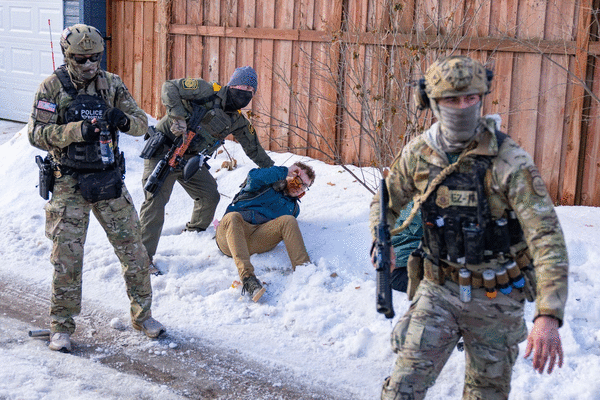
On Jan. 8, in the White House press room, Vice President JD Vance declared that the ICE officer who shot and killed Renee Good in Minneapolis on Jan. 7 “is protected by absolute immunity.” His assertion came before any investigation was conducted and before all the facts were known.
“Absolute immunity”? In the United States? In a constitutional democracy that insists — at least in principle — that no one should be above the law?
We have heard this language before. President Donald Trump has claimed absolute immunity for himself for official acts, and in 2024 the U.S. Supreme Court agreed. His administration issued pardons to those who participated in the insurrection at the U.S. Capitol on Jan. 6, 2021, and has amplified false narratives about what happened that day. What many dismissed as bluster or spectacle at that time was, in fact, a rehearsal: The administration was testing how far the boundaries of a constitutional republic could be pushed — and who would object.
Now that same logic is being extended to agents of the state empowered to detain, deport and kill. In the days since Good, a 37-year-old mother of three, was repeatedly shot in the face, hundreds of federal agents have threatened and detained peaceful protestors exercising their constitutional rights — sometimes violently. Warrantless entries by armed ICE officers and the unlawful data tracking of protesters show this administration’s willingness to disregard the Bill of Rights.
In short, Minnesota is experiencing a state-wide police riot backed by the full authority of the federal government.
This is how police states are built — not by a single law or single leader, but through precedents set in moments of crisis. Through declarations made before facts are gathered. Through the steady retreat from the assumption that power flows from — and must answer to — the people.
History offers us lessons here. When immunity becomes absolute, accountability collapses. And when accountability collapses, the language of public safety gives way to the brute force of arbitrary power. That is not security. That is not safety. That is not democracy.
In a nation built on laws, how can public officials condone the taking of human life before an investigation even begins? Can due process survive when outcomes are announced in advance of judicial inquiry? Can the executive branch bypass the Constitution to satisfy its own political desires? Can sworn law enforcement officers openly violate their own agencies’ official policies against using lethal force except when it is absolutely necessary?
These are not abstract questions. They are real constitutional questions. And they are before us — all of us — right now.
Lawyers often describe the authority used by agents of the state to deploy deadly force as “police power.” Communities who live under its weight — who have lived under its weight for a long time, at the border, in American cities, and in every state in this country — call it something simpler. They call it a police state.
Absolute immunity is not a declaration or a doctrine. It is an architecture. When those who wield force are placed beyond accountability, the rule of law erodes. Authority fills the void. Impunity is normalized.
The killing of Renee Good demands more than reassurances and legal abstractions or thoughts and prayers. It demands fidelity to the most basic democratic principle we claim to hold: that no one — not presidents, not sworn officers, not agents of the state — is above the law.
If that principle no longer holds, then we should at least be honest about what we are becoming.
____
Yohuru Williams is a historian and professor of history at the University of St. Thomas in St. Paul, Minnesota, where he is founding director of the Racial Justice Initiative. Michael Lansing is a historian and professor of history at Augsburg University in Minneapolis, Minnesota, and the author of the forthcoming book, “A Police State: Politics and Public Safety in Minneapolis, 1945-2020.” This column was produced for Progressive Perspectives, a project of The Progressive magazine, and distributed by Tribune News Service.
_____
©2026 Tribune Content Agency, LLC.


































Comments