Editorial: Harvard's president reminds academia it's 'not about the activism.' Good for him
Published in Op Eds
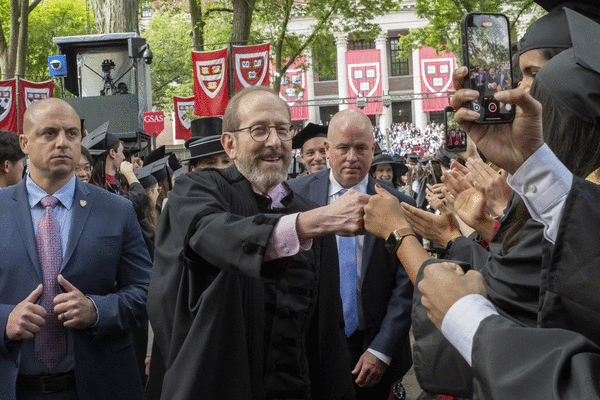
Harvard University is home to The Harvard Crimson, the nation’s oldest continuously published daily college newspaper, and the fine student journalists there offer excellent coverage on a wide array of topics, beginning with their own campus leaders. That storied student paper published something last week that caught our eye, amplifying the university president’s comments on free speech on campus during a podcast interview.
President Alan Garber appeared in December on the “Identity/Institute” podcast and made candid comments about Harvard’s drift away from objectivity and how to fix it.
“What we need to arm our students with is a set of facts and a set of analytic tools and cultivation of rigor in analyzing these issues. It is not about how to sling slogans or how to advance a particular political perspective,” he said, adding: “We’re not about the activism.”
This should be uncontroversial in academia.
We’ve admired for a while Garber’s commitment to promoting these principles in classroom debate, and pushing out bad practices that would stifle engagement in the kinds of lively conversations that foster true learning and offer young minds the opportunity to sharpen their arguments, see an issue from a different point of view and, in many circumstances, change their opinion. We feel the same way about our own University of Chicago, which has several thought leaders on this issue.
Harvard, of course, has had this reckoning forced upon itself, in many ways, which we’ve written about before. Deep divisions over the conflict in the Middle East threatened to tear the campus in two. Garber described the 2023-24 academic year as “disappointing and painful.”
Then, in 2025, the university faced intense external pressure as President Donald Trump’s administration froze billions in federal funding — an action a judge later ruled unconstitutional.
These are the fires that refined and defined Garber’s early tenure. We’d say he knows a thing or two about the struggle to protect free speech. That’s why his words are important — and welcome.
Of course, his critique also applies to campuses beyond his own. As many students at any number of universities across the U.S. know, there’s a real risk to speaking your mind, particularly if it doesn’t align with the accepted norms on hot-button issues. Especially in the classroom
Students reasonably fear that revealing an unpopular view could come at a cost, including, fairly or not, their grades. The result is an environment in which students are either silenced, indoctrinated or have their existing worldview reinforced, unchallenged.
“Think about it, if a professor in a classroom says, ‘This is what I believe about this issue’ … how many students would actually be willing to go toe to toe against a professor who’s expressed a firm view about a controversial issue?” Garber said.
As a result, students often actively reject contrary points of view. Stories of conservative speakers being shouted down or banned from campus altogether have become so commonplace they no longer make headlines.
That’s not the way we’re meant to learn. It’s also not the way institutions dedicated to education are meant to function.
During his 2025 commencement address, author and physician Abraham Verghese noted it was “a reflex of so-called strongmen to attack the places where truth and reason prevail.”
Harvard, an epitome of excellence in American higher education, has proved it can weather attacks from without. Now, it is weeding out pernicious problems within. We hope Garber’s message and commitment to truth and reason takes root far and wide.
___
©2026 Chicago Tribune. Visit at chicagotribune.com. Distributed by Tribune Content Agency, LLC.

















Comments