Commentary: The DOJ suing for voter data is dangerous on many levels
Published in Op Eds
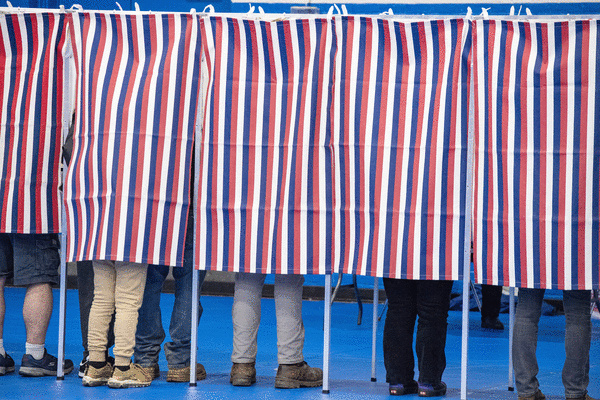
Uncle Sam wants you. And now he wants your voting data, too.
The law — and long-standing policy — say he shouldn’t get it.
The U.S. Department of Justice has filed lawsuits in 23 states and the District of Columbia seeking access to detailed voter information for the purpose of building a national database. The department’s demand sets a dangerous precedent and could expose millions of Americans to fraud, abuse and other nefarious activity.
In an amicus brief filed in late December, several former DOJ voting-rights lawyers argued that the suit filed in California should be dismissed because the demand, like those filed in other states, violates federal law. As the amici note, although the federal government is entitled to certain voter information under various statutes, the Department of Justice has exceeded its authority by requesting sweeping access to all data for all voters nationwide, including “registration method, participation history, party affiliation, partial Social Security Numbers (SSNs), and driver’s license numbers,” without demonstrating a sufficient legal or factual basis.
Some critics argue that the Justice Department is collecting this data to bolster a false narrative that noncitizens are voting illegally. While preventing ineligible voters from casting ballots is a valid goal, the National Voter Registration Act and the Help America Vote Act assign the responsibility for maintaining voter rolls to states, not the federal government.
One of the things I learned in my work as a national security prosecutor is the importance of keeping information “compartmented.” That means that data should be segregated so that only those with a legitimate need to know can access it. For example, classified information is compartmented into categories so that those who need access to confidential human sources in a terrorism case cannot also learn the location of nuclear weapons. Such separations are essential to operational security, ensuring that unauthorized individuals cannot access highly sensitive information. The same principle should apply to the private data of American citizens.
A comprehensive national repository of personal information poses serious dangers to the public. First, a centralized federal database would create a significant vulnerability to cyber intrusions. A single breach of a database that contains both driver’s license and Social Security numbers could enable identity theft on a massive scale. In 2015, for example, I was one of the 22 million current and former federal employees victimized in a cyberattack on the Office of Personnel Management. Hackers stole highly sensitive personal information, including Social Security numbers, fingerprints and answers to background-investigation questions, some of which included data pertaining to our parents, siblings and children. That information is now in the hands of identity thieves and potentially hostile foreign adversaries, patiently waiting for the right moment to strike. We voluntarily provided that information as a condition of working for the federal government. Other Americans should not be required to expose their personal data to such risk.
Second, data compiled for a laudable purpose can later be abused for a nefarious one. During World War II, Nazis in Germany used census data to round up Jewish citizens. And lest we think the U.S. is immune from such conduct, our own government relied on similar data to identify and locate Japanese Americans for internment. In the 1960s and 1970s, the FBI ran a program called COINTEL PRO — the Counterintelligence Program — using personal data to surveil Vietnam War protesters and civil rights leaders, including Martin Luther King Jr.
We should be free to speak out against our government without fear that our data will later be used to target us for retaliation. Knowing that the government maintains a comprehensive database of personal information could lead to self-censorship and chill free speech, particularly under an administration that at times appears motivated by retribution.
Third, the creation of a national database is contrary to our foundational commitment to a limited federal government. The Constitution gives states the power to decide the time, place and manner of elections. While Congress is permitted to enact laws to protect the right to vote, the executive branch should not be permitted to engage in mission creep by developing a comprehensive federal voter database without clear and specific legislative authorization.
Fourth, mistakes are inevitable. Voter rolls are dynamic documents, constantly changing as citizens reach voting age, become naturalized, die or move between states, making it likely that any federal database would be inaccurate almost immediately. Identifying and correcting errors in federal databases can be difficult, and those errors can have harmful consequences. When I served as a federal prosecutor in Detroit, I encountered instances in which people were incorrectly placed on no-fly lists. Although the lists served an important public safety function, I saw firsthand how someone could be flagged simply because they shared a name with a suspect or due to human error. According to a letter submitted by a dozen secretaries of state to the U.S. Department of Homeland Security, a massive federal voting database is particularly dangerous because it “is likely to misidentify eligible voters as non-citizens and to chill participation by eligible voters.”
Given the Trump administration’s willingness to push legal boundaries, the last thing we should entrust it with is a centralized trove of our sensitive personal data.
____
This column reflects the personal views of the author and does not necessarily reflect the opinion of the editorial board or Bloomberg LP and its owners.
Barbara McQuade is a professor at the University of Michigan Law school, a former U.S. attorney and author of "Attack from Within: How Disinformation Is Sabotaging America."
©2026 Bloomberg L.P. Visit bloomberg.com/opinion. Distributed by Tribune Content Agency, LLC.


















































Comments