James Stavridis: Trump's big, beautiful battleship is a sitting duck
Published in Op Eds
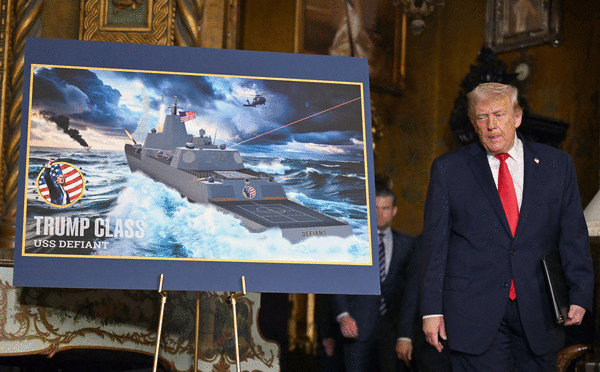
Even before using a U.S. Navy armada to capture Venezuelan leader Nicolás Maduro, President Donald Trump had big ideas to remake the service in his image. At a glitzy Mar-a-Lago rollout last month, he announced a new “Trump class” of battleships, ostensibly to lead a 21st-century “Golden Fleet.” Is this bold — and very expensive — vision the right approach for dominating the high seas?
While the overall class of warships would be named for the president, the first hull would not bear his name (perhaps because he would prefer a future nuclear aircraft carrier to be the USS Donald J. Trump). Thus BBG-1 — the acronym for a battleship is “BB” and the “G” connotes the ability to launch guided missiles — is to be USS Defiant.
Under any name, the new ship will weigh in at over 30,000 tons and pack a significant punch — although it may not meet the president’s boast of being “100 times more powerful than any battleship ever built.”
The list of planned capabilities and technologies is an admiral’s dream, starting with 128 Mark 41 vertical-launch tubes to fire a combination of standard anti-air defenses and Tomahawk land-attack missiles. (The Tomahawks will include both conventional and the controversial nuclear-tipped variants.)
Then comes an Aegis air-defense system with a new SPY-6 radar; an advanced laser system called the Optical Dazzling Interdictor, Navy (ODIN); two hangars for V-22 Osprey tilt-rotor aircraft and Seahawk helicopters; a powerful electronic warfare suite; two 5-inch conventional surface guns; an advanced electric railgun; and a 12-cell Conventional Prompt Strike (CPS) hypersonic missile system (which may eventually also have a nuclear capability). Operating this formidable arsenal would be a large crew of 600 to 800 sailors.
Trump says the ships will be in service within a few years, which isn’t impossible but seems highly unlikely. Given the constant delays at America’s antiquated and undermanned shipyards, I wouldn’t bet on new ships being operational sooner than 2035.
The cost estimates are whopping: roughly $9 billion per ship, with the initial USS Defiant probably costing $10-$15 billion.
Does the Trump class make sense in today’s warfare? Are there better uses of defense dollars than big, beautiful battleships?
The antecedent to the new battleship is the Arleigh Burke-class guided-missile destroyer. After three decades in service, these remain the workhorses of the fleet, with 75 in commission. I first captained one — the USS Barry — in the early 1990s, and had many among the USS Enterprise carrier strike group I commanded during the 2003 invasion of Iraq.
Those destroyers are about a third of the size of the planned new battleships, at roughly 10,000 tons, with a crew about half the estimated size of the Trump class. They too have an Aegis air-defense system and vertical launch tubes that can support Tomahawk missiles; 5-inch naval guns; Harpoon antiship cruise missiles; standard missiles for air defense; and a capable flight deck to embark helicopters.
What the new battleships would bring to the table is, first, the rail gun — which uses electromagnetic forces to launch projectiles, sort of like a huge slingshot, with remarkable range and precision. Other planned innovations for the Golden Fleet include lasers for air defense and hypersonic cruise missiles.
Sounds good so far. The problem is, neither the rail gun, hypersonic cruise missiles nor anti-air lasers are ready for prime time. While testing has gone on for years, there is no operational version of any of them. So, in addition to the challenges of designing the new ship itself, three of the major offensive systems will need to be completed and ready for sea duty.
A second concern is more strategic: Does it make sense to put so much expensive weaponry and so many sailors on a single, potentially vulnerable platform?
The fate of the last large fleet of U.S. battleships is instructive: Eight were either sunk or badly damaged in the attack on Pearl Harbor in 1941. Those that were repaired saw little important use during that war, as massive fleet-on-fleet battles were decided by aircraft carriers, not the big guns of the battleships.
The four most recently constructed U.S. battleships (the New Jersey, Wisconsin, Missouri and Iowa) are still afloat — as naval museums. You should tour one: They are powerful, impressive, beautiful — and utterly obsolete. Given today’s drone swarms, stealthy submarines, hypersonic missiles, advanced torpedoes and offensive cyberweapons, putting lots of eggs in a handful of big baskets doesn’t make much sense.
A better use of precious shipbuilding assets would be to construct many low-cost, unmanned, semi-submersible platforms that could operate drone swarms launched from land, or launch land-attack missiles controlled from space. Even better would be fully underwater drones, like those the Ukrainians are perfecting in the Black Sea. A more expensive but also sensible option would be expanding the Navy’s fleet of nuclear-powered submarines, the true apex predators of the oceans.
Bottom line: The U.S. desperately needs more warships, given China’s naval advantages in terms of pure numbers — about 360 ships against America’s 300 — and superior speed of construction. The smart approach, though, would be what’s called “distributed firepower” — spreading weaponry across many platforms — the opposite of a massive battleship. The watchwords should be lethality, quantity, simplicity and affordability. Also, smaller crews: Over time, sailors are the most expensive part of any warship.
Here is another cautionary tale. At the start of the Russian invasion of Ukraine, the Russian Black Sea Fleet flagship was the guided-missile cruiser Moskva, with 500 sailors and powerful missile defenses. I had seen her often at sea during the Cold War, a sharp-looking warship bristling with weapons. But in April 2022, just a few months after the start of the war, she was sunk by the Ukrainians — who don’t even have a Navy.
Ukraine did it with a combination of intelligence (provided by the U.S.) and land-based cruise missiles. Probably a majority of the sailors on board the Moskva died, although Russia denies that. It was an inglorious end to a storied warship. One of the first things they teach you at the U.S. Naval Academy is, “Don’t let them sink your flagship!”
As much as I love the look of a big, beautiful battleship, they won’t make a new fleet “golden”: their time has passed.
_____
This column reflects the personal views of the author and does not necessarily reflect the opinion of the editorial board or Bloomberg LP and its owners.
James Stavridis is a Bloomberg Opinion columnist, a retired U.S. Navy admiral, former supreme allied commander of NATO, and vice chairman of global affairs at the Carlyle Group.
_____
©2026 Bloomberg L.P. Visit bloomberg.com/opinion. Distributed by Tribune Content Agency, LLC.





















































Comments