Max Hastings: How to save the US from authoritarianism
Published in Op Eds
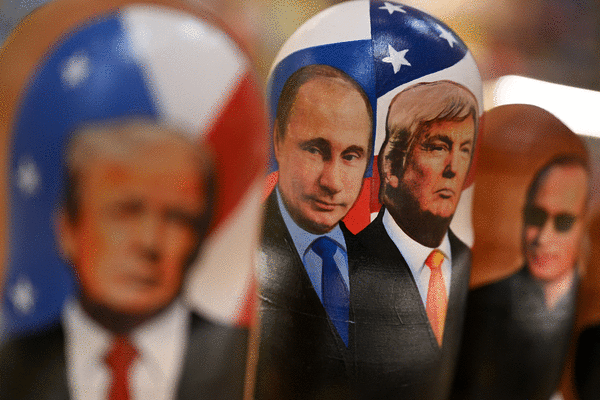
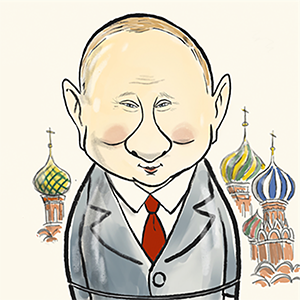
In Russia’s public museums today, antiquarian statuary depicting naked Roman or Greek figures is condemned by the Kremlin as violating the country’s “deep moral traditions.” Sharing unauthorized information about Vladimir Putin’s Ukraine war is punishable by up to 15 years’ imprisonment. All things Western are canceled.
Russia is a tyranny, which makes some of us feel naive. Three decades ago, we fooled ourselves all that was over. When meeting Mikhail Gorbachev and Boris Yeltsin — leaders of their country during its democratic false dawn — I, like many people, supposed them to represent the future.
Instead, of course, they have proved to be the past. In 2026 their memories are reviled by their countrymen. Russia has reverted to what it has been for most of its history: a cruel, corrupt, mendacious, xenophobic, bungling, dangerous autocracy.
As we enter the 21st century’s second quarter, it would be nice to suppose that such a nation is unusual. Unfortunately, every survey of world governance shows democracy in retreat. Meanwhile, dictators prosper and multiply. According to Gothenburg University’s Varieties of Democracy index, only 29 countries can now be identified as fully democratic, while 45 nations shifted in 2025 toward dictatorship. An estimated 70% of the world’s peoples, controlling almost half of its gross domestic product, are governed by autocrats.
The U.S. has officially stopped caring about the democratic credentials of governments which it chooses to support or oppose. In July Secretary of State Marco Rubio instructed U.S. diplomats to forgo expressions of opinion about the “fairness or integrity” of foreign elections; and about other nations’ “democratic values,” or lack of them.
Donald Trump’s administration is not to blame for the rise of autocracies. In former democracies, that trend is rooted in popular disillusionment with traditional elites. But it is dismaying to witness Washington’s abandonment of any pretense of concern about human rights and the rule of law. Saudi Arabia’s Mohammed bin Salman is welcomed at the White House. The Trump family enjoy hugely profitable commercial relationships with repressive Gulf dictatorships.
Right-wing nationalists may well secure power in some big and important European countries, a development driven partly by dismay about mass immigration, and partly by economic stagnation. Elected governments have been failing to deliver what voters want, above all prosperity. Last February’s Make Europe Great Again rally in Madrid was attended by far-right representatives from all over the continent.
In the years ahead Trump favorite Viktor Orban, ruler of Hungary, may be joined in power by France’s Jordan Bardella or Marine Le Pen, and possibly by Britain’s Nigel Farage. The White House is promoting Germany’s far-right AfD.
Most of Africa and the Middle East is governed by rulers who bar genuinely contested elections. Partnerships between illiberal states are burgeoning. In September China’s President Xi stood on a platform in Beijing alongside Putin and North Korea’s Kim Jong Un.
This last, overlord of a country run like a concentration camp, pioneered the exploitation of criminality to fund his regime: from currency counterfeiting to internet fraud, online-hostage taking and reckless weapon sales.
Among the fraternity of dictators such revenue streams have now gone mainstream. Many treat the entire assets of their countries, especially mineral resources, as personal property. Wealth was once a mere by-product of tyranny. Hitler, Mussolini, Franco and communist leaders of the Cold War era lived comfortably enough and made some money — in Hitler’s case, from royalties on his writings. But ideology and megalomania drove their ambitions.
Today, while many autocrats proclaim their commitment to the common man, they are chiefly in it for the money. Putin, creator of a mafia state, is one of the planet’s richest men. Many African and Middle East leaders are unimaginably wealthy, their fortunes often curated by Western bankers and lawyers, including some of Wall Street and the City of London’s biggest names.
The central question is whether the rise of autocrats is reversible. The historian Stephen Kotkin, a biographer of Stalin, argues that the world’s “strongmen” are much weaker than they appear, partly because repression is the enemy of economic and technological progress.
In an essay in the latest issue of Foreign Affairs, he writes that the authoritarians suffer a “debilitating incapacity stemming from corruption, cronyism and overreach.” Kotkin argues that their advance can be rolled back, if Western democracies display the guts they lacked when — for instance — in 2001 they admitted China to the World Trade Organization, and more recently through their inertia in the face of Russian sales of hundreds of billions of dollars’ worth of sanctioned oil and gas to China, India and Turkey.
Kotkin believes that the U.S. will escape becoming a dictatorship, because at the nation’s heart is a huge, stupendously successful open-market economy. The country lacks anything like the machinery of repression common to Russia, China, Iran, North Korea.
“The U.S. has periodically rediscovered and renewed itself, sometimes in profound ways, and it must do so again,” he concludes. “Its authoritarian adversaries are displaying audacity and resolve, but the nature of their regimes always presents an opportunity.”
I admire Kotkin’s optimism. None of us must despair. But I cannot share his confidence. It is for sure that tyrannies such as Putin’s in Russia will some time fall. It seems doubtful, however, that they will be replaced by something or someone better. A new generation of dictators looks more probable. No one is mourning the fall of Venezuela’s Nicolas Maduro, but many of us are deeply fearful about what may follow him, and the outcome seems most unlikely to be democracy.
As for America, alongside Trump stand his close allies the tech giants, of whom Elon Musk is only the most conspicuous. To us Europeans, it seems terrifying that the government couples itself to Musk and his peers in rejecting as “censorship” checks upon online content that threatens the mental health of future generations.
The administration has joined the Magnificent Seven tech companies, which wield greater power than most nation-states, in fighting regulatory control of artificial intelligence. Their armaments — the tools and content which the tech moguls sell — are arguably more menacing than nuclear weapons, because they are usable. Indeed, they are used daily all over the world.
I wholeheartedly agree with Kotkin, however, that the U.S. can yet be saved from authoritarianism. This will require a new presidential trustbuster, with the will to break up the tech giants, as Theodore Roosevelt demonstrated when crushing the U.S. industrial monopolies in the first years of the 20th century.
Moreover, America’s justice system must be delivered from partisanship and corruption. In 2015 a group of legal scholars analyzed the previous decade’s decisions of the Venezuelan Supreme Court and found that it had handed down 45,474 rulings, all supportive of dictator Hugo Chavez, who had packed its membership. Sound familiar?
The U.S. cannot and should not aspire to generate regime change abroad, which experience and prudence show to be beyond its means. It may yet regain its stature, however, as an exemplar of freedom and justice. It would be a good beginning for U.S. banks and law firms, together with their European counterparts, to forsake systemic complicity in the activities of tyrants.
As for the governance of the West, honorable politicians and public servants, such as do still exist, face a huge challenge: to convince voters that democracy remains the least bad system of government available; that autocrats are invariably enemies of the people, however they dress themselves up; and that in 2026 civilized values are still worth fighting for.
____
This column reflects the personal views of the author and does not necessarily reflect the opinion of the editorial board or Bloomberg LP and its owners.
Max Hastings is a Bloomberg Opinion columnist. His histories include "Inferno: The World At War, 1939–1945," "Vietnam: An Epic Tragedy 1945–1975" and "Abyss: The Cuban Missile Crisis 1962."
©2026 Bloomberg L.P. Visit bloomberg.com/opinion. Distributed by Tribune Content Agency, LLC.

















Comments