Commentary: Why the success of the gay romance series 'Heated Rivalry' matters
Published in Op Eds
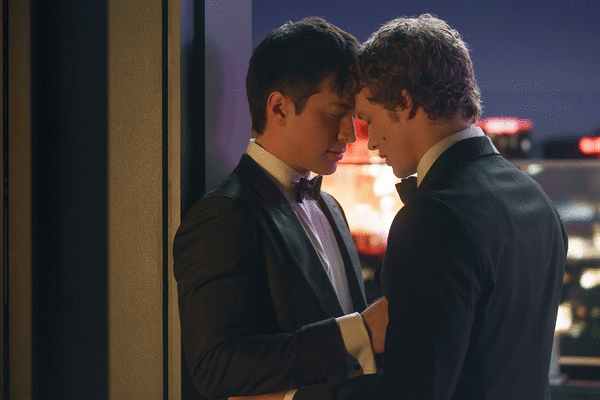
I am a 56-year-old woman who loves romance fiction, so I fell for “Heated Rivalry.” My daughter introduced me to the streaming adaptation. She texted me about it with the confidence of someone who knew I would understand why it mattered. I raised my daughters to believe that sex can be a source of connection and pleasure, something to claim without embarrassment or shame.
We loved “Heated Rivalry,” first as readers and later as viewers, when the story moved from page to screen on HBO Max. It surged into the cultural mainstream. What began as erotic fantasy deepened into something else: a public story about intimacy, courage and what love is allowed to look like.
Part of the draw is obvious. The series is sexy and unapologetically physical. Viewers are pulled in by desire, by chemistry and by bodies on-screen. That isn’t incidental. Sex has always been one of the ways people cross lines they are told must remain fixed. What matters is not the novelty, but what keeps them watching.
In “Heated Rivalry,” a confident Russian professional hockey player named Ilya is drawn to his quieter rival, Shane, who is still coming to terms with his sexuality. What begins as attraction slowly becomes attachment, then commitment. By the time another player, Scott Hunter, stands before a national championship crowd and kisses the man he loves, the moment feels earned rather than provocative.
Fans watched that scene unfold in sports bars, a place long associated with rigid ideas of masculinity, and no one felt the need to look away. The show’s fifth episode, titled “I’ll Believe in Anything,” earned a 9.9 out of 10 rating on IMDb and drew widespread attention for its emotional depth.
Watching the show, I felt a flush, then curiosity, then attention. Two men inhabited their bodies with confidence as their relationship took shape. What held me wasn’t the spectacle but clarity. That kind of portrayal still feels rare. Once seen, it recalibrates what viewers expect to be allowed to witness.
None of this occurred outside today’s political moment. It unfolded squarely within it.
When President Donald Trump banned transgender Americans from serving in the military, he did more than reverse a policy. He told capable service members that their willingness to risk their lives for their country was irrelevant — that their identity alone rendered them disposable. It was a misuse of state power to declare that some Americans count less, even when they serve with honor.
At the same time, his administration moved to weaken federal protections for gay and lesbian Americans. Safeguards in health care, housing, employment and education were eroded. Equality was no longer treated as a right. Civil rights became provisional, dependent on politics rather than principle.
Against that backdrop, a sport long coded as immutably masculine was transformed, without controversy, into a setting for tenderness and love between two men. Viewers accepted that inversion without hesitation.
Who embraced “Heated Rivalry” matters. The series didn’t break through because heterosexual men suddenly came around. Most did not. It became a shared cultural touchstone among women and the LGBTQ+ community. Research has consistently shown that heterosexual women are more comfortable with homosexuality than heterosexual men, whose acceptance drops sharply when intimacy involves other men. For viewers already practiced at reading emotional nuance, watching two men love each other openly — even in locker rooms or on the ice — felt honest.
“Heated Rivalry” doesn’t argue with skeptics. It moves past them. Cultural change often begins by deepening the convictions of those already willing to see.
No one mandated that choice. There was no policy, no program, no government directive. Cultural acceptance matters politically because once people recognize a life as familiar and real, it becomes harder for the state to treat that life as disposable.
It is often said that politics follows culture. If that’s true, then culture becomes political the moment people decide who belongs and whose lives are worth defending.
Trumpism depends on exclusion — the idea that people may belong only if they conform to a narrow definition of who counts. Inclusion becomes something to manage, not a right to assume.
In communities ravaged by Immigration and Customs Enforcement raids, concealment has become a survival strategy. Living through Operation Midwest Blitz in Chicago, I gave my dearest friend a yarmulke. He is a light-skinned Hispanic man; in Trump’s America, he was safer looking Jewish than Hispanic. I begged his mother to wear a blond wig to hide her dark hair. The family now leaves their home only for work. Visibility has become a risk.
When audiences fall in love with “Heated Rivalry,” they are signaling whose lives deserve care and whose futures remain imaginable — including those pressured to shrink their lives.
Scott Hunter did not just win a championship. He carried his trophy around the rink, then did something braver. He brought the man he loves onto the ice and made his private life public, refusing to let success require silence or shame.
That moment illustrates what resistance can look like — against an administration that thrives on fear and against the lie that some love must be hidden to be acceptable.
Trump offers a smaller country, defined by boundaries rather than belonging. But Americans keep making a different choice. Long before laws change, people decide collectively who they are willing to stand beside in public. Increasingly, they choose an America larger than fear and stronger than the exclusion being sold to them as a restoration.
____
Jennifer Obel is a retired oncologist who writes about the intersection of medicine, ethics and public policy.
___
©2026 Chicago Tribune. Visit at chicagotribune.com. Distributed by Tribune Content Agency, LLC.









































Comments