Commentary: When silence becomes a green light for normalizing cruelty
Published in Op Eds
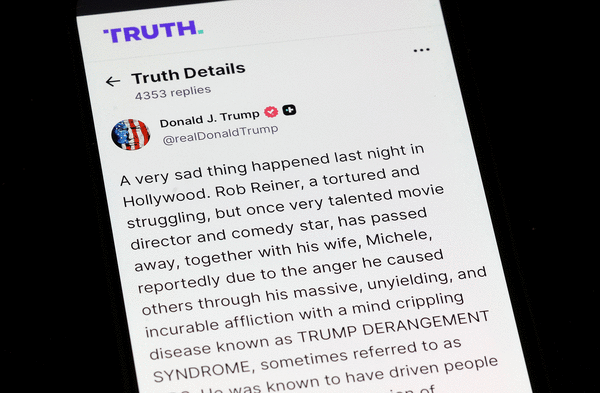
The reaction to President Donald Trump’s recent social media post was immediate and telling.
For many, the post was stunning in its cruelty, a line so clearly crossed it demanded condemnation. For others, it was dismissed, defended or waved away as exaggeration, provocation or “just how he talks.” That divide is the story. Because when words that demean, dehumanize and even invoke death can shock some while being excused by others, we are no longer arguing about tone. We are confronting a culture that has begun to normalize cruelty in plain sight.
In the post, Trump mocked the deaths of filmmaker Rob Reiner and his wife, framing them not with grief or restraint but as a political taunt. He attributed their demise to what he derided as a “mind crippling disease known as TRUMP DERANGEMENT SYNDROME,” turning disagreement into pathology and invoking death as a punch line. Disability language was weaponized. Human dignity was discarded. And suffering was treated as deserved.
The post was reckless and cruel, and the meaning was unmistakable: Nothing is off-limits anymore. Not illness. Not grief. Not even death itself.
We cannot make this normal.
Yet this is exactly the danger of the moment we are living in, a new “normal” settling in, one defined by public figures who no longer fear consequences for demeaning, dehumanizing and hateful speech. They don’t just insult individuals; they target entire communities and identities. And far too often, their targets are women, immigrants, people of color and people with disabilities, those whose dignity has always been treated as negotiable in America.
“Seriously retarded.” “Garbage.” “We don’t want them in our country.” “Quiet, piggy.”
These are not whispers from fringe extremists. They are slurs and degradations launched from the highest offices in the land, delivered by leaders who imagine themselves guardians of American greatness. They weaponize identity, casting whole populations as criminals, burdens or subhuman, and they do so with a smirk, confident that too many will excuse it as “just words.”
But words shape worlds.
As Harvard Law professor Cass Sunstein explains in a 1996 article “Social Norms and Social Roles,” even small shifts in behavior can trigger “norm bandwagons” and “norm cascades,” rapid cultural changes that occur once a tipping point is reached. When powerful leaders break norms publicly, they become that tipping point. Society absorbs the message that cruelty is acceptable, that mockery is leadership and that humiliation is entertainment.
What does it mean for our children when they hear a president use slurs for intellectual disability to describe a governor? What do young girls and boys learn when female reporters are called “stupid,” “ugly” or “piggy” for daring to ask questions? What do immigrant children internalize when leaders describe people who look like them as “leeches,” “entitlement junkies” or “garbage”?
This normalization of hate isn’t just rhetoric; it’s permission. Permission for cruelty. Permission for fear. Permission for exclusion.
Cristina Bicchieri, professor of social thought and comparative ethics at the University of Pennsylvania and author of “The Grammar of Society,” explains that social norms persist because people believe others believe in them. When leaders model open contempt, they shift shared expectations of what is acceptable or normal and cruelty spreads.
This is how the floor drops out — not with a single shocking act but with repetition, minimization and silence. Statements that once would have ended careers become content. Behavior that should provoke universal outrage becomes background noise.
We should all be alarmed by this. By the cruelty, the casual degradation and the insistence that this is normal political discourse. Because it isn’t, and it never has been. This is a moral crisis, not a partisan one.
The consequences are profound. Children model adult behavior; when cruelty becomes normalized, so do bullying, misogyny, racism and xenophobia. Marginalized communities absorb the harm first and worst through fear, trauma and harassment. And democracy itself corrodes. Cruelty becomes a brand. Authoritarian swagger becomes a leadership style. Governance loses the possibility of compassion.
So we must ask, as citizens and as humans: What kind of society do we want?
A nation where leaders mock disability or one where dignity is the norm? A culture where female journalists are demeaned or one where their voices are valued as much as men’s? A country where even death is weaponized or one where empathy still matters?
Because when leaders invoke suffering with contempt and others laugh it off, silence becomes a green light.
We are at a crossroads. Either we reject cruelty or we accept that the next generation will inherit it. We must resist desensitization. We must insist that dignity is nonnegotiable.
If we want a country where kindness still means something, where power is not measured by who you can demean, then we must say so loudly. Because if we cannot demand decency from the powerful, we have already surrendered the moral soul of the nation.
Silence is complicity. Outrage is a responsibility. And demanding better is not optional; it is how we save the soul of this nation.
____
Jodi Bondi Norgaard is the creator of the award-winning Go! Go! Sports Girls brand and the author of “More Than a Doll: How Creating a Sports Doll Turned into a Fight to End Gender Stereotypes.” She worked with the White House Gender Policy Council under the Joe Biden administration and the Geena Davis Institute on Gender in Media.
___
©2025 Chicago Tribune. Visit at chicagotribune.com. Distributed by Tribune Content Agency, LLC.



































Comments