Mary Ellen Klas: States are now the check on America's executive
Published in Op Eds
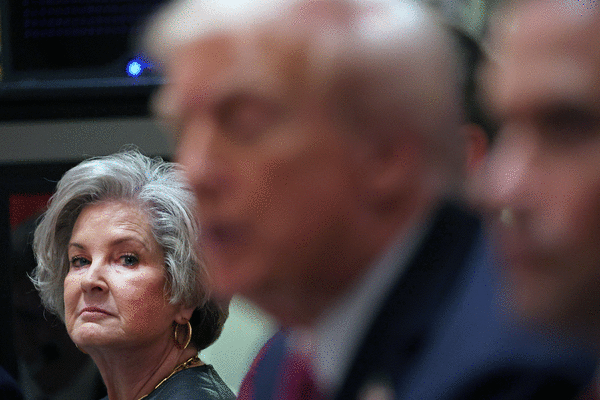
Thank goodness for state governments. One of the most underappreciated stories in 2025 was the role states played in checking federal overreach. As the Trump administration barreled through norms, rules and laws, state officials — sometimes from both parties — supplied the friction to slow the administration’s power grab.
Trump swept into power with Republican control over both chambers of Congress, but he avoided working with Congress as much as possible. He spent the first year of his second term pushing the bounds of executive power. As his Chief of Staff Susie Wiles told a Vanity Fair journalist: Trump “operates [with] a view that there’s nothing he can’t do. Nothing, zero, nothing.”
Congress may have rolled over, but at the state level, things played out pretty much the way America’s founders intended. As James Madison wrote in Federalist No. 45: “The powers delegated by the proposed Constitution to the federal government are few and defined. Those which are to remain in the State governments are numerous and indefinite.”
Madison and his fellow visionaries settled upon a system that enshrined in the U.S. Constitution the legal authority for states to protect the freedoms of their residents and uphold the rule of law when the federal government abused its power.
President Donald Trump gave them ample opportunity to do that right out of the gate. Between Jan. 20, 2025, and Dec. 18, 2025, he signed 221 executive orders — more than he signed in the four years of his first term.
But that approach infringed on many fundamental rights held by states. Many of those executive orders intruded upon state authority over administering elections and enforcing crime. Twenty-two states sided with the District of Columbia to successfully stop the Trump administration from federalizing the National Guard to be deployed to Washington, although the decision has been paused to allow for appeal. Twenty-three states joined with Illinois and Chicago to oppose the administration’s federalizing of Illinois National Guard troops. And 12 states joined Oregon to challenge the use of the president’s emergency powers to impose import tariffs on Canada, Mexico and China.
An analysis from States United, a nonpartisan organization that supports state officials and law enforcement leaders, found that at least 33 of Trump’s orders are facing federal court challenges and 10 of the most controversial dictates have either been blocked or paused while a court reviews them — from Trump ending the constitutional right to birthright citizenship, to his order to reject absentee ballots that arrive after Election Day, to the massive deployment of National Guard troops in Democrat-run cities. Many of the lower court orders are still pending rulings in the appellate courts, but they have served to slow the speed with which Trump can dismantle state protections.
State pushback is important, not only to preserve state constitutional authority, but also because the American people don’t approve of Trump’s approach on many of these issues. A Reuters/Ipsos poll in September, for example, found that 7 in 10 Democrats and half of Republicans didn’t want the president to send armed troops into American cities unless those cities face an external threat.
Remarkably, Alexander Hamilton predicted this 238 years ago this month when he wrote, in Federalist No. 17, that because states “will generally possess the confidence and good-will of the people,” they can use that popular support to “oppose all encroachments of the national government.”
The conservative majority on the Supreme Court has demonstrated that it will continue to expand the president’s power despite the limits intended by the nation’s founders. Joanna Lydgate, CEO of States United, thinks the ultimate test of Trump’s executive overreach won’t be in the courts. “We’re going to win or lose it in the court of public opinion,” she told me. “At the end of the day, the power here is in the hands of the American people.”
The next challenge will be for states to make sure the Trump administration doesn’t attempt to tip the scales in November 2026, when voters will decide every seat in the U.S. House and 33 seats in the U.S. Senate. Trump signed a sweeping executive order earlier this year to take critical election power away from states. That brought challenges from more Republican states than any other Trump executive order this year. (That order has also been paused.) And there is bipartisan opposition to the Department of Justice’s attempts to seek access to voter data, with the likely intent of trying to undermine trust in elections.
In the last year, the balance between state and federal power faced an historic test. But upholding the rule of law also means making sure there are consequences for those who undermine it. States also should launch investigations, file bar complaints against administration lawyers who violate ethics codes by lying to judges and advocate for Congress to tighten the legal loopholes the administration has exploited.
It’s been heartening to watch states step up and become a bulwark against federal overreach. But next year, there is much more to do.
____
This column reflects the personal views of the author and does not necessarily reflect the opinion of the editorial board or Bloomberg LP and its owners.
Mary Ellen Klas is a politics and policy columnist for Bloomberg Opinion. A former capital bureau chief for the Miami Herald, she has covered politics and government for more than three decades.
©2025 Bloomberg L.P. Visit bloomberg.com/opinion. Distributed by Tribune Content Agency, LLC.












































Comments