Karishma Vaswani: Islamic State isn't back in Asia, but its ideas endure
Published in Op Eds
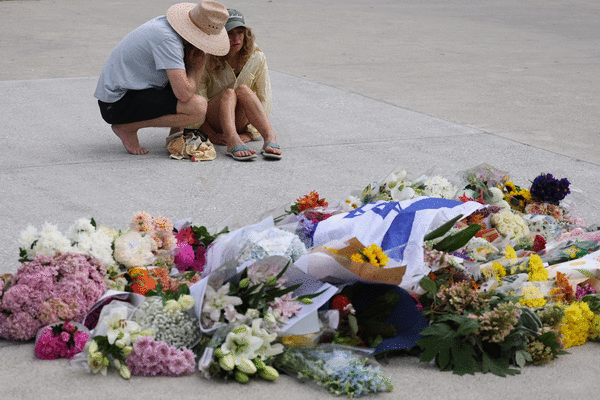
The deadliest domestic terror attack in Australia’s history is raising an uncomfortable question: Is there an Islamic State revival in Asia?
Despite years of counterterrorism successes and the group’s territorial collapse in Iraq and Syria, the assault at Sydney’s Bondi Beach highlighted a troubling reality: This radical ideology remains active across the region.
The father-and-son duo who gunned down 15 people celebrating a Jewish holiday on Dec. 14 are believed to have been radicalized by IS propaganda. The extremist network has expressed admiration for the shooting — and while not officially claiming responsibility has acknowledged the influence of their ideology on the gunmen.
Last month, the men traveled to an area in the southern Philippines where Islamic State-aligned groups have operated. Officials said it’s unlikely they received training from local insurgents or terrorists, but the duo may have met with religious leaders during their visit, according to intelligence authorities.
The events in Australia resemble patterns elsewhere. In October, a Syrian-born British citizen rammed a car into pedestrians, and stabbed worshippers outside a synagogue in Manchester on Yom Kippur, which authorities later labeled terrorism. A month later, Polish authorities arrested a law student suspected of plotting an Islamic State-inspired attack at a Christmas market. Earlier this month, two US soldiers and an American civilian interpreter died in Syria in an ambush by an Islamic State gunman. In Afghanistan, the Islamic State Khorasan Province is experimenting with artificial intelligence to push its message and reach new recruits.
The recurring bloodshed reflects how the network has adapted, even though it has weakened considerably compared with a decade ago, when it held large swathes of territory in Iraq and Syria. Islamic State remains the deadliest terrorist movement in the world, notes Sydney-based think tank Lowy Institute, because its ideology continues to motivate plotters long after the defeat of its so-called caliphate. Today, its power lies in propaganda, much of it circulating online.
During the group’s peak, they became known for using social media platforms to generate support and recruit new followers. Propaganda pieces were distributed online in its magazine, Dabiq. These became vital tools to promote the caliphate’s vision.
Authorities have battled this threat for years. In Indonesia, the world’s most populous Muslim nation, groups such as Jamaah Ansharut Daulah swore allegiance to Islamic State, and carried out several attacks across the archipelago in its name. In the Philippines, rebels linked to IS staged the 2017 siege of Marawi in Mindanao, a five-month battle that killed hundreds and displaced tens of thousands. The militants were eventually defeated, but the group’s appeal has endured.
I saw the group’s power when covering the Islamic State’s first claimed attack in Southeast Asia in January 2016 in Jakarta, which left four civilians and four militants dead. In the aftermath, I traveled to Solo to meet the family of the alleged ringleader, Bahrun Naim, then the group’s most notorious Indonesian member. Authorities said he coordinated the attack from Syria. Experts told me that Naim was radicalized long before he left the country through a combination of online activity, school networks and time in prison. In a blog attributed to him, he praised previous attacks, urging followers to stage similar ones back home.
The digital environment has only strengthened the network’s reach since then, as I’ve written about before. Southeast Asia has some of the world’s most active youth populations on social media, where extremist content often spreads unchecked. Singapore’s 2025 Terrorism Threat Assessment warns that this radical propaganda continues to resonate among young people, especially those consuming material in encrypted channels like Discord and Telegram.
The movement exists more online these days than as an active physical structure, Sidney Jones, a terrorism expert and adjunct professor at New York University, told me. “In Indonesia, Islamic State lost much of its appeal when it no longer became possible to go to Syria,” she said. “In the Philippines, the remaining fighters are probably driven as much by clan feuding and local politics as by ideology.”
Day-to-day grievances make the belief systems even more appealing. The southern Philippines region of Mindanao where the Sydney attackers visited struggles with poverty, clan tensions and weak governance that savvy militants can exploit.
Policymakers will have to counter this with anti-radicalization efforts that are digital-first. Authorities need to track extremist messaging in local languages, and work with platforms to curb their spread. Providing alternative vocational pathways for disillusioned youth exposed to propaganda would also be wise. Online literacy programs should focus on vulnerable communities: schools, mosques and even online gaming spaces were recruiters increasingly operate.
Governments must also address the underlying social tensions that extremists exploit. Delays in implementing the Bangsamoro peace process in Mindanao risks fanning flames of resentment. In Indonesia, prison radicalization remains a serious and persistent challenge.
The question is not whether Islamic State is “back” in Asia. It isn’t, but its ideology remains. As the tragedy in Bondi shows, that is dangerous enough.
____
This column reflects the personal views of the author and does not necessarily reflect the opinion of the editorial board or Bloomberg LP and its owners.
Karishma Vaswani is a Bloomberg Opinion columnist covering Asia politics with a special focus on China. Previously, she was the BBC's lead Asia presenter and worked for the BBC across Asia and South Asia for two decades.
©2025 Bloomberg L.P. Visit bloomberg.com/opinion. Distributed by Tribune Content Agency, LLC.


















































Comments