James Stavridis: Hegseth is targeting the military's 'constitution'
Published in Op Eds
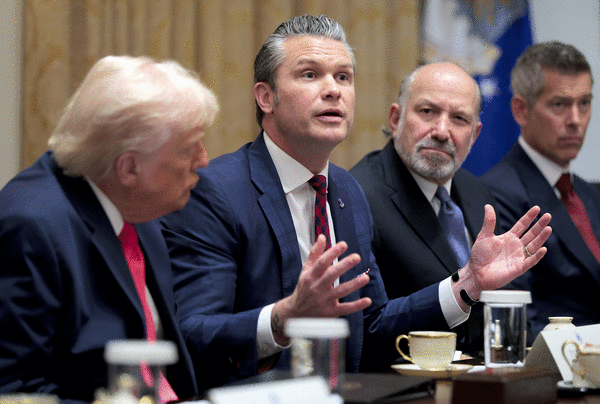
There have been recent reports that the U.S. Department of Defense, under Secretary Pete Hegseth, is planning significant revisions to its Unified Command Plan (UCP).
This document lays out the U.S. military's global command structure and defines the missions and geographic areas of responsibility of the most senior four-star commanders.
This may seem like an obscure, bureaucratic issue to most Americans, but it is not. The UCP is as close as the U.S. military has to a constitution, and any plan to alter it must not only improve our warfighting ability, but also respect the most important aspect of our national defense: that the military is under civilian control.
So, what would be a sensible new structure for the UCP that would preserve its coherence but respond to shifting global circumstances?
Any new plan would reportedly consolidate the military’s 11 combatant commands worldwide, and reduce the number of senior officers. General Dan Caine, chairman of the Joint Chiefs of Staff, and his team have no doubt considered a variety of options, which would be presented to Hegseth and then forwarded to the White House for decision and action. This appears to be a fast-moving train.
I understand the Unified Command Plan extremely well. I served twice as a combatant commander, which is the highest position in the plan save for the secretary and Joint Chiefs. I was for three years the commander at the U.S. Southern Command, charged with military-to-military operations throughout Latin America, and then moved to Europe for four years as the commander of U.S. European Command.
But before serving at the four-star level, I was at the Pentagon as the “action officer” for the Unified Command Plan, in what’s called the J-5 directorate, which carries out the department’s long-term strategy and policy. My sole focus was running the biennial conferences in which the UCP was studied, debated and occasionally changed. We looked at many of the options that were later made or are apparently under consideration today, from an “America Command” to a Space Command (which was eventually launched during President Donald Trump’s first term).
Like the U.S. Constitution, the Unified Command Plan dictates the separation of powers between the principal parties — in this case, the combatant commands. And much like the Constitution, the UCP is hard to change, generally requiring consensus among the commands, agreement of the chairman of the Joint Chiefs, and finally the approval of the defense secretary and the president.
When changes are made, the knock-on effects and often-unintended consequences can be enormous. But there are times when big changes make sense, and this may be one.
The current structure has 11 unified combatant commands, each with either a specific geographic area of responsibility — such as the U.S. European Command, with a remit for Europe, the Atlantic Ocean and much of the Arctic — or a major functional responsibility, such as U.S. Cyber Command.
There are seven geographic commands: Africa, Central (Middle East), Europe, Indo-Pacific, Northern (Canada, U.S. and Mexico), Southern, and Space. The four functional commands are cyber, special operations, strategic (nuclear forces) and transportation (logistics).
According to current reporting, the options on the table include merging some of the geographic commands; for example, forging European, Africa and Central Command into one entity. There is also discussion of fusing Southern and Northern Commands into a hemisphere-wide entity, perhaps to be called America Command.
None of these ideas is new. Some variants were studied in the mid-1990s when I was on the Joint Chiefs staff in the search for efficiencies, but over time — as is typical of the Department of Defense — the system actually expanded to the current 11 commands from seven.
I agree that it is time to trim our sails. I’d recommend reducing the overall number of commands back to seven — four regional and three functional, creating synergies and keeping a tighter focus on current priorities.
The four geographic commands should be America Command (Southcom and Northcom, with the Arctic and Greenland added); European Command (Europe and most of Africa); Middle East Command (Centcom and parts of Africa); and, first among equals, Indo-Pacific Command.
Each should continue to be helmed by a four-star general or admiral. Their staffs would include regional experts, intelligence specialists, diplomats, CIA officers and other authorities to provide that vital feel for each region.
Getting the functional commands down to three is more challenging, but a logical breakdown might be a Space-Cyber Command; Strategic-Special Operations Command; and a Transportation Command (logistics is what usually wins wars).
There are a thousand second- and third-order effects to consider, including the locations of each headquarters, much prized by congressional delegations if they are located within the U.S. (Southern Command is run out of Florida, for example); the total number of three- and four-star officers; the specific boundaries around the world (who “owns” the Arctic, for example); budget allocations (almost everything now goes to the individual services, not the joint combatant commands); and the size and shape of the smaller component commands that would exist inside each of the big seven.
Finally, there is the structure of the highest levels of the chain of command, which currently runs directly from the combatant commanders to the secretary of defense, bypassing the Joint Staff. While this appears counterintuitive, it works well in practice.
Think of it this way: The individual services (Army, Navy, Air Force, Marines) control the personnel and budgets. They recruit, train, equip and organize the forces. If the armed services were an automobile, the military services run the garage, while the combatant commanders drive it into operations. The chairman of the Joint Chiefs oversees traffic, makes sure they line up and are also subject to civilian control from secretary to president. This structure is codified by the Goldwater-Nichols Act of 1986, which fundamentally reorganized the military.
This all sounds like a colossal game of Risk, the board game about dividing up the world between the various players, but it works, and the Unified Command Plan is the rulebook.
If there are to be changes, the congressional leaders of the relevant committees need to be involved deeply. The UCP is more than a document, it is a crucial element in keeping Americans safe and maintaining our leading role in the world.
____
This column reflects the personal views of the author and does not necessarily reflect the opinion of the editorial board or Bloomberg LP and its owners.
James Stavridis is a Bloomberg Opinion columnist, a retired U.S. Navy admiral, former supreme allied commander of NATO, and vice chairman of global affairs at the Carlyle Group.
©2025 Bloomberg L.P. Visit bloomberg.com/opinion. Distributed by Tribune Content Agency, LLC.













































Comments