Commentary: Iran's white SIM card scandal reveals privilege, state control and fake dissent
Published in Op Eds
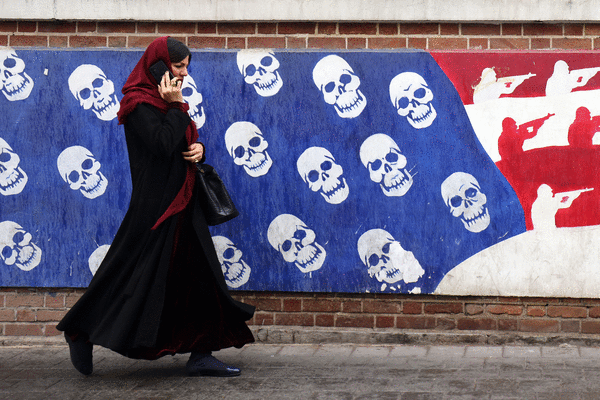
For many decades, Iranian citizens have lived under one of the world’s most restrictive internet regimes. The Islamic Republic has crafted a sophisticated digital architecture that allows the state to surveil, monitor and limit access to information at will. Yet it was only recently — following Elon Musk’s decision to reveal the approximate connection locations of X users — that a deeper layer of digital inequality emerged into public view.
Musk’s transparency initiative unintentionally exposed a stark divide between ordinary Iranians who rely on virtual private networks and filtered connections, and a select group of regime-affiliated individuals who access social media through what are widely referred to as white SIM cards.
These white SIM cards are special telecommunication lines that bypass Iran’s national filtering system entirely.
Unlike ordinary users — who must constantly navigate a maze of VPNs, proxy servers and state-imposed connectivity disruptions — holders of white SIM cards enjoy stable, high-speed, unfiltered access to global platforms. In a country where the internet has become a battlefield of power, this privilege alone reveals a profound political hierarchy.
But the scandal did not end with the exposure of inequality. What emerged was a revelation far more corrosive: Many individuals who presented themselves as “opposition activists,” political commentators or even former detainees of the Islamic Republic were discovered to be using these state-issued lines. The discovery has ignited a wave of anger across the Iranian diaspora and inside Iran, raising serious questions about infiltration, manufactured dissent and the state’s strategy of embedding informants in activist communities.
To understand the significance of this scandal, we must consider the everyday reality for ordinary Iranians. Since the protests of 2009 and, more severely, during the nationwide uprisings of 2017, 2019 and 2022, the government has restricted or entirely shut down the internet.
During the 2019 Aban protests — where hundreds were killed — Iran imposed a near-total blackout that lasted almost a week. Information flow was choked off, families were unable to reach one another and activists risked their lives to smuggle footage out of Iran.
Even during periods without mass protests, the average Iranian faces a highly filtered and unstable digital environment; basic communication often depends on unreliable VPN services.
Against this backdrop, the existence of a privileged category of unfiltered SIM cards — accessible only to the Revolutionary Guard, intelligence agencies, state media operatives and a select group of regime-favored individuals — exposes not only inequality but also a deliberate two-tier system of digital citizenship.
Perhaps the most explosive element of the scandal was the discovery that some figures long treated as dissidents were operating with white SIM cards. Iranian users noticed that during major shutdowns, these individuals remained active on X, livestreaming political debates, attacking opposition groups and shaping online narratives that subtly aligned with the regime’s interests.
Some of these figures had publicly claimed to be persecuted by the government or even arrested in the past. Yet the use of white SIM cards suggested cooperation with, or at minimum protection from, the very intelligence networks they claimed to oppose. Many Iranians had already suspected that the digital and political opposition space had been penetrated by the state. Musk’s data leak, intentionally or not, confirmed that suspicion.
The scandal also revealed the strategic sophistication of Iran’s security apparatus. By enabling certain individuals to maintain unrestricted internet access — even during national shutdowns — the state ensured that pro-regime narratives could continue circulating while the voices of ordinary citizens were silenced. Online activism became a stage managed from above, with these dissenters amplifying divisive rhetoric, attacking other activists and creating confusion about the authenticity of opposition movements.
The existence of white SIM cards must be understood as part of a larger ecosystem of digital repression. For years, Iranian authorities have framed internet filtering as a measure to “protect national security,” “preserve morality” or “counter Western influence.” In practice, however, control over the internet has functioned as the regime’s most powerful nonlethal weapon against mass mobilization.
By controlling bandwidth; blocking platforms such as X, Instagram and WhatsApp; and deploying artificial intelligence-driven surveillance tools, the government has created a digital environment in which dissent can be monitored, slowed or crushed at the state’s discretion.
Yet the white SIM card scandal reveals something deeper. The internet in Iran is not merely filtered — it is weaponized. The same tool that deprives millions of Iranians of access to information becomes a privilege handed out to insiders, spies and propagandists.
From a human rights perspective, access to the internet is increasingly recognized as a fundamental right connected to freedom of expression, freedom of assembly and access to information. The United Nations has repeatedly affirmed that states should not intentionally disrupt or shut down internet access. In my own academic work, including an article written for the Chicago Law Journal, I have argued that internet access is foundational to meaningful participation in public life.
Iran’s discriminatory system of digital access violates basic principles of equality and freedom. It also undermines any claim by the state that internet restrictions are imposed uniformly for national security.
For many Iranians, the white SIM card scandal confirmed long-standing fears that the government had infiltrated opposition movements, empowered undercover agents and shaped online discourse.
And perhaps most importantly, it demonstrated that internet control in Iran is not merely a technical policy — it is a mechanism of political domination. As long as the Islamic Republic maintains its monopoly over connectivity, the possibility of organic, widespread, coordinated protest remains constrained.
The scandal may have uncovered a hidden truth, but it also provided clarity. It showed Iranians — inside and outside the country — that the struggle for democracy cannot be separated from the struggle for digital freedom.
Until the architecture of digital repression is dismantled, political change will remain vulnerable to the state’s most potent weapon: control over the flow of information itself.
____
Pegah Banihashemi, a native of Iran, is a legal scholar and journalist in Chicago whose work focuses on human rights, constitutional and international law, and Middle East politics.
___
©2025 Chicago Tribune. Visit at chicagotribune.com. Distributed by Tribune Content Agency, LLC.




















































Comments