Microsoft CEO warns AI needs to spread beyond Big Tech to avoid bubble
Published in Science & Technology News
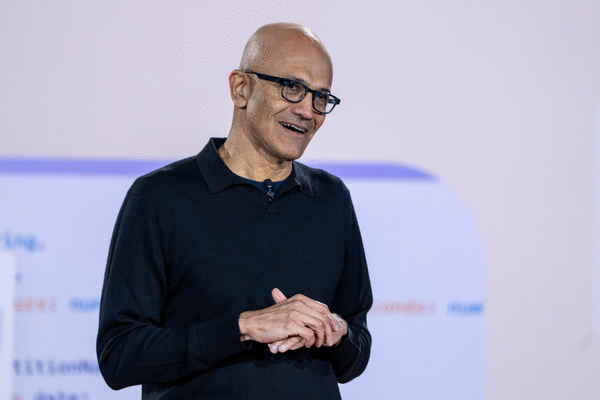
As tech companies spend billions on artificial intelligence data centers and computer chips, fears of an AI bubble held privately by Wall Street traders and some Big Tech titans are beginning to pop into public view.
Speaking to the world’s economic elite Tuesday in Davos, Switzerland, Microsoft CEO Satya Nadella tossed out his 2 cents.
AI technology has to spread beyond the confines of tech firms, said Microsoft CEO Satya Nadella during the World Economic Forum’s annual meeting. Otherwise, the AI frenzy that has buoyed stock markets for years and driven record-high valuations — including Microsoft’s of $3.4 trillion — will by definition prove to be a bubble.
Nadella said he was confident that widespread adoption, or diffusion, of AI will occur and large companies will use the technology to change the way they work. But he said the benefits of AI must be more evenly spread.
“A telltale sign of if it’s a bubble would be if all we’re talking about are the tech firms,” Nadella said to BlackRock CEO Larry Fink. “If all we’re talking about is the technology side.”
Nadella and Microsoft have been preaching about AI diffusion for the past year, pitching the technology mostly as a way for workers to unlock more productivity. The company’s public comments stand in contrast with fears that AI will replace workers.
Nadella addressed those fears in a blog post at the end of 2025, in which he argued AI should be thought of as a “scaffolding for human potential” rather than a substitute. He also sneaked into the post that he’d rather people stop arguing about the AI “slop” that’s invading much of the internet.
Microsoft’s AI strategy also shows it isn’t keen to market the technology as a replacement, but rather as a companion. The company foresees workers using AI-powered agents that autonomously complete tasks for them throughout the day.
To quell further fears of an AI bubble, Nadella said he’s confident the technology will spread quickly thanks to widespread adoption of cloud computing and mobile devices over the past two decades. Nadella is among those that believe broader uses of the technology by firms outside of the tech sphere will drive economic growth.
That economic growth has to be driven by companies adopting AI to fuel their own revenues, not just capital expenditures from tech firms investing in AI infrastructure, Nadella said.
Economic growth driven by capital expenditures “is what we’re seeing right now,” he said.
A report from J.P. Morgan last year said that in the first half of 2025, AI-related investments contributed to 1.1% of GDP growth, “outpacing the U.S. consumer as an engine of expansion.”
Between Meta, Alphabet, Microsoft, Amazon and Oracle, about $342 billion was allocated toward capital expenditures in 2025. In its 2025 fiscal year, Microsoft reported it spent $88 billion on AI-related investments and projected to increase spending this year.
©2026 The Seattle Times. Visit seattletimes.com. Distributed by Tribune Content Agency, LLC.






Comments