Let them eat cake: Food for cancer patients can also add joy
Published in Variety Menu
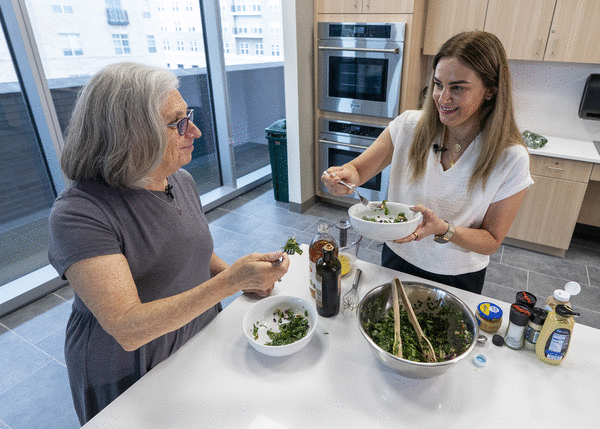


PITTSBURGH — A healthful approach to food can be an important step in a cancer patient's journey. But experts want to dispel fear and confusion around nutrition during a time that is rife with those emotions.
"No matter what, when you have cancer, you have anxiety," said Lanie Francis, a medical oncologist and hematologist who is founder and director of the Wellness and Integrative Oncology Program at the UPMC Hillman Cancer Center in Pittsburgh.
That anxiety can be translated into being "rigid," "paranoid" or even "paralyzed" about food, she said.
Which is not to deny food's potentially transformative effects on well-being, but Francis said that though there are general research-backed suggestions, her program focuses on listening to individual patients and making recommendations based upon their needs.
Francis traces her own focus on integrative or "whole person" oncology partly to a patient she met early in her career.
He had localized pancreatic cancer, which was in remission, and yet his health was endangered because he couldn't retain food.
"He got to the end of his treatment and he was trying to launch back into life, and he was having a horrific time keeping weight on," she said, because he was plagued by nausea and diarrhea.
After investigation, his medical team found that he had developed a gluten intolerance. With his wife's help, all gluten was taken out of his diet.
"He was completely better," Francis said.
"We almost lost him" because he couldn't retain food, she said. "This patient's diet made all the difference even after he'd been through all of this treatment and was cured of pancreatic cancer."
After this experience, her idea of integrative oncology began to form around the "pillars" of movement, touch, nutrition and mindfulness. The program at Hillman offers yoga, aromatherapy, meditation, massage, acupuncture, exercise therapy and nutrition counseling for symptom management and overall wellness.
Even the physical space at the integrative oncology services unit focuses on the patient's experience. It is calm and uncrowded. Colors are soothing.
"We're not going to have a talk show on in our waiting room," Francis said.
'Make it tasty and delicious'
The creation of a calm environment is an essential part of another program — at the James Cancer Hospital, part of the Ohio State University's Comprehensive Cancer Center in Columbus.
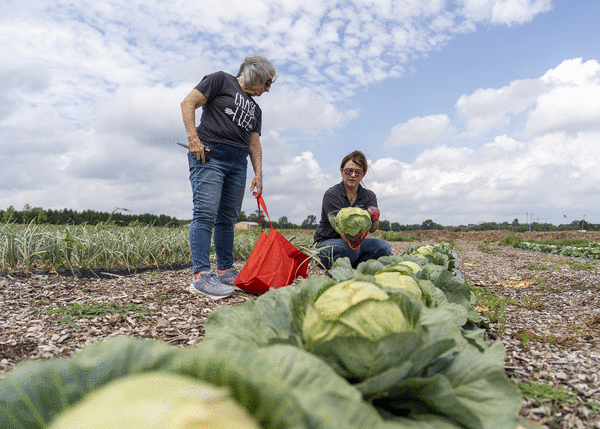
The Garden of Hope is about 1.5 acres near the hospital, with more than 100 varieties of fruits and vegetables. The hospital invites anyone who has a cancer diagnosis to harvest vegetables and benefit from twice weekly cooking and nutritional advice on site for a two-year period.
Dena Champion is an oncology dietitian at the hospital, and has worked in the Garden of Hope program for about a decade.
"Instead of just handing them produce, we actually also do some education surrounding it," she said, including "how to make it tasty and delicious."
This advice is especially useful for more obscure vegetables, such as kohlrabi or sunchokes.
The program offers a downloadable online cookbook, which gathers healthful, appealing recipes from a variety of sources.
"And because we're out there in this beautiful space, they're typically in this much more relaxed, better head space than a typical clinic setting," Champion said.
Champion said that though recommendations vary according to people's circumstances, in general the hospital advocates a plant-heavy diet. That does not necessarily mean a vegetarian or vegan diet, but one in which, ideally, your plate is about half-filled with fruits and vegetables.
"Most Americans, including cancer survivors, are definitely not eating enough fruits and vegetables," she said.
A plant-forward diet provides vitamins, minerals, fiber and phytochemicals — found only in plants — which are known for their antioxidant and anti-inflammatory properties.
Champion points out that vegetables can be high in nutrients but low in calories, a boon for people struggling with their weight.
Garden participants include people who are actively undergoing treatment — and who may be suffering from side effects like fatigue, taste changes, dry mouth and sore mouth — to those who have finished treatment and are in remission.
Chemotherapy, immunotherapy and radiation — depending on what the radiation is targeting — can cause changes to people's sense of taste.
"Sometimes you'll hear a patient describe something tasking like metal, or you might hear some say, 'Everything tastes so bland.'"
To counter these effects, Champion suggests adding maple syrup or honey to combat bitter flavors, or if patients have mouth sores, avoiding acidic foods or drinking soothing smoothies. Experimenting with herbs can also address blandness.
These taste changes are transient, she emphasizes.
"We try to keep reminding [patients] that it will get better," Champion said.
Dietitians as food psychologists
The Hillman Center's Francis makes a distinction between a more traditional focus on cancer patients' maintaining calories and those with more personal questions — which may imply a more long-term outlook.
Patients with certain types of cancer, such as of the head and neck or gastrointestinal system, may be in the former category because of problems with chewing, swallowing and digesting food.
"Typically, these patients are undergoing really difficult treatments," she said. "So they need protein and calories to keep them going."
Medical resources traditionally focus on these patients, she said.
People in the second category benefit from what she calls "lifestyle nutrition" counseling.
"It's really much more about the long game," she said.
She gave the example of patients with breast cancer who might be overweight or gaining weight during treatment. Both hormonal treatments and natural hormonal changes can have a snowballing effect.
Research indicates that the majority of women gain weight after breast cancer treatment.
"Their metabolism changes, their hormones change," Francis said. "They may be at the same time naturally proceeding through perimenopause and menopause, and it becomes very all-encompassing when they begin to gain weight."
Chronic obesity creates inflammation, which is a risk factor for many chronic diseases, including heart disease and cancer, Francis said. But the aim is to educate patients, not to judge them or make them feel guilty about food choices.
Dietitians must enter this fraught territory as "food psychologists," she said. Food is so personal because it is literally "stuff you're putting inside your body."
That is why the program tries to put the joy back into eating, and approach it with "a light spirit and with a little bit of fun," Francis said. "We don't want this to feel like another difficult, hard, sad prescription"
While oncologists 20 or 30 years ago may have just emphasized maintaining weight without consideration for nutrition details, she said, "I think we now have a new appreciation, and what we try to really say is, 'Yeah, it really does matter what you eat, but don't freak out about it.'"
People should feel good about having a piece of cake at their granddaughter's birthday party, she said, but at the same time keep in mind that the long-term goal is to reduce white sugar in the diet. (Incidentally, among the program's YouTube cooking videos, a recipe for silken tofu chocolate mousse, is the most popular.)
OSU's Champion concurs on the need for a balance.
"If somebody's really miserable going through active treatment, you know what? We're not going to worry all that much about getting fruits and vegetables," she said. "We've also got to think about the big picture: their quality of life."
Curried Carrot Soup
3 tablespoons canola oil
2 teaspoons curry powder
8 medium carrots, peeled and thinly sliced
4 medium stalks celery, thinly sliced
1 medium onion, coarsely chopped
5 cups reduced-sodium chicken broth
1 tablespoon lemon juice
1/2 teaspoon salt
Freshly ground pepper, to taste
Cook oil and curry powder in a large saucepan over medium heat, stirring, until fragrant, 1-2 minutes.
Stir in carrots, celery and onion; toss to coat in oil.
Cook, stirring frequently, for 10 minutes. Stir in broth. Bring to a boil.
Reduce heat and simmer until the vegetables are very tender, about 10 minutes.
Remove from the heat; let stand 10 minutes.
Lay a paper towel over the surface of the soup to blot away the oil that has risen to the top.
Working in batches of no more than 2 cups at a time, transfer the soup to a blender and puree (use caution when pureeing hot liquids).
Return the pureed soup to the pan, place over medium heat and heat through.
Season with lemon juice, salt and pepper.
Serves 6.
— EatingWell.com via OSUCCC
Roasted Beets with Balsamic Glaze
2 pounds red beets, medium sized, tops removed, and washed
Olive oil
Salt
1/2 cup balsamic vinegar
2 teaspoons sugar
1 teaspoon grated orange zest
Freshly ground black pepper
Preheat oven to 400 degrees.
Line a roasting pan with aluminum foil. Place the beets in the pan.
Rub olive oil over the beets and sprinkle with salt.
Cover them with another sheet of aluminum foil.
Roast for 1-2 hours, depending on the size of the beets. After one hour, test every 15 minutes by poking a beet with a fork. Once the fork goes in easily and the beets are tender and cooked, remove from the oven.
Prepare balsamic glaze. Add balsamic vinegar and sugar to a small pan and cook on medium-high heat, stirring often. Continue cooking until glaze is syrup consistency.
Once beets are cool enough to handle, peel off the outer skins and cut into bite-size portions.
Place beets in a serving bowl and pour balsamic glaze over them, coating well, add orange zest and serve.
Serves 6-8.
— Simply Recipes via OSUCCC
Avocado-Lime Honey Smoothie
1/2 ripe avocado
1 handful parsley
1 tablespoon honey
1 teaspoon lime juice
1/2 cup water
Wash and cut avocado in half.
Remove the seed and roughly chop the pulp.
Wash parsley and chop finely.
Place 1 tablespoon each of honey, lime juice, avocado pulp, parsley and water in a blender and blend on high for 20 seconds, or until thoroughly combined.
Pour into a glass and enjoy.
Serves 1.
—Stephanie DeValencia via OSUCCC
©2025 PG Publishing Co. Visit at post-gazette.com. Distributed by Tribune Content Agency, LLC.








Comments