The Orbit Theory: Why Your Pet Is Always Exactly Six Feet Away
Published in Cats & Dogs News
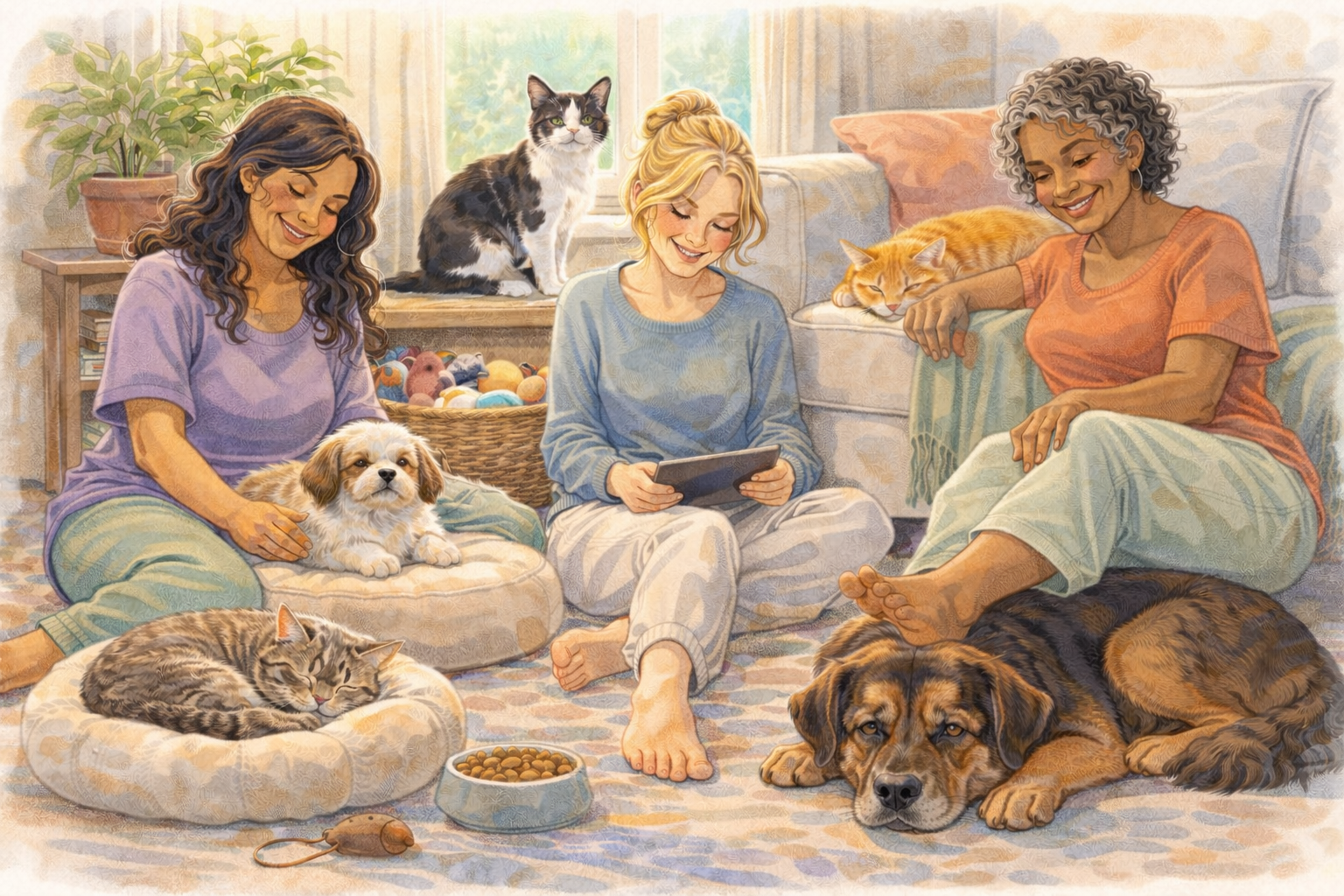
Pets don’t just live with us—they arrange themselves around us. Anyone who has shared a home with a dog or cat has felt it: that subtle, persistent presence hovering just beyond arm’s reach. Not underfoot, not demanding, not entirely distant either. Just there. Watching. Waiting. Orbiting.
Call it a coincidence, or call it habit, but over time it begins to feel like something more deliberate. A pattern. A geometry of affection. The Orbit Theory suggests that many pets, especially dogs, maintain a consistent radius from their humans—often about six feet—balancing connection with autonomy in a way that feels almost engineered.
A Radius of Trust
Six feet is not a magic number, but it shows up often enough to feel intentional. In living rooms, kitchens, front yards, and quiet sidewalks, pets position themselves at a distance that allows them to monitor their person without crowding them. Close enough to respond instantly. Far enough to avoid intrusion.
Behaviorists might frame this as a mix of attachment and self-regulation. A well-adjusted dog doesn’t need constant contact to feel secure. Instead, it establishes a zone of awareness—keeping its human within sight, sound, and scent, while maintaining its own sense of space.
That distance becomes a kind of emotional equilibrium. Too close, and the dog risks overstimulation or correction. Too far, and it risks disconnection. The orbit holds.
Cats, often mischaracterized as aloof, participate in their own version of this radius. They linger in doorways, perch on furniture just outside reach, or settle in adjacent rooms with a clear line of sight. It’s not indifference. It’s selective proximity.
The Difference Between Clingy and Connected
Not all following behavior is the same. A dog that shadows every step, presses constantly against legs, or becomes anxious when separated is not orbiting—it’s clinging. Orbiting, by contrast, is calm. Intentional. Flexible.
A dog in orbit might follow from room to room, but it doesn’t insist on contact. It settles. It watches. It waits. There’s confidence in that distance.
This distinction matters, especially for pet owners navigating training or behavioral concerns. Clinginess often stems from insecurity or lack of boundaries. Orbiting reflects trust. The dog knows you’re there. It doesn’t need to prove it every second.
Owners often reinforce orbiting without realizing it. A glance, a word, a small acknowledgment—these are enough to maintain the bond. The dog doesn’t need to climb into your lap. It just needs to know you see it.
Rescue Dogs and Tight Orbits
For rescue dogs, the orbit often starts much tighter. A dog that has experienced instability, neglect, or hunger may initially stay glued to its new owner, sometimes literally touching at all times. The distance collapses to zero.
Over time, as the dog learns that food is consistent, affection is reliable, and the environment is safe, the orbit expands. What begins as constant contact softens into that familiar radius—two feet, then four, then six.
It’s a quiet transformation, but a meaningful one. The widening orbit signals growing confidence. The dog no longer needs to monitor every movement at close range. It trusts that you will remain.
Shelter workers and adopters often recognize this shift as a milestone. The anxious shadow becomes a relaxed companion, still attentive, but no longer tethered by fear.
Doorways, Thresholds, and Strategic Positioning
Watch where a dog chooses to lie down, and the orbit becomes even clearer. Doorways are prime real estate. From there, a dog can monitor multiple spaces at once—keeping track of its human while maintaining a defensive vantage point.
Similarly, the foot of a couch, the edge of a room, or a spot near a hallway intersection often becomes a preferred resting place. These positions maximize awareness while preserving that crucial buffer zone.
Even outdoors, the pattern holds. A dog may wander, sniff, and explore, but it frequently returns to a position that keeps its human within that invisible circle. Not too close. Not too far.
This is not random. It reflects a blend of instinct and learned behavior—part guardian, part companion.
When the Orbit Breaks
There are moments when the six-foot rule collapses. Thunderstorms, illness, unfamiliar environments, or sudden changes can draw a pet closer. The dog that usually lounges across the room may press against your leg or climb beside you.
These moments reveal the underlying purpose of the orbit. Distance is a choice, not a necessity. When circumstances demand it, the pet closes the gap.
Food, of course, is another powerful disruptor. The orbit tightens dramatically when bacon is involved. Even the most independent dog will abandon its radius in favor of proximity when the stakes are high enough.
Yet once the moment passes, the dog often returns to its preferred distance. The orbit reestablishes itself, as if pulled back into place by an invisible tether.
A Shared Geometry of Living
For many pet owners, the orbit becomes part of the rhythm of daily life. You move, and your pet adjusts. You sit, and it settles nearby. You stand, and it repositions.
Over time, this choreography becomes so familiar it fades into the background. But once noticed, it’s hard to ignore. The dog isn’t just following. It’s calibrating.
This subtle dance speaks to a deeper truth about the human-animal bond. It is not built solely on touch or direct interaction, but on awareness. Presence. A shared understanding of space.
The orbit is not about distance. It’s about connection maintained without constant contact—a quiet agreement between two beings who have learned to live together.
More Than Habit
The Orbit Theory may not appear in scientific journals, but it resonates with lived experience. It captures something intuitive and recognizable: the way pets arrange themselves around us with a consistency that feels purposeful.
Whether shaped by instinct, training, or simple affection, the result is the same. A dog lies just beyond reach, watching. A cat lingers in the doorway, observing. Both are present, both are connected, and neither needs to be any closer.
In that space—those few feet of quiet distance—there is trust.
And for many, that’s exactly where a good companion belongs.
========
Ellis Marrow is a freelance features writer focusing on the subtle dynamics of everyday life and human-animal relationships. His work explores the unnoticed patterns that shape how we live together. This article was written, in part, utilizing AI tools.






Comments