US hits island in Hormuz, Iran targets Kuwait as tensions flare
Published in News & Features
American warplanes hit an Iranian missile launch site on Qeshm Island in the Persian Gulf late on Tuesday, a U.S. military official said, as the two sides intensified tit-for-tat attacks in the ongoing war.
The strike on the Islamic Revolutionary Guard Corps facility was in response to Iran earlier targeting U.S. personnel and assets, the official said, declining to be named.
Iranian media reported the U.S. struck several locations on the island, which sits in the Strait of Hormuz, but caused no casualties or damage to critical and public-service infrastructure.
On Wednesday morning, Tehran appeared to retaliate, firing drones at U.S. air defenses and missile launchers at a Kuwaiti base, Iranian state media reported. Kuwait’s army said it intercepted drone attacks, without elaborating. It’s the first Iranian attack on the Arab state in around two months.
Bahrain, another U.S. ally in the region, said it intercepted Iranian projectiles around the same time.
The U.S. bombing comes as peace talks with Iran make little progress and as the two countries step up strikes, though not to the point of triggering all-out fighting such as that seen during the first phase of the war between late February and early April.
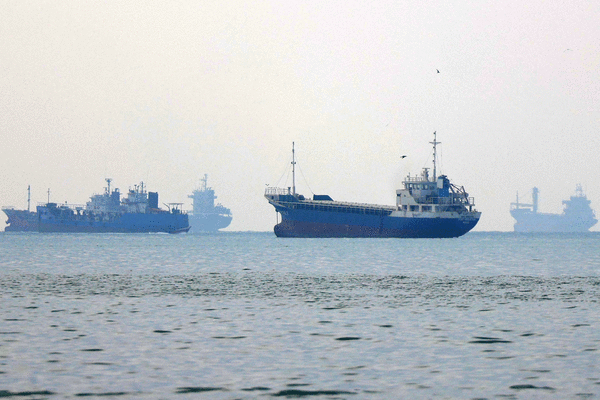
Iran continues to attack energy tankers and container ships in the Hormuz strait, hitting roughly one a day on average. Tehran has targeted Bahrain several times in the past week, saying it was aiming for U.S. radar and other military systems.
Separately on Tuesday, U.S. President Donald Trump said his government is investigating potential Iranian plans to bomb American officials in Washington, DC.
Since this month’s U.S. midterm elections, in which the unpopularity of the Iran war contributed heavily to Trump’s Republican party losing control of Congress, the president has been under pressure to wind down the war and avoid the mass strikes on the Islamic Republic he’s threatened. But there’s no easy way for Trump to extricate the US from the conflict, and he says his forces remain “locked and loaded.”
This week, a third American aircraft carrier, the USS Theodore Roosevelt, arrived in the Middle East.
“For both the U.S. and Iran, there’s an operational rationale for their strikes, from reducing threats to their ability to operate in the Strait of Hormuz,” said Becca Wasser, defense lead for Bloomberg Economics. “But we’ve seen throughout this conflict the mismatch between operational objectives and political realities, where tit-for-tat strikes quickly escalate.”
A second front in the war, involving Saudi Arabia and the Iran-backed Houthis in Yemen, is also intensifying. The Houthis targeted the Saudi capital, Riyadh, again on Wednesday, while a Saudi-led coalition said it destroyed 60 military targets controlled by the Islamist militants.
Neither Iran nor the U.S. has shown a willingness to compromise on key issues that might pave the way to a diplomatic resolution, such as the lifting of a U.S. naval blockade or concessions from Iran on its nuclear program.
Qatar, the main mediator, was due to meet with representatives of the Islamic Republic on Tuesday, part of a long-running effort to find an off-ramp.
Oil prices fell about 2% in early trading on Wednesday, with Brent crude down to $91.50 a barrel. While its still up 50% this year, its fallen from $117 just before the midterms.
Qeshm lies off Iran’s coast in the Strait of Hormuz. The U.S. launched limited attacks on the island earlier this month, saying they were defensive in nature and designed to help energy tankers and other vessels get through the strait safely.
Earlier Tuesday, Iran’s parliamentary speaker and lead negotiator with the U.S., Mohammad Bagher Ghalibaf, warned that Tehran would retaliate against civilian infrastructure near U.S. and Israeli bases if Washington did the same.
His comments, a standard Iranian response to any perceived indication of U.S. escalation, followed a New York Times report that water infrastructure sites in Iran “may have been developed to support the country’s military buildup.”
This amounted to “prepping the next round on civilian” infrastructure, Ghalibaf said. “We’ll apply your logic consistently and even-handedly.”
The NYT cited unnamed analysts and did not report that the U.S. or Israel — which began the war by bombing Iran on Feb. 28 — were considering hitting Iranian dams.
—With assistance from Michelle Jamrisko, Eltaf Najafizada and Jen Judson.
©2026 Bloomberg L.P. Visit bloomberg.com. Distributed by Tribune Content Agency, LLC.






Comments