Can these surf cams save San Diego's coastline?
Published in News & Features
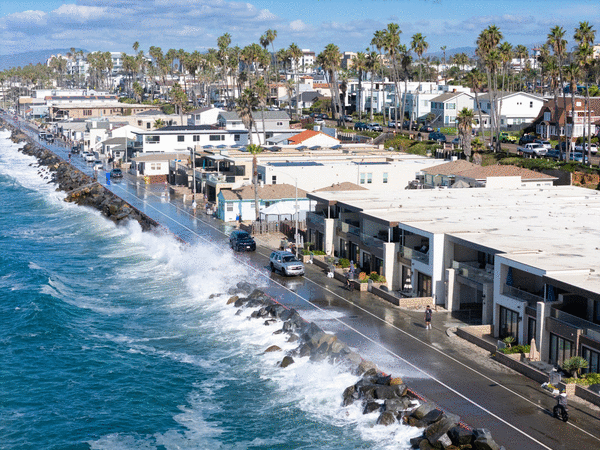
SAN DIEGO — It’s hard to imagine Oceanside without its beloved beaches.
But decades of footage from Surfline’s webcams shows the coast eating up sand, creeping toward homes and businesses.
Now, the city is using the popular surf company’s cameras to monitor its beach restoration project.
Oceanside residents are desperate to get sand on their beaches, explained Jayme Timberlake, the city’s coastal program manager. She described the recent erosion that led to king tide swells taking over city streets. Last month, waves were unearthing rocks and scattering debris.
The destruction is obvious to anyone watching, she said, but convincing the city of Oceanside to actually budget for coastal defenses was harder.
The burden of proof cost her coastal team years. In 2021, they finished mapping Oceanside’s shoreline to show the city exactly where the coast is most vulnerable. Then, they debated the best ways to stop the waves from tearing into town.
Finally, four years later, the city landed on a solution. Oceanside is building an artificial reef designed to control wave energy and prevent beach erosion.
The project will take about 1 1/2 years to build and cost $60 million to $70 million. The city is in the process of issuing permits.
Surfline’s smart cameras play a critical role in monitoring how the coastline moves and where the sand goes. After reef construction is finished, Timberlake says the city plans to keep the cameras on to track sea levels for the foreseeable future.
The city of Oceanside received a $1.8 million grant from the California Coastal Commission for its RE:BEACH project last year. About $270,000 of the grant is budgeted for baseline surf condition and use assessments, a portion of which will go to Surfline, Timberlake said.
This quick and consequential data is how a company best known for scouting waves, and occasionally snitching on secret surf spots, has become one of the most useful sources of coastal intelligence.
Big-picture data about how the coast is changing is relatively widespread, Timberlake said. Scripps Institution of Oceanography, for example, projected 6 inches of sea level rise in La Jolla by 2030.
But the response to reports like that is often “so what?” said Lucy Baker, climate resilience specialist at Adaptation International. Her company, in Austin, Texas, works with small towns that face existential risks from climate change to form protection plans.
“Most people already know climate change is happening,” she said. “Now we just need to use this information to adapt to the new normal.”
Surfline never set out to collect that kind of data, but they hold troves of it — comprehensive, real-time data that helps cities monitor coastal changes. This kind of preemptive data is essential, Baker said, because many communities don’t fix the problem until the damage is done.
Surfline’s 1,100 cameras have collected decades’ worth of coastal data from around the world. But before the 100-person company took on the AI wave, it was a surf company.
Forty years ago, Sean Collins, the father of surf forecasting, founded Surfline in Huntington Beach.
The lifelong surfer and self-taught meteorologist, who died in 2011, wanted a better way to find the best waves.
Back in 1985, Collins would pay surf bums and school kids to wake up before dawn and study the surf conditions.
Once at their assigned beach, Collins would call a neighboring payphone, asking for a report on the waves. He would then aggregate the data from each beach and fax a report to anyone who signed up for Surfline.
“If you didn’t pick up the payphone at 4:45, you’d be fired,” said Ross Garrett, Surfline’s CEO, who lives in Encinitas. “It was a good way of early quality control.”
Surfline went from faxed reports to pay-per-call to the first live surf stream on the internet.
“Now we’re at the dawn of AI,” said Garrett.
After buying its biggest competitors, including U.K.-based Magicseaweed and Australia’s CoastalWatch in 2017 and 2019, respectively, Surfline solidified its dominance as the largest surfing intelligence network.
In recent years, the company has moved from its Huntington Beach headquarters to Cardiff. Surfline has also focused on hiring software engineers to build and perfect its AI analytics platform.
Garrett recently stood on the Oceanside pier, describing each data point with the precision his system tracks them.
To those familiar with the type, Garrett is quintessentially San Diego. In one breath, he’s talking about the best poke in town and letting his boys ditch school to ride Hurricane Genevieve’s swell.
In the next, he carefully explains how Surfline’s cameras use bathymetry to correlate wave heights to the sediment below.
Surfline’s cameras, he explained, are powered by a patented process, leveraging an extensive archive of coastal imagery.
This intelligence layer is called Surfline Coastal Intelligence, SCI, and its high-definition camera digests images on the pixel level, capturing individual surfers and even heights of sea spray, Garrett said.
The platform tracks everything from how many surfers ride a wave to overall crowd size and year-to-year coastline shifts. It can pinpoint where waves break, how hard they hit and which way they’re moving, letting AI piece together a detailed map of the beach — and even what’s happening underwater.
Garrett called this a digital twin of the beach.
Digital twins work as a constant feedback loop between a physical place and its virtual copy, letting engineers test scenarios safely before committing resources.
Tech companies have used them for years to manage cell networks, factories and supply chains. Surfline is applying the idea to something far less predictable: a shoreline.
“I’ve seen some breaks move,” said Garrett, who has surfed Cardiff Reef since he was 15. Recently, he says, the shape of the waves has changed. The once-sturdy breaks are now more sensitive to tide shifts.
When Garrett checked Cardiff’s sandbar evolution on the SCI platform, the data confirmed what he’d felt.
Adding evidence to intuition is exactly what Timberlake is doing with Oceanside’s newest Re:Beach project for real-time analytics and predictive modeling.
Oceanside lifeguards are already using the technology to plan staffing, and Surfline is bringing similar restoration work to Australia’s Gold Coast.
But as with most data technology, information gained is privacy lost.
Surfline regularly gets heat from surfers about their cameras exposing local surf spots, but the cameras also raise a bigger question: If they can pick up sea spray, what’s stopping them from identifying who’s at the beach?
It’s the same worry behind the debate over Flock’s license-plate cameras.
Surfline told The San Diego Union-Tribune that these cameras cannot facially identify you.
“Our attendance tracking is completely faceless; we aren’t tracking anything personally identifying, like license plates, nor would we ever,” said Leif Harder, head of marketing strategy for SCI.
Individual surfers are only captured by choice. Surfers can opt in to the company’s “smart clips” integration at specific beaches, which can give surfers footage of themselves on a wave.
As a business, “it’s tempting to put a camera everywhere. If we don’t, someone else will,” Garrett said. Instead, the company has a list of criteria before putting a camera on a coastline: Is there a major parking lot? Is it regularly on social media? “We balance enabling discovery without destroying discovery.”
_____
©2026 The San Diego Union-Tribune. Visit sandiegouniontribune.com. Distributed by Tribune Content Agency, LLC.






Comments