Wild US weather halts flights, dumps snow and knocks out power
Published in News & Features
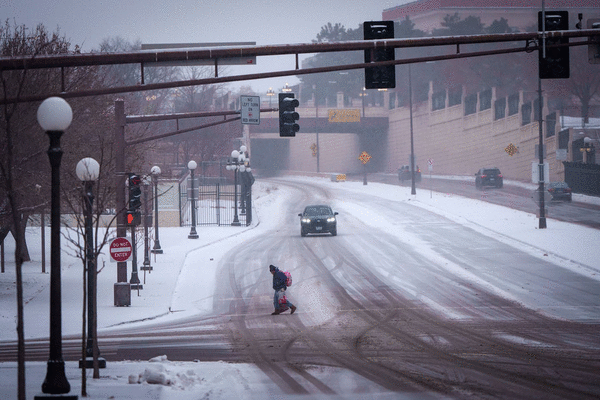
Blizzards, wildfires and thunderstorms swirling toward the eastern U.S. have knocked out power to thousands and grounded hundreds of flights across the Midwest.
Heavy snow touched off blizzard warnings from South Dakota to Michigan’s Upper Peninsula on Sunday, the National Weather Service said. Meanwhile, high winds are shaking power lines and tree branches from Texas to upstate New York, while raising the wildfire risk across the Great Plains.
Nebraska Governor Jim Pillen has declared an emergency and mobilized the state’s National Guard to help. Wildfires have prompted evacuations and scorched more than 500,000 acres.
The risk of severe thunderstorms, tornadoes and hail will spread on Sunday from the central Mississippi Valley to the Mid-Atlantic, including the Washington, D.C., and Richmond, Virginia, areas on Monday, the U.S. Storm Prediction Center said. The worst may arrive on the evening commute.
Tornado watches have been posted Sunday from southern Illinois to eastern Texas.
“All of a sudden, Mother Nature is having a fit,” said Bob Oravec, a senior branch forecaster at the U.S. Weather Prediction Center.
The wild weather has had widespread effects on transportation and power supplies across the Midwest, and the heavy snow and cold are forecast to push into areas that depend heavily on natural gas for heating, raising fuel demand days before the official arrival of astronomical spring.
As of 3:50 p.m. New York time, 2,114 flights into and around the U.S. had been canceled through Monday, mostly in Minneapolis and Chicago, according to FlightAware. More than 290,000 homes and businesses across the U.S. were without power, notably in Ohio and Pennsylvania, PowerOutage.com said.
High winds Sunday will only make that worse, Oravec added. In addition to the fire threat in Nebraska, governors Tim Walz and Tony Evers of Minnesota and Wisconsin, respectively, have declared emergencies as snow piles up. In Michigan, Governor Gretchen Whitmer activated the state’s emergency operation center.
As much as 23 inches has fallen in parts of Montana, 21 inches in Wisconsin and 20 in Minnesota, said David Roth, a senior branch forecaster at the U.S. Weather Prediction Center. Minneapolis has declared a snow emergency.
“When you start getting near two feet that is abnormal for the Midwest and upper Great Plains,” Roth said. Those depths need moisture being pulled up from the Gulf of Mexico to feed into the cold air descending south and that is what is happening with this storm.
On top of the heavy snow, winds may gust up to 60 miles per hour.
“Travel could be very difficult to impossible.” the weather service said. “The hazardous conditions will impact the Monday morning commute.”
Michigan’s Upper Peninsula has already seen almost 21 feet of snow this season, Oravec said, “I don’t know when it’s going to ever melt.”
Chicago will be spared the worst, seeing mostly rain and the potential for possibly 1 inch of snow overnight. However, the city will be shaken by high winds late Sunday. Across the border, orange winter storm warnings have been posted across parts of Ontario and Quebec, where as much as 20 inches of snow may fall and gusts are forecast to reach 50 mph in places, according to Environment and Climate Change Canada.
Sweltering west
While the Midwest shivers, the U.S. West faces record-breaking heat and the island state of Hawaii has been hit with heavy rains and flooding. Through next Saturday, 444 daily high temperature records may be broken or threatened, mainly west of the Mississippi. The highest concentration is in California and the Southwest, where an extreme heat watch is in place.
Downtown Los Angeles is forecast to reach 101F on Tuesday.
In Hawaii, more than 48,000 homes and businesses were without power, according to PowerOutage.com. Schools, state and local offices were closed across the state Friday and many roads have been closed by floods. In 24 hours, 1 to 2 feet of rain has fallen across the Big Island, Roth said.
Oravec said the worst of the storm is winding down, yet the state will remain stuck in a deep plume of moisture that will bring more heavy rain through the week.
“It’s amazing how active it’s going to be across the U.S. for the next few days,” he said.
_____
(With assistance from Isis Almeida.)
_____
©2026 Bloomberg L.P. Visit bloomberg.com. Distributed by Tribune Content Agency, LLC.






Comments