Homeless deaths are dropping. This group is part of the reason why
Published in News & Features
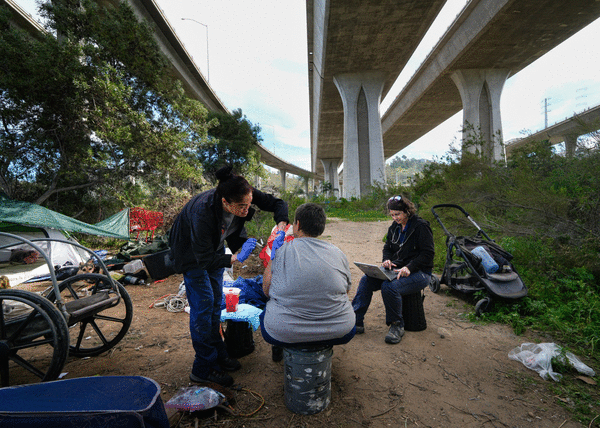
It takes 20 minutes to find out if you have HIV.
On a Monday in March, Dulce Delgado, a 37-year-old woman living in a tent on a hill, held out her hand. Prizma Mercado, a member of a roving medical team called Healthcare in Action, pricked a finger. Blood welled up on the skin and Mercado dropped a small amount onto a test strip.
The timer began counting down.
Last year, homeless people in San Diego County died while suffering from HIV, hypothermia, undernourishment, sleep apnea and pneumonia, according to data from the Medical Examiner’s Office. Leukemia killed a 58-year-old man in Encinitas. On the same day, a 37-year-old woman’s brain hemorrhaged as a result of preeclampsia, a complication of pregnancy.
None of those cases involved drugs or alcohol.
In total, at least 375 homeless people died countywide in 2025, records show. That number is an almost certain undercount as the medical examiner generally only investigates those who die outside. Deaths in hospitals are harder to track.
Yet the total still marks the second straight year that homeless fatalities have declined. The last time the county saw fewer than 400 annual deaths was near the start of the pandemic.
Healthcare in Action is one of several groups working to further reduce that toll. Teams from the Long Beach-based nonprofit spend five days a week driving around San Diego, looking for current and potential patients. You never know what emergencies might be averted by meeting people where they live.
The Monday of the HIV test began with Mercado climbing into the driver’s seat of a van and pulling out of a Mission Valley parking lot. Next to her was a nurse practitioner named Lisa Silvestro, who spent part of the drive calling patients. “Can you send me a photo?” Silvestro asked one person. “If I see a picture of your nose I might be able to see what’s going on.”
The pair had a general idea of who they hoped to find, but there were no guarantees. The combination of packed shelters and encampment sweeps has led some homeless residents to hide in isolated areas. And because phones are often lost or stolen, Silvestro is constantly writing down her own number — on a hat, under a bridge — in the hopes that people call.
While on Interstate 805, Silvestro looked out the window and spotted a tarp under a pepper tree. “We might have found our patients!” she exclaimed.
They exited the highway and parked on top of a hill. Mercado, a clinical support partner, walked to the hill’s edge and peered down. There was no path to walk on. They tried a second spot. Still too steep.
The pair circled back to the interstate, drove off the road and parked on some dirt. Trucks whizzed by as they loaded up a tote bag with supplies.
When they got near the campsite, Delgado, the 37-year-old, stepped out from underneath the tarp. Silvestro raised her hands in triumph. This was who she was looking for. Delgado was due for two shots of Yeztugo, a medication that can prevent recipients from contracting HIV, but it only works if the virus isn’t already inside the body. Thus, the finger prick.
While they waited for the 20 minutes to pass, Silvestro checked Delgado’s blood pressure and examined a swollen ankle. A fuzzy caterpillar climbed onto the Yeztugo box. Silvestro flicked it off.
The timer ended. Silvestro looked at the test strip. No HIV.
The team walked into a tent to administer the shots. Delgado lay down on a mattress and lifted up her sweatshirt. The medicine would be injected into her stomach.
Starla, a young boxer that had been excitedly jumping on the visitors, seemed to sense that something serious was happening. As the needles slid in, the puppy, its tail unmoving, climbed onto the bed and squeezed in next to Delgado.
Experts have credited the drop in homeless deaths with a variety of factors. Some are hopeful, including the fact that the unsheltered population may similarly be shrinking. Others remain dispiriting: Many of the region’s most vulnerable have already died.
The mass distribution of naloxone, an opioid-overdose-reversing nasal spray commonly known by the brand name Narcan, is a significant element. Drugs continue to kill hundreds of people a year — more than half of the homeless deaths in 2025 involved fentanyl, methamphetamines or other substances — but countless overdoses have been stopped.
The Healthcare in Action team carries naloxone, and some of their patients discussed recent drug or alcohol use. (When Silvestro asked one person if he had smoked anything lately, the man responded, “I’m gonna plead the fourth because I drank the fifth.”) Many of their conversations, however, were about other issues. Shingles, diabetes, a warped ankle.
Addressing those problems early can save vast amounts of money. More than a decade ago, Santa Clara County in Northern California figured out that the biggest expense accompanying a large homeless population wasn’t a social service or police patrol, but health care. Those costs, which included emergency room visits and hospital stays, annually added up to more than $275 million.
Late in the morning, Mercado and Silvestro pulled up to a motel in Mid-City. A large man with a graying goatee climbed inside the van. He had several ailments to discuss, yet the biggest complaint was his foot. The man believed he had stepped on something that was now lodged in his skin and wanted the team to dig it out.
Silvestro crouched down to take a look. After a few moments she murmured, “I’m not convinced there’s something in there.”
They numbed the man’s foot and leaned in closer. “I think it’s a wart,” Silvestro said. “I can’t get rid of a wart.” She offered to refer the man to a doctor who could.
“You do realize that you’ve given me a shot,” the man remarked, “and I can easily walk upstairs, and not feel this, and cut this open and get it done myself.”
“Well,” Silvestro said, “I wouldn’t want you to do that —.”
“OK, well, since you don’t want me to, and I think that you may have a steadier hand …”
The negotiation continued. The team searched the van’s shelves for a tool that might let them dig into skin without creating a large wound. Watching this, the man pulled out a knife with a 3-inch blade. “You need a knife?”
They did not need a knife. Silvestro finally found a curette, a tiny surgical instrument with a metal circle on top. One side was sharp, and she began scraping it carefully over the man’s foot, the work illuminated by Mercado’s phone light. Dead skin fell through the air.
“Yup, right, right, yup, right up in there,” the man said.
“Do you see something?” Silvestro asked. Mercado shook her head. “There’s nothing there to pull out!”
They kept scraping. Minutes passed. Then, without warning, a piece of metal as thin as a human hair emerged from his foot. The team pulled it out and dropped the shard into a tray.
_____
©2026 The San Diego Union-Tribune. Visit sandiegouniontribune.com. Distributed by Tribune Content Agency, LLC.






Comments