Trump weighs several options to tame surging gasoline prices
Published in News & Features
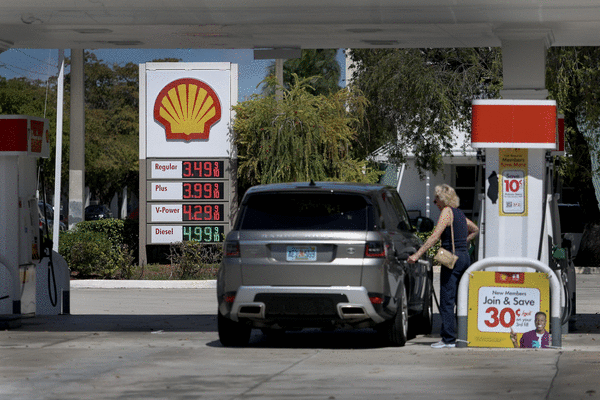
WASHINGTON — President Donald Trump is mulling a menu of possible options to combat surging oil and gasoline prices in the wake of the Iran war, according to people familiar with the matter.
The deliberations come as crude soared past $100 per barrel at one stage on Monday before erasing its gains in volatile trading. Average U.S. retail gasoline prices rose to their highest since August 2024.
Measures discussed by Trump administration officials in recent days include the release of emergency stockpiles, a halt to the collection of the federal gas tax and the U.S. Treasury Department’s involvement in the oil futures market, said the people, who requested anonymity to detail private conversations.
The tax pause would require approval of Congress, something that former President Joe Biden was unsuccessful in obtaining in 2022. Questions remain about the effectiveness and mechanics of oil futures trading by the Treasury Department.
“The White House is in constant coordination with the relevant agencies on this important issue, as it is a top priority to the President,” White House spokeswoman Taylor Rogers said in a statement. “President Trump and his entire energy team have had a strong game plan to keep the energy markets stable well before Operation Epic Fury began, and they will continue to review all credible options.”
The Strait of Hormuz, through which roughly a fifth of the world’s oil normally transits, remains virtually at a standstill due to the conflict. The global benchmark for crude surged toward $120 a barrel at one point Monday, up more than 60% since the Iran war began. Brent crude later pared its gains as the world’s largest economies considered a coordinated release of emergency oil stockpiles.
The president insisted earlier on Monday in an interview with the New York Post that that he had a plan to address concerns over energy costs, without providing additional details. He also told CBS the Strait of Hormuz was seeing more ship traffic and that he’s “thinking about taking it over.”
The White House has weighed tapping into the nation’s emergency supply of oil, known as the U.S. Strategic Petroleum Reserve. The emergency stockpile was created in the 1970s after the Arab oil embargo. Currently, it’s roughly 60% full, with 415 million barrels of crude.
Such a drawdown could be coordinated with other nations. Group of Seven ministers said Monday they’re prepared to release oil stocks if needed, but that they were “not there yet.” The U.S. stance is a joint release of up to 400 million barrels, CNBC reported.
“We will continue to closely monitor the situation and developments in the energy markets and will meet as needed to exchange information and to co-ordinate within the G-7 and with international partners,” the group said in a statement. “We stand ready to take necessary measures, including to support global supply of energy such as stockpile release.”
That statement seemed to calm markets. Trump officials have previously downplayed the idea of a U.S. release.
Republicans heavily criticized previous drawdowns under then-President Biden, including the sale of 180 million barrels in an attempt to bring down gasoline prices following Russia’s 2022 invasion of Ukraine.
Still, analysts say the effect of any release, even if coordinated with nations that belong to the International Energy Agency, could be limited depending on the duration of the conflict in the Mideast and disruption to the Strait of Hormuz. Another obstacle is simply the rate at which oil could flow from the reserve.
Other potential alternatives for Trump include calling for a halt to the collection of the federal gas tax, which is 18.4 cents per gallon for gas and 24.3 cents per gallon for diesel.
While such a move would lower consumers’ costs at the pump, it could slash billions of dollars from the government’s main fund used to pay for roads, bridges and public transit.
One option Trump apparently has ruled out — for now — is seizing Iran’s oil. The president told NBC News on Monday that while “certainly people have talked about it,” it was too soon to discuss such a measure.
There may be creative options on the table to mitigate price spikes, but none can offset a 20% hit to supply, said Bob McNally, president of consultant Rapidan Energy Group.
“No policy instrument I’m familiar with will come remotely close to that,” he said. “There’s no substitute for a resumption of Hormuz traffic — period, end of story.”
_____
©2026 Bloomberg L.P. Visit bloomberg.com. Distributed by Tribune Content Agency, LLC.






Comments