US is less prone to oil price shocks than in past decades
Published in News & Features
Oil is a global market, so when prices rise in one place, they rise everywhere. The current war against Iran has already raised oil prices significantly.
Mideast oil production has been slowed by efforts to close the Strait of Hormuz, a key route for oil tankers from the Middle East to the rest of the world, as well as by attacks – and fears of attacks – on oil production, storage and shipment installations.
And this war has also disrupted the flow of liquefied natural gas from Qatar, which controls almost 20% of the global market. That also affects the world economy and supply chains. And shortages of natural gas affect production of fertilizer and aluminium, as well as other key materials.
As a professor who has been studying oil price shocks for two decades, I’m often asked about the effects of rising oil prices on the U.S. economy. The answer to that question has changed over the past two decades.
Countries that import much of their oil have to pay other countries for that imported oil.
That was a problem for the U.S. back in the 1970s through the early 2000s. The U.S. sent billions of dollars a year abroad to oil-producing countries in the Middle East, Africa and Latin America. That money built up other countries’ economies or sloshed around as financial surpluses that fueled financial market exuberance and asset bubbles that could suddenly pop.
Oil imports increased the U.S. trade deficit in the 1970s and beyond. And as a result, U.S. industries suffered from high energy costs, which forced closures of major U.S. steel plants and iron and copper mines. Falling purchases of cars and other durable goods also stimulated worker layoffs.
Now, however, the United States is a major producer and exporter of oil and refined petroleum products. Every day, on average, the U.S. exports over 6 million barrels of refined products and over 4 million barrels of crude oil.
The U.S. does still import some crude oil, most of which is heavy oil from Canada handled at certain American refineries on the U.S. Gulf Coast. Factoring in those imports, net U.S. oil trade balance is a positive 2.8 million barrels per day, as contrasted with the mid-2000s, when the balance was a deficit of 12 million barrels per day.
U.S. production comes from 32 states – though mainly from the biggest producers: Texas, New Mexico, North Dakota, Alaska, Oklahoma and Colorado. Because that revenue comes to companies in the U.S., the nation’s gross domestic product is less vulnerable to oil price increases than in the past, when high prices meant more U.S. dollars flowing overseas.
In addition to being less dependent on imports, the U.S. economy is much less oil-intensive than it used to be, producing more economic value with far less oil use today than in the past.
And researchers at the U.S. Federal Reserve report that gasoline prices haven’t been a major contributor to U.S. inflation in recent years. That’s because there are lots of ways Americans use less gasoline, including telecommuting and remote work, online shopping and using electric vehicles and delivery trucks that run on batteries or other fuels.
Still, other economists disagree and say current oil prices, which are above $100 a barrel, could increase current U.S. inflation rates by as much as 1 percentage point.
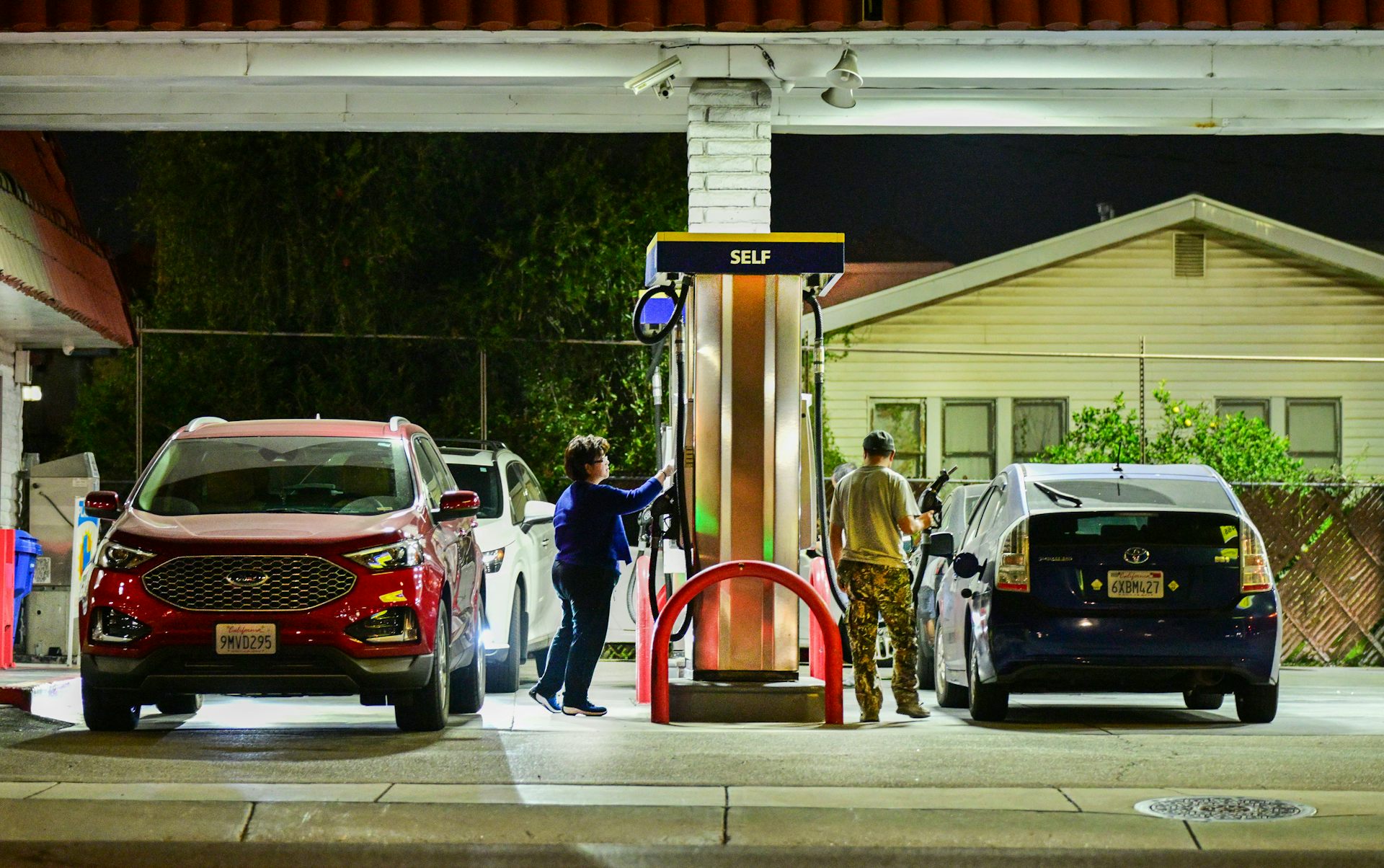
Though the U.S. is economically less vulnerable to oil-price shocks, there is also a psychological factor. It’s hard not to feel pessimistic when gasoline prices at the local pump are already rising: Bulk market prices are already soaring amid hedging trades and speculative fervor among traders and wholesalers and on U.S. commodity futures markets.
Americans feel pessimistic about consumer spending when gasoline prices are rising. And a study found that high gas prices even make people feel unhappy.
Research also shows that people tend to put off major durable goods purchases, such as automobiles, when oil prices rise sharply. That could mean bad news for the U.S. auto industry.
But it is also possible that high gasoline prices might encourage more Americans to consider buying electric cars. That could help the car companies that were having difficulty moving their electric-vehicle inventories. And for people who own electric vehicles, the war and its resulting price increases can be a reminder of the benefits of living gasoline-free.
More broadly, the war might be yet another reminder of the benefits of diversifying energy sources away from fossil fuels. As my research shows, oil price shocks generally lead to greater investment in clean technologies.
This article is republished from The Conversation, a nonprofit, independent news organization bringing you facts and trustworthy analysis to help you make sense of our complex world. It was written by: Amy Myers Jaffe, New York University; Tufts University
Read more:
War in Middle East brings uncertainty and higher energy costs to already weakening US economy
Rising oil prices, surging inflation: The Arab embargo 50 years ago weaponized oil to inflict economic trauma
Why unlocking Venezuelan oil won’t mean much for US energy prices
Amy Myers Jaffe does not work for, consult, own shares in or receive funding from any company or organization that would benefit from this article, and has disclosed no relevant affiliations beyond their academic appointment.







Comments