US, Israel start attacks on Iran in war that engulfs region
Published in News & Features
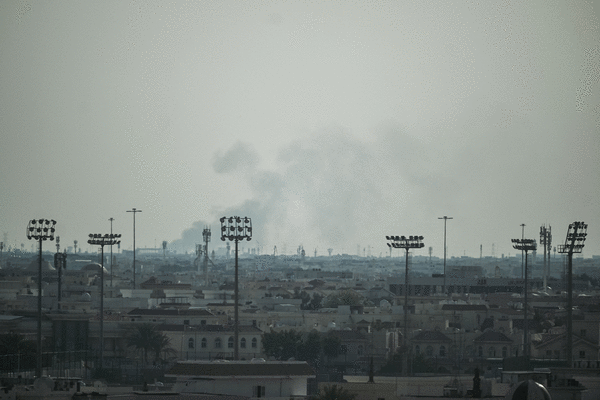
The U.S. and Israel struck hundreds of targets in Iran, with President Donald Trump urging Iranians to overthrow the government in a conflict that’s spiraling across the oil-rich Middle East and disrupting tanker traffic around the Hormuz shipping strait.
The two allies began the assault on Saturday with the aim of “eliminating imminent threats from the Iranian regime,” Trump said in a video posted on his Truth Social platform. “When we’re finished, take over your government,” he added, addressing Iranians directly. “It will be yours to take. This will be probably your only chance for generations.”
The military campaign could be a defining moment for Trump, risking a drawn-out regional war that leads to a surge in energy prices and U.S. casualties ahead of midterm elections in November. Iran quickly responded by firing missiles on Israel, U.S. military bases and Persian Gulf countries including the financial hub of Dubai. Countries around the region closed their airspace.
Saudi Arabia, Qatar, the United Arab Emirates, Kuwait and Bahrain — all of which host U.S. troops — reported Iranian attacks, most of which they seemed to repel. Saudi Arabia said it intercepted Iranian missiles over its capital, Riyadh, and the eastern region, where most of the kingdom’s oil fields are located.
Israel’s military said its fighter jets targeted “approximately 500 objectives,” including aerial defenses and missile launchers, severely degrading Iran’s offensive capability.
U.S. forces successfully defended against hundreds of Iranian missile and drone attacks, Central Command said in a statement, adding that there were no reports of U.S. casualties or combat-related injuries.
Targets included Islamic Revolutionary Guard Corps command and control facilities, Iranian air defenses, missile and drone launch sites and military airfields in a campaign that included the first combat use of “low-cost one-way attack drones,” according to CENTCOM.
Iranian media reported strikes on defensive and civilian sites, including one that killed 64 people at a school in Hormozgan. Several large explosions were reported in the capital, Tehran. Iranian television reported 201 people were killed and 747 injured in the strikes.
Risks to global energy markets came into focus as oil and gas tankers increasingly avoided the Strait of Hormuz, which links the Persian Gulf to the open seas. Iran’s semi-official Tasnim news agency, describing the waterway as effectively shut, said Iran’s Revolutionary Guard warned ships that transiting Hormuz isn’t safe.
Iran’s response outweighed its retaliation to Israeli airstrikes in June — both in scale and speed — as Tehran treats the conflict as an existential threat to the government born out of the Islamic Revolution in 1979.
Foreign Minister Abbas Araghchi held calls with counterparts in Saudi Arabia, the UAE, Qatar, Kuwait, Bahrain and Iraq, according to a ministry statement, urging them to prevent the U.S. and Israel from using their territory to attack the Islamic Republic.
The prospect of a weekslong, regional war is a nightmare scenario for U.S. allies in the Gulf such as the UAE, Saudi Arabia and Qatar. They pushed hard for Iran and the U.S. to agree a diplomatic solution to their impasse over Tehran’s nuclear activities, fearing the chaos and flight shutdowns now unfolding could hit their economies and deter tourists as well as foreign investment.
UAE President Mohamed bin Zayed and Saudi Arabia’s Crown Prince Mohammed bin Salman spoke by phone, the UAE’s state-run WAM news agency said, putting aside a bitter feud to discuss the situation.
Amid the possibility of strikes due to a U.S. military buildup in the Middle East, oil has gained almost 20% this year. Brent crude increased 2.5% to $72.48 per barrel on Friday, the highest closing price since July. Oil markets are closed for the weekend.
Trump said the military operation began after Iran refused to renounce nuclear weapons, which Tehran has repeatedly said it isn’t pursuing.
The U.S. aims to destroy the Islamic Republic’s missile inventory and industry as well as its navy, the president said. The Associated Press said at least one strike took place near the office of Iran’s supreme leader, Ali Khamenei. An Israeli military official, speaking on condition of anonymity, said Iranian officials and their military capabilities are the focus of the campaign, declining to comment on whether Khamenei or President Masoud Pezeshkian are targets.
The official cited a sharp acceleration in Iran’s missile production and fortification of nuclear sites as a reason for the renewed attack.
“My administration has taken every possible step to minimize the risk to U.S. personnel in the region,” Trump said. “Even so, and I do not make this statement lightly, the Iranian regime seeks to kill. The lives of courageous American heroes may be lost and we may have casualties. That often happens in war, but we’re doing this not for now, we’re doing this for the future.”
The attacks came two days after delegations from Iran and the U.S. met in Switzerland for a third round of negotiations on the Islamic Republic’s nuclear activities. While Iran sounded upbeat about the trajectory of the talks, Trump responded by saying that he wasn’t happy with how they were unfolding.
The U.S. has in recent weeks amassed its largest military buildup in decades in the Middle East, with Trump indicating more ambitious goals than the limited strikes he ordered against Iran’s atomic installations in June of last year.
In addition to demanding that Iran give up its nuclear program, he vowed to support protesters who have faced a deadly crackdown from Iranian authorities in recent months.
U.S. officials also called on Tehran to curtail its support for proxies in the region, such as Hezbollah, as well as its missile program, which they describe as a critical threat to Israel.
Israeli Defense Minister Israel Katz declared a state of emergency as he announced Saturday’s strikes, and said the country expected to come under retaliatory drone and missile attacks. Sirens sounded throughout Israel, according to the military.
OPEC+ will consider the option of a larger oil supply increase when key members meet on Sunday, after the Israel strikes, according to a delegate. The group led by Saudi Arabia and Russia was expected to resume modest production increases from April after a three-month supply freeze, several delegates said earlier this week.
Trump on Friday downplayed concerns about the likelihood of oil prices spiking if he attacks Iran, saying, “I’m concerned about people’s lives. I’m concerned about long-term health for this country.”
———
(With assistance from Dan Williams, Galit Altstein and Julius Domoney.)
©2026 Bloomberg L.P. Visit bloomberg.com. Distributed by Tribune Content Agency, LLC.





Comments