Who are the 'hidden homeless'? In Miami-Dade, they could fill Hard Rock Stadium
Published in News & Features
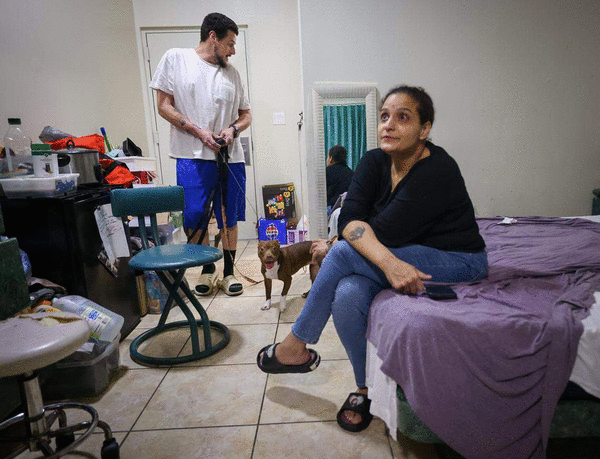
MIAMI — Going by the official count, roughly 3,500 people are experiencing homelessness in Miami-Dade on any given night. Some sleep in shelters, others on the street.
But a population nearly 20 times that size exists beyond that tally. An estimated 66,000-plus county residents are part of Miami-Dade’s “hidden homeless,” according to an analysis of U.S. Census data conducted exclusively for the Miami Herald by Molly Richard, an assistant professor of public health at the University of Rhode Island who studies homelessness. That number includes 11,000 children, according to the Florida Department of Education.
Those 66,000 people bounce around the spare bedrooms, couches and living room floors of friends, family and acquaintances. They live week-to-week or even day-to-day in extended-stay motels. Often, they’re at risk of sleeping in their car, if they have one — or on the street if they don’t. Always, they’re fighting to keep some sort of roof over their heads.
As a group, they could fill Hard Rock Stadium and then some. If incorporated as a city, they would rank as the seventh-largest in Miami-Dade, larger than North Miami and Coral Gables.
But despite not having stable homes, the U.S. Department of Housing and Urban Development does not consider them homeless, shutting them out from receiving critical assistance.
Reporter, author and anthropologist Brian Goldstone has spent years embedded with families in this shadow realm of homelessness. In his new book, “There Is No Place for Us: Working and Homeless in America” — which was a finalist for the Carnegie Medal and one of the New York Times’ and The Atlantic’s 10 best books of 2025 — he chronicles how families are pushed into homelessness and how hard it is to claw their way back out.
The Herald sat down with him recently to hear more.
Below is an edited version of an hour-long interview, which readers can listen to here:
Tell us about your book. What’s it about?
The book follows five families in Atlanta over two years, but the reporting itself went for nearly six years. It tries to immerse readers in [those families’] day-to-day lives. These are all families who are part of the low-wage workforce. One by one, each of these families are pushed into homelessness.
The book has two main arguments. What are they?
The first is that all of this insecurity we’re seeing is, paradoxically, being fueled by the very renaissance that so many cities [including Miami] are celebrating. The transformation of their urban center and the revitalization of urban space is not only pushing people out of the neighborhoods they grew up in, but increasingly, it’s pushing people out of housing altogether.
And the second big argument is that there’s this entire world of homelessness that is out of sight, that has been actively rendered invisible. Each of the families I write about in the book — they do not count. They literally don’t count when it comes to the federal homeless census.
The book tries to show how those families have come to inhabit what I refer to as a kind of shadow realm of extended-stay hotels, of sleeping in their cars, doubled up in overcrowded apartments with others. And not only are they invisible, but they’re also locked out of crucial services because they don’t fit the federal definition of homelessness, which is really limited to only those in designated homeless shelters or living on the street.
So who counts as experiencing homelessness?
A vast population fits into that category. The definition of homelessness is a contentious issue. The Department of Housing and Urban Development (HUD) has a narrow definition of homelessness. It’s those living in environments not meant for human habitation, so that would be the street, abandoned buildings, etc., or if they are in a homeless shelter.
The Department of Education has a much more expansive definition. They define homelessness as lacking a fixed, regular nighttime residence. So there are these two competing definitions. I argue in the book that before something can be counted, it first has to be defined. And one way we as a nation have managed to “reduce homelessness,” at least in the public conversation, is by defining entire segments of the total homeless population out of existence.
In your book, you say this modern homelessness crisis is one born of prosperity. What does that mean?
For many of us, there has been this intuitive assumption that homelessness and poverty go together. And of course, in a sense, that’s true. But the skyrocketing homelessness that we have seen over the last few years is not emerging out of the poorest areas of the country. It’s not emerging out of the poorest areas of our cities. It’s springing up in areas of the country that are not only the wealthiest areas, but also the most rapidly developing areas.
There’s this interplay of development and deprivation, of unbridled growth and displacement and dispossession. That tension is really at the heart of the kind of precarity we’re seeing across the country.
The single greatest variable today in which cities and which regions of the country will see the highest rates of homelessness is where there’s a growing chasm between what people are earning with their incomes and what it costs to have a place to live.
Before experiencing homelessness, all of the families you followed had stable housing — until they didn’t. What were some of the initial pushes that sent people down a path toward homelessness?
I’ll give one example, Maurice and Natalia, a two-parent household in the book, they and their three children end up losing their housing for a really mundane reason — because their landlord decided that it was the perfect time to sell this investment property. Their lease was not renewed. They had lived in their home for several years. They thought they were stably housed, and all of a sudden, after they had their third child, the ground was pulled out from underneath them because their lease was not renewed. Losing your home because your landlord decided that it was the perfect time to sell even though they were ideal tenants, they’d never been late on their rent. That was the initial domino that fell in their story. It’s really mundane.
In another story, Cara, a single parent, loses her apartment when her landlord refuses to fix her hot water heater. Unable to bathe herself or her children properly for weeks, she refuses to pay rent, so she ends up getting evicted. That was the initial push for her.
What does an eviction do to someone and their future prospects of securing housing?
It puts a scarlet E on that person for years. In many cases, it destroys one’s prospect for renting another apartment. A landlord, faced with two prospective tenants, one with an eviction on their record, one without, is very unlikely to rent to the person with the eviction on the record.
It also completely tanks your credit score, this three-digit number that has really come to determine whether millions of people in our country have access to something as fundamental as a place to live.
When your credit score drops below a certain threshold, you join what might be described as America’s “credit underclass.” At that point, you are, for all intents and purposes, locked out of the formal housing market and are forced to try to survive in the informal housing market.
And that overwhelmingly takes the form of an extended-stay hotel or motel, where no credit checks are conducted. The only requirement is cash up front, and a lot of it. People end up in these tiny extended-stay hotel rooms — they’re spending double what they were spending on the three-bedroom apartment they had lost.
What are those hotels like?
The hotel where I spent the bulk of my time is a place called Efficiency Lodge.
There’s not a blade of grass on the entire property. It’s just this concrete expanse. And the rooms are all manner of abysmal conditions. I’m talking about leaking ceilings, where water is coming through from the room above and rooms get flooded. Rodents. Electrical outlets where when you plug something in, you get a bad shock. Roaches. Black mold.
Children are living in these environments. They are exposed to what public health researchers refer to as “toxic stress.” This is stress that’s so chronic and debilitating that it can fundamentally alter their long-term development and brain chemistry.
They are exposed in these hotels to violence. Just in the span that I was embedded at this hotel as a reporter, there were shootings. One man was intentionally run over in the parking lot and died. A woman next door to one of the families I was interviewing was beaten by her boyfriend and ended up miscarrying her baby.
Open drug dealing, sex trafficking, but also the precariousness, the insecurity of not knowing, will we be able to stay here another night? Because unlike a traditional apartment, where, if you miss rent, you have a chance to pay it up, at these hotels, you could just be locked out at a moment’s notice, and your possessions could be locked inside the room, and you’re forced to find another place to live. Children are living with uncertainty — will I even be able to stay here another night with my mom and dad? And the kind of anxiety and stress that that creates really can’t be overstated.
Once locked out, some of the people in your book moved in with extended family or friends. What was that like?
I saw up close just how volatile it can be to live in an overcrowded apartment, where the people who are on the lease, the people allowing you to stay there, resent your presence. In many cases, there’s this tension in the air because they realize that they themselves are risking losing their housing by having others stay with them.
Experts on family homelessness have been at pains to show over the last several years that all of these circumstances, the hotels, the cars, doubled up with others, can be just as detrimental to people’s mental and physical health as being on the street.
But those who aren’t on the street often don’t qualify for homeless assistance services?
Yeah. I’ve come to think that the only thing worse than being homeless in this country is not earning the designation “homeless” because at that point you inhabit this kind of purgatory, where you are homeless and yet you have been systematically locked out of essential services and resources.
When the families [in the book] who are living at Efficiency Lodge become desperate enough to try to get services, they discover that because they are not literally on the street or in a shelter, they don’t qualify for services like rental assistance or help finding a landlord who will rent to them despite their low credit score.
But we have housing assistance programs — vouchers to subsidize the cost of their rent — that should theoretically help people in this situation.
One problem is that the vouchers are not funded at the scale of the need. They’re not an entitlement, like food stamps or Medicaid, where, if you just fit the requirements, you automatically receive one. Just 25% of all people who qualify for housing vouchers actually receive them.
The second is that we’ve left it up to landlords to decide when they will accept these vouchers. In hot rental markets, there isn’t a financial incentive to rent to a voucher holder because landlords can’t jack up rents at will. If they don’t accept the voucher, they don’t have to go through the bureaucratic red tape and the inspections that vouchers involve.
So even people who win the housing lottery and then finally receive a voucher often end up losing it because no landlord will rent to them, and they expire [typically after 60 days], as happens to one family in the book.
This is just a mammoth problem with this model of looking to the private market to take care of people’s housing needs.
How do you feel the private market — and the commodification of housing more generally — factors into the experiences you witnessed when reporting this book?
There’s the famous James Baldwin quote about how extremely expensive it is to be poor in America. I think a lot of what my book tries to demonstrate is the flip side of that equation. How extremely lucrative all of this insecurity has become. How much money is being made, not only off of people’s desperation, but how much is invested in exacerbating that desperation and really limiting the supply of affordable housing in this country.
Nowhere is that more true than in Wall Street firms, private equity firms, trying to just gobble up much of the nation’s housing.
Research has shown us that when private equity gets involved in rental housing, it becomes more likely that someone will be evicted, because now it’s shareholders who are the main priority, not the tenant themselves, so we see much higher eviction rates.
They’re also buying up the places where people are forced to go once they lose their housing. Maurice and Natalia, they end up at Extended Stay America, one of the largest chains of extended-stay hotels in the country. While they’re living there, they spend $17,000 in the span of eight months on their studio-sized hotel room, where they’re living with their three kids.
Blackstone and Starwood Capital, two private equity giants, actually bought Extended Stay America while Maurice and Natalia were living there for $6 billion. So homelessness has become big business.
But I want to say that private equity firms and Wall Street investors play a relatively small role in the private rental market. More fundamentally, housing is treated as a vehicle for accumulating wealth. And that is as true for smaller property owners, or owners who might buy four or five properties and turn them into Airbnbs, as it is for these big Wall Street firms.
How do we keep people from being pushed out of their homes and into homelessness?
It not only makes good fiscal sense to design policy around early interventions, but it’s also the morally right thing to do because of all the ensuing suffering that is prevented.
It’s so much cheaper to give someone direct, short-term cash assistance to keep them in their apartment. That kind of intervention could be so important.
Also, having habitability standards and enforcing those standards can keep people in their homes. So can cracking down on “retaliatory evictions,” where someone reports a landlord to the authorities for unsafe conditions or health hazards, and the landlord turns around and evicts the tenant.
And rent stabilization laws. I know those are controversial, but why should people’s rents go up so far beyond the rate of inflation, beyond the rising cost of property taxes and insurance, when the conditions in the apartments themselves aren’t necessarily improving? The term for that is price gouging. It’s taking advantage of people’s desperation.
Reporting your book was probably emotionally taxing. What gives you hope?
It’s easy to despair. It’s easy to see the true scale of this crisis and feel very little hope. But Washington is not the final word on whether we will become the kinds of cities where people no longer have to say “there is no place for us.” Cities like Seattle, which recently voted to fund a social housing developer, are choosing differently, and that gives me hope.
It gives me hope that people are showing up to their city council meetings demanding that people’s ability to have a home not be put above “the character of the neighborhood” or protecting property values, that it’s OK to build an affordable housing development down the street, because these are our neighbors and this is the kind of city that we want to be.
And tenants are coming together across the country in a way not unlike an earlier generation of workers, who came together to form unions and take matters into their own hands. Tenants are forming tenant unions across the country.
There’s so much happening around the country that should give us hope.
©2026 Miami Herald. Visit at miamiherald.com. Distributed by Tribune Content Agency, LLC.





Comments