DFLers, Annunciation families call for gun control in Minnesota, but prospects still dim
Published in News & Features


ST. PAUL, Minn. — Minnesota Gov. Tim Walz and Democratic-Farmer-Labor lawmakers continue their push for new gun control legislation in the wake of the Annunciation Catholic School shooting in Minneapolis, though without the support of rural DFLers and at least one Republican, the path forward remains unclear.
That hasn’t stopped the governor from promoting a “gun violence prevention package” that includes a ban on so-called assault weapons, new magazine capacity limits, a firearms insurance requirement and new spending on school safety and mental health resources. Assault weapons are generally described as weapons originally designed for military or police use with a large ammunition capacity.
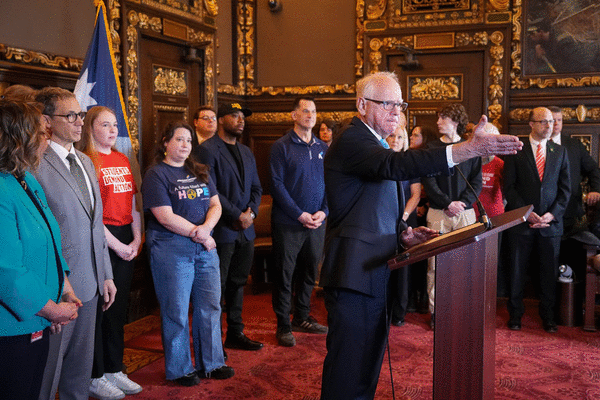
Walz presented the slate of legislation at a Tuesday news conference at the state Capitol, where he was joined by DFL lawmakers, gun control proponents and a survivor of the Aug. 27 shooting in the Annunciation school church, which took the lives of two young children and injured more than 20 others.
“This is a time for bipartisan action around an issue that tore at the heart and continues to and we owe it to the Annunciation families not to have that just be another statistic,” said Walz, who unsuccessfully pushed for a special session on guns last fall. “That was the final straw. That was it. I pushed and pushed and pushed and we couldn’t even get legislators to have a hearing. Well, those days are over. Some of these folks in here are going to be testifying today.”
Annunciation student calls for action
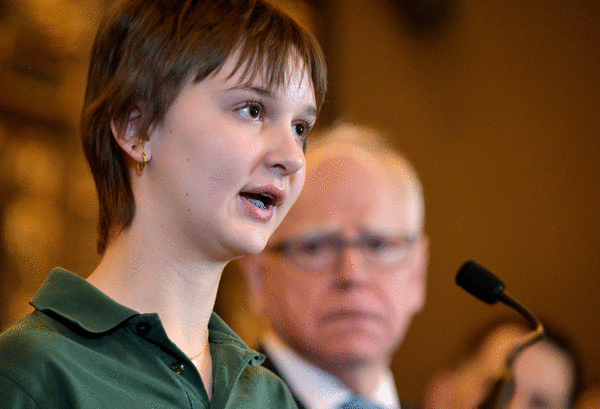
Among those speaking in favor of gun legislation at the Capitol on Tuesday was Lydia Kaiser, an eighth grader at Annunciation who survived a gunshot to the head while trying to protect a younger student with her body.
Kaiser had to undergo surgery to remove bullet and bone fragments from her head and spent more than a month recovering in the hospital. Speaking at a morning news conference ahead of afternoon House hearings on DFL-backed gun control bills, she called on lawmakers to take action.
“All children have the right to live free from gun violence in schools, churches and in our communities,” she said. “Elected officials have a duty to protect us from guns. No one should have to go through what we went through.”
Kaiser and others affected by the shooting gathered at the Capitol to pressure lawmakers to change state gun policies. Outside the Capitol, they set up 60 empty school desks to represent 200 Minnesota children who died from gun violence since 2021.
Prospects for additional gun control measures
Prospects for gun control measures remain dim in the closely divided Minnesota Legislature, where bills need bipartisan support to pass.
There are 67 Democratic-Farmer-Labor and 67 Republican representatives in the House. And while the Democrats have a one-seat majority in the Senate, some members from rural districts have been hesitant to back new gun laws.
After last summer’s violence, Walz, DFL and Republican lawmakers spent more than a month negotiating terms for a special session on guns. Walz at one point said there’d be a special session on guns “one way or another,” but by October, it was apparent that closed-door negotiations were not delivering results.
Walz then held town hall meetings promoting gun control policies in Republican legislative districts and in December issued executive orders aimed at educating the public on existing state gun policies and laying the groundwork for future gun control legislation by creating a gun violence prevention research council.
Republicans remained opposed to new restrictions
Neither made any immediate changes to state gun control policy and came after months of frustration for the governor.
Republicans have remained opposed to new restrictions on guns and have backed funding boosts for school security and mental health services. Those proposals are part of the governor’s overall gun violence prevention package.
“We’re glad the Governor finally acknowledges that addressing mental health, early intervention, and making our schools safe for students will help prevent violence, and we look forward to working together on bills that keep people safe and protect our constitutional rights,” Republican House Speaker Lisa Demuth and House GOP Floor Leader Harry Niska said in a joint statement responding to the proposal.
Walz said he also believed he might get Republican support on a bill restricting so-called ghost guns — privately made firearms without serial numbers that can be difficult to trace to a crime.
But past the mental health measures and possible support for a ghost gun ban, there’s little indication of bipartisan appetite for restrictions on assault weapons.
Walz: New laws needed to address semiautomatic weapons
Walz previously described mental health and school safety measures as a distraction from what he called the central problem: that the wide availability of semiautomatic weapons with features like pistol grips and detachable magazines is the main cause of high-casualty spree shootings in the U.S.
DFLers failed to pass an assault weapons ban when they controlled state government from 2023 to 2025.
But they enacted new laws, including universal background checks for gun sales and a so-called red flag law allowing a court to order people to give up guns if they’re deemed a danger to themselves or others.
None of those laws prevented the Minneapolis school shooter, 23-year-old Robin Westman, from legally obtaining guns, as Westman didn’t have a criminal record or civil commitment that would have disqualified her from purchasing a firearm under the law.
Local gun control laws, binary triggers
Another change DFLers are hoping for is an end to a 1985 state law banning local gun control laws, something Twin Cities metro mayors called for in the fall after the Annunciation school shooting. Former St. Paul Mayor Melvin Carter and Minneapolis Mayor Jacob Frey were among several mayors who gathered at the Capitol in September, calling for the change. However, like other gun-control-related policies, it does not appear to have the support needed to pass.
Walz also is calling for the Legislature to repass a ban on binary triggers, modifications for semiautomatic rifles that fire a shot when the trigger is pulled and again while released, greatly boosting the weapon’s rate of fire.
Minnesota lawmakers passed a ban in 2024, but Ramsey County Judge Leonardo Castro shot it down last August, as it became law as part of a 1,400-page bill passed at the last minute of the 2024 session, violating a rule limiting bills to a single overall subject.
That was just one of several recent successful legal challenges to state gun laws by the Minnesota Gun Owners Caucus, a prominent state gun rights group.
In another August ruling, the Minnesota Supreme Court said a decades-old law banning certain guns without serial numbers didn’t apply to homemade “ghost guns” as long as federal law doesn’t require a serial number.
And, earlier this year, Minnesota’s minimum age to obtain a permit to carry a firearm dropped from 21 to 18 after the U.S. Supreme Court declined to take up the state’s appeal in a case challenging the minimum age.
Tuesday hearing
The version of the assault weapons bill before the House Public Safety Committee on Tuesday would ban the private possession of “semiautomatic military-style assault weapons” such as AR-15-pattern rifles, which have features like pistol grips and folding stocks.
Current owners would be able to keep semiautomatic weapons covered by the ban, but they would be required to “safely and securely” store the device and register it with state law enforcement.
Owners would have to allow local law enforcement to inspect the storage of their weapons and renew certification of ownership with the state every three years. Registration data would be private under an amendment approved Tuesday afternoon. Weapons covered by the law would only be allowed in homes and on shooting ranges.
Bill sponsor Rep. Emma Greenman, DFL-Minneapolis, argued the bill would save lives.
“These assault weapons were designed for the military to effectively kill as many people as possible as quickly as possible on the battlefield,” she said. “There is so much we need to do to end this epidemic of gun violence, and we are doing that, and that starts with getting these weapons of war off our streets. We don’t have to live this way, and we can’t become numb to these mass shootings.”
Opponents of the ban, including the Minnesota Gun Owners Caucus, told the committee they were concerned that such a ban — and the inspection requirement — would violate gun rights guaranteed by the Constitution.
“This bill is premised entirely on the false presumption that banning something makes it go away,” said Rob Doar, president of the Minnesota Gun Owners Law Center. “The uncomfortable truth is, this bill, if it was law, would not have prevented that attack. The best way to honor victims is through symbolic isn’t through symbolic prohibition of a particular category of arms.”
_____
©2026 MediaNews Group, Inc. Visit at twincities.com. Distributed by Tribune Content Agency, LLC.





Comments