'I was never an activist': The San Diegans signing up to watch ICE
Published in News & Features
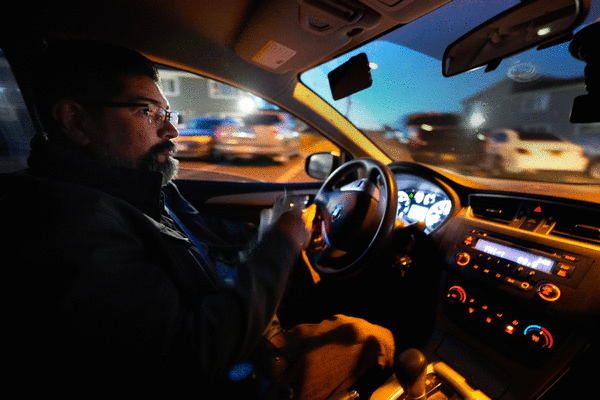
Community patrols that monitor San Diego County neighborhoods for immigration enforcement activity have seen big jumps in new members and trainees in recent months — part of a larger movement of San Diegans pushing back against immigration enforcement under the Trump administration.
Community networks dedicated to monitoring federal immigration enforcement have sprung up around the country over the last year in response to President Donald Trump’s crackdown, with interest growing not just in patrols but in mutual aid, protests and demonstrations outside of detention centers.
Hundreds of new volunteers have joined patrols around San Diego County in the last year, organizers estimate. One patrol group says its numbers of new trainees are up tenfold, with the biggest jumps in recent months.
The patrols monitor their communities for agents from Immigration and Customs Enforcement or Customs and Border Protection in the midst of a sharp rise in immigration arrests. They serve as an alert system, with patrollers trained in techniques to identify immigration enforcement vehicles and agents and observe them from a distance.
“There’s just a tremendous interest,” said Ricardo Favela, a member of Alianza Comunitaria, a North County-based, community-run patrol group. “This is one way to fight back, and it’s a proven method. It’s a trusted method. It’s training people to do this safely, to know the limits and to not intervene.”
Favela says around 20 people typically came to the group’s weekly training sessions during the first Trump administration, and fewer under President Joe Biden. But in the last year, that number has soared to 100 to 200. The new trainees either join Alianza Comunitaria’s growing network of volunteers or branch out to form their own patrols.
The groups’ growth comes as San Diego has lost its more centralized rapid response network, which was run by a coalition of local nonprofits and previously could serve as a hub for some services. That’s made community-led patrols the main way communities communicate about ICE activity.
“I was never an activist,” said Jon Bachelor, 52, who lives in Poway and is new to local patrol efforts. “I certainly cared, but I never felt like I was literally losing my democracy.”
The retired software developer joined a community patrol group a few months ago. He goes out on patrol about four times a month — a number limited, he says, by his children’s school drop-off schedule. He also attends protests around the county four or five days a week.
Bachelor says the first few months on the patrol have been calm; he hasn’t encountered any ICE agents. He’s gone to several training sessions, including through the community group Union del Barrio, which taught him how to follow agents from a distance, record arrests and connect with the family members of people who are arrested.
“I’m terrified of (ICE), but I feel like it’s crucial that we run toward them, not away from them,” he said.
Organizers say that strengthening community networks — rather than relying on larger organizations — can feel more actionable for San Diegans concerned about their immigrant neighbors and can build a deeper sense of trust within neighborhoods.
“It has to be community-led and community-driven,” said Benjamin Prado, who has been a volunteer with Union del Barrio for nearly three decades. “They should be able to respond, and be able to do it in their own neighborhoods.”
Favela says Alianza Comunitaria has more than 11,000 people signed up to get its text alerts, which go out whenever the organization confirms local immigration enforcement activity. It has also provided an avenue to communicate with neighbors, especially Spanish speakers, during other crises like wildfires.
Rapid response networks are common in other regions and provide services in the event ICE activity is seen in a community or someone is detained. San Diego’s own rapid response network, launched in 2017, operated a 24-hour hotline residents could call if ICE was in their neighborhood.
That hotline no longer operates. The rapid response network’s members — Jewish Family Service, the American Civil Liberties Union of San Diego & Imperial Counties, San Diego Organizing Project and Casa Cornelia Law Center — divided their efforts into two different partnerships last year, and the focus is now on legal services and advocacy.
Now, some community patrol organizers say they want to build up their networks in case immigration enforcement further intensifies in San Diego.
“We know that it’s there right now,” Prado said. The goal is “making sure that as many people are trained to be able to identify them, so if there is this massive surge, people are able to respond.”
From January to mid-October of last year, ICE’s San Diego field office made 4,934 arrests — more than six times the number made in all of 2024, according to agency data analyzed by The San Diego Union-Tribune. The agency’s San Diego division made more than 1,400 of those arrests in just the month of September. Community arrests accounted for about 80% of all local ICE arrests in 2025, up from roughly half the year before.
Before the crackdown, Jaidacyn Madrigal had previously been involved in environmental activism, but she just began participating in community patrols with Union del Barrio a few months ago. Like Bachelor, she says her experience so far hasn’t yielded any ICE encounters, but she’s glad to join the effort.
For some newcomers to community engagement around immigration, joining such action gives them a sense of purpose and usefulness.
“Social media has caused a lot of people to freeze … you feel already overwhelmed, and you can’t imagine adding in more to your life,” said Eva Coleman, a graduate student in geography at San Diego State University, at a recent rally against ICE in Teralta Park. “I felt frozen until I started physically talking to people.”
Activate San Diego, an East County division of Indivisible, holds weekly protests and other actions in and around El Cajon. Connie Elder, who started the group last spring, said attendance has swelled since the killing of Renee Good by ICE last month in Minneapolis; a rally one recent Saturday saw 200 people, about twice the typical turnout.
Others are meeting to support people in immigration detention. One group led by the San Diego Bike Brigade meets at the Otay Mesa Detention Center every Sunday around 1:30 p.m., when people jailed in the center get outdoor time. Some call out their alien registration number, which lets protesters deposit money into the migrants’ accounts so they can call their families or lawyers or buy food at the commissary.
When the Sunday vigil began last year, about 15 people would show up each week, said Jeane Wong, a volunteer with the San Diego Bike Brigade. Now between 150 and 400 do.
The community patrols, meanwhile, are seeing not only more volunteers but also more frequent reports and confirmed sightings of ICE activity as their ranks swell and as enforcement has ramped up.
Groups like Favela’s and Prado’s train patrollers to avoid engaging with agents. In instances when an agent approaches, a patroller typically backs away while recording the interaction, video footage posted to Union del Barrio’s YouTube page shows.
Since the trainings encourage patrollers to keep their distance from ICE, Bachelor said he was unprepared when he spotted a group of agents in North County about a month ago and started recording them from his car. He was alone — not on an organized patrol — and says the agents approached his car from three sides, leaving a path clear for him to drive away.
“For myself personally, I would get that close again,” he said. “Just because I think it’s so important to be able to document and witness and report what it is they’re doing.”
Julie Diaz-Martinez, 65, a patroller who lives in Fallbrook, completed her training last summer but stays up to date on the latest trainings. A recent one shared information on California law with regard to witnessing law enforcement activity — as well as reminders about patrollers’ ability to record it.
She also now carries two cellphones with her, in case the one she records with is confiscated, along with a backpack with a bullhorn and extra batteries.
“I realized this could, at any moment, become very, very dangerous,” she said.
Diaz-Martinez is assigned to a Wednesday morning patrol with Alianza Comunitaria, though she says there are frequent calls at all hours to check on reports of possible ICE activity.
When she joined the patrol last summer, she didn’t expect the work to be as on-call as it is — especially for a new volunteer.
She recalls watching a mother and her children stopped alongside Interstate 15; another time, she watched a man who appeared to be pleading with agents.
It’s heartbreaking not to intervene, but she says she knows that’s not her role.
“If I got involved in any way or detained in any way myself, then I could no longer serve as a voice of warning for the community,” she said.
Other San Diegans have pursued their own avenues for publicizing local enforcement. Social media activist Arturo Gonzalez uses his Instagram account to share suspected ICE sightings, and he often confronts people in vehicles he believes are agents, yelling and cursing at them with a megaphone until they drive away.
“I’m more independent — the reason being is because I’m such a powerful platform,” Gonzalez said. “I could go work with an organization, but there’s so much that I can do as one person.”
Gonzalez, 23, believes his approach can be more effective than that of groups because he’s willing to risk arrest. He says patrolling neighborhoods has become a full-time job, and he collects donations for gas money and to buy out food from street vendors.
Watching ICE solo comes with its own risks. Prado and Favela don’t encourage people interested in joining the effort to go out alone, and they stress the importance of building community networks. Members of Union del Barrio won’t approach ICE agents unless another member is there to observe the interaction, and Favela said Alianza Comunitaria encourages patrollers to go out in groups of at least two.
But Prado acknowledges it takes all kinds. “The more people going out there and exposing ICE operations in our community, the merrier.”
©2026 The San Diego Union-Tribune. Visit sandiegouniontribune.com. Distributed by Tribune Content Agency, LLC.





Comments