Pennsylvania mandates cursive writing instruction in schools
Published in News & Features
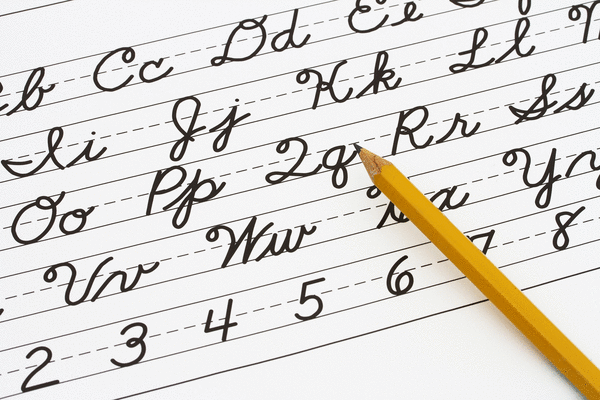
Two hundred and fifty years ago in Pennsylvania, the Declaration of Independence was written and signed in cursive.
Now, schools across the commonwealth are mandated to teach that style of handwriting.
Gov. Josh Shapiro signed into law this week a bipartisan measure that requires schools to teach K-12 students to write in cursive. While many schools have and continue to teach writing, proponents of the legislation said the practice improves students' cognitive development and connects students to American history.
"Cursive writing fosters fine motor skills, enhances memory retention and equips students to read foundational documents in their original form," said state Sen. Wayne Langerholc, R-Johnstown. "In doing so, we ensure future generations are prepared both intellectually and practically."
The law went into effect upon the governor's signing on Wednesday. According to Mycursive.com, a website devoted to teaching and learning handwriting, Pennsylvania's mandate means that more than half of the states in the U.S. require cursive as part of a school curriculum, including Ohio, West Virginia and Maryland.
The Pennsylvania Department of Education said in a statement that it was developing guidance for schools on the legislation.
"Many schools have continued to include cursive writing in their curriculum, while others will need time and support to incorporate it into their schedules," the department said. "Our priority is to provide practical assistance and clear expectations so teachers can focus on students and learning."
In the Pittsburgh Public schools, cursive is taught starting in third grade and continues into the fourth and fifth grades.
It's almost a "rite of passage" for students to be able to sign their names, said Ann Fillmore, executive director of literacy and library services for PPS.
Writing in cursive, though, is useful for a student's educational growth, she said.
"Research says that it helps students to build the cognitive development, the fine motor skills," Fillmore said. "But it's also important in terms of our reading and comprehension and making sure that the students are writing in accompaniment or in response to literature or texts."
The state House approved the law, 195-8, and the state Senate, 42-5.
State Sen. Lindsey Williams, D-West View, minority chair of the Senate education committee, said she has no problem with schools teaching cursive writing.
However, she was one of the senators to vote against the bill because she said it circumvents state academic standards that are created though a thorough process.
That process, she said, includes ample opportunity for expert testimony from educators, researchers and others in addition to providing dedicated public comment.
"As a member of the state board of education, I know how much work goes into establishing and updating Pennsylvania's academic standards," Williams said. "Once those standards are set, school districts have significant local control to figure out how to structure their course and curriculum offerings to meet those standards."
Williams called the law "piecemeal" and said she worries about what other subjects the state Legislature would attempt to address in a similar way in the future.
She noted that many schools already teach cursive, and she didn't fully understand the point of the law, adding that no constituents or residents called her office with concerns about the teaching of cursive writing.
State Rep. Dane Watro, a Republican from Eastern Pennsylvania who was the primary sponsor of the bill in the House, said the legislation strengthens civic engagement and historical literacy by ensuring that documents such as the Declaration of Independence and U.S. Constitution remain accessible for future generations.
But he also noted the practical uses of cursive writing, such as signing checks, legal papers and adding a personal touch to letters.
"More than half of U.S. states already require cursive instruction in public schools," Watro said. "They recognize that cursive gives students another way to learn, express themselves and prepare for success academically, professionally and personally."
_____
© 2026 the Pittsburgh Post-Gazette. Visit www.post-gazette.com. Distributed by Tribune Content Agency, LLC.





Comments