Minnesota loses bid to force US to preserve Pretti evidence
Published in News & Features
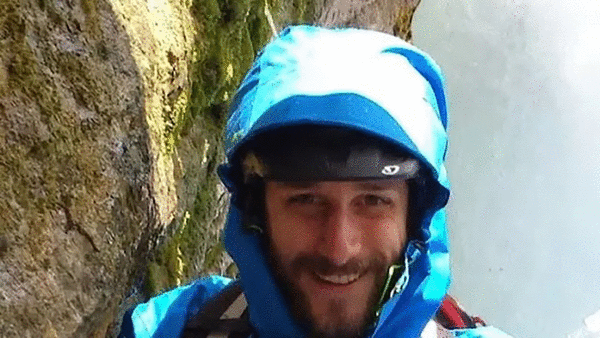
A U.S. judge declined to order the Trump administration to preserve evidence tied to the fatal shooting of Minneapolis nurse Alex Pretti by federal immigration agents, a setback for Minnesota state investigators who were initially blocked from the scene.
U.S. District Judge Eric Tostrud on Monday denied the state’s request to extend a temporary order requiring Homeland Security Secretary Kristi Noem to ensure all evidence is protected for a state investigation into the Jan. 24 shooting. The judge said there was no evidence that DHS wouldn’t preserve the evidence under its own procedures absent a court order.
“Though the record is not one-sided, the greater weight of the evidence shows defendants are not likely to destroy or improperly alter evidence related to Mr. Pretti’s shooting during the life of this case,” the judge, an appointee of President Donald Trump, said in the ruling.
The state had argued that a temporary order must remain in place because Noem and other federal officials, who have already declared the shooting was justified, would otherwise continue to allegedly “withhold, destroy, alter, or conceal” evidence.
The ruling is the latest setback for Minnesota in its clash with the federal government. On Friday, a different U.S. judge in Minneapolis denied the state attorney general’s request to pause the Trump administration’s surge of thousands of immigration enforcement agents in the state.
The suit over Pretti’s shooting ultimately seeks to force the federal government to grant Minnesota investigators access to all evidence from the incident, which could help state prosecutors build a criminal case against those responsible for Pretti’s death and present it to a grand jury.
In a statement, Hennepin County Attorney Mary Moriarty, whose office filed the suit, said the federal government had affirmed under oath to the court that the evidence would be preserved.
“We expect them to do what they have pledged to do: preserve evidence of this fatal shooting,” Moriarty said. “Preservation was step one. Access is step two and those efforts are already well underway.”
The Minnesota Bureau of Criminal Apprehension, which sued with the county, referred questions to the state attorney general’s office, which did not immediately respond to a request for comment.
Pretti, a 37-year-old intensive care unit nurse at a Veterans Affairs hospital, was shot by federal agents and killed on Jan. 24 while being restrained on the ground.
The incident was three weeks after the fatal shooting by federal agents of Minneapolis mother Renee Good during the same immigration crackdown, known as Operation Metro Surge. In both cases, federal investigators declined to cooperate with their state counterparts in a major departure from how typical cases of officer-involved shootings are handled.
The ruling comes after Greg Bovino, the U.S. Border Patrol commander who became the face of Trump’s immigration crackdown in Minneapolis, left the city following a mounting public outcry over the killings of Good and Pretti, both U.S. citizens. The Justice Department has since said it is conducting a civil rights investigation into Pretti’s death. DHS also is investigating the shooting by its agents.
The state pointed to social-media posts by top Trump administration officials to support their argument that the federal government had made sweeping conclusions about Pretti that were not backed by evidence, including a post by White House adviser Stephen Miller saying that Pretti was a “domestic terrorist” who “tried to assassinate federal law enforcement.”
Noem and other top administration officials made similar claims about Good.
White House press secretary Karoline Leavitt on Monday said that Trump “wants to let the facts and the investigation lead itself.”
Even so, the Minnesota Bureau of Criminal Apprehension said in its court filings that the federal government could not be trusted to preserve evidence.
“According to reports, federal personnel may have seized cell phones, taken other evidence from the scene, and detained witnesses,” the Minnesota agency said in a filing. “It is unclear whether federal personnel otherwise processed the scene — let alone how carefully.”
According to the lawsuit, federal agents who purported to block state investigators from the scene of the shooting left the area a few hours later, “allowing the perimeter to collapse and potentially spoiling evidence.”
“From a law enforcement perspective, this is astonishing,” the state said in a filing. “The federal government’s actions are a sharp departure from normal best practices and procedure, in which every effort is taken to preserve the scene and the evidence it contains.”
The case is Minnesota Bureau of Criminal Apprehension v. Noem, 0:26-cv-00628, U.S. District Court, District of Minnesota (Minneapolis).
©2026 Bloomberg L.P. Visit bloomberg.com. Distributed by Tribune Content Agency, LLC.




Comments