Judge indicates skepticism of Nevada 'fake electors' case
Published in News & Features
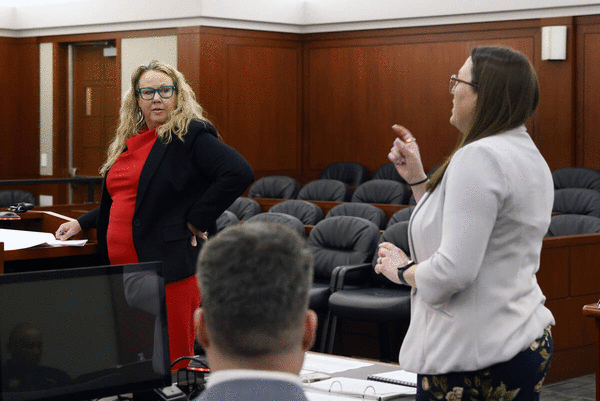
The Las Vegas judge presiding over the ‘fake electors’ case voiced skepticism Monday about aspects of the case, including whether the defendants actually had an intent to defraud officials.
Six Republican defendants are accused of plotting to give Donald Trump Nevada’s electoral votes in 2020, even though Joe Biden won the state by more than 30,000 votes, and signing a certificate purportedly handing Trump the votes, which they then sent to officials.
Those accused include Nevada Republican Party Chairman Michael McDonald and Jesse Law, who was chair of the Clark County Republican Party but lost his position in July when a new chair, Jill Douglass, was elected.
“There’s no evidence that defendants were doing anything other than exercising their First Amendment rights to preserve their future First Amendment rights, petition the government and challenge the results of Nevada’s election,” argued attorney Maggie McLetchie, who represents Law and has also represented the Las Vegas Review-Journal.
District Judge Mary Kay Holthus quickly cut in to voice her own concerns.
“It’s not a forgery, right?” the judge said. “Everybody signed their own names.”
The defendants were indicted in 2023 on a count each of offering false instrument for filing or record and uttering forged instruments: forgery.
Holthus made her comments at a hearing where attorneys argued over a petition that could lead to the indictment being dismissed against defendants in the case, at least in Clark County. Holthus did not issue a decision Monday and McLetchie said after court that a parallel case continues in Carson City.
Later in the hearing, the judge noted that no one acted upon the documents, something Chief Deputy Attorney General Alissa Engler said was not a legal requirement.
“The way I see it, it would be so impossible that I don’t see how there can be an intent to defraud,” replied Holthus. “None of that would kick in unless something else happens. So I don’t see that it could ever, possibly have done anything other than grandstanding or preservation. Those two things are all I can really see; and to me, it’s only actionable if it’s an intent to defraud.”
She added: “If they file something that said, ‘Donald Trump is the president’ and he’s not the president, you can file it all day long, but it doesn’t make any difference.”
Engler told Holthus that a jury should decide the question of intent. The defendants intended to make a false document and claimed to be qualified electors because they wanted to change the outcome of the election, the prosecutor said.
“It was their position that he did win the election and it was their intent that those certificates be executed by the president of the Senate and by the (national) archivist,” argued Engler.
She added: “This isn’t a First Amendment argument. They didn’t just make a grandstand, make their position and then throw those certificates in the trash. They took them to the post office. They mailed them to all the four places that’s required by law because they wanted them to be considered.”
McLetchie said the certificate was exactly what it purported to be: the Republican party’s certificate.
“There simply was no scheme,” she said. “There’s no evidence that they were trying to steal the election by trying to get anybody at the secretary of state’s office or the federal government to accept this as the real thing.”
Asked after the hearing if he thought Holthus seemed inclined to dismiss the case, McDonald’s attorney Richard Wright said, “I think she identified the correct issues,” including “Where is the intent to defraud and deceive?”
___
©2026 Las Vegas Review-Journal. Visit reviewjournal.com.. Distributed by Tribune Content Agency, LLC.






Comments