Iran's top leader warns of regional war as Trump renews demands
Published in News & Features
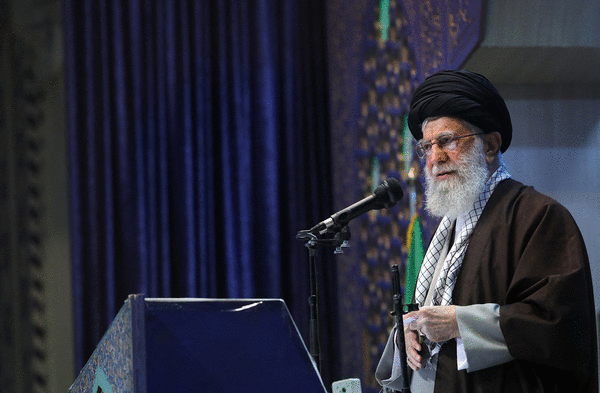
Iran’s supreme leader warned of a “regional war” as tensions continued to mount over potential U.S. strikes on Tehran and top Israeli military officials visited Washington.
“We don’t want to attack any country,” 86-year-old Ayatollah Ali Khamenei said in a public speech broadcast on state television on Sunday. “But in response to anyone who harbors ambitions, wants to attack, and seeks to cause harm, the Iranian people will strike back forcefully.”
Weeks of escalating tensions have pushed Iran and the U.S. to the brink of conflict, following threats by President Donald Trump in January to attack over Tehran’s deadly crackdown on protests against poor economic and living conditions.
Trump has followed up by ordering a U.S. military buildup, including deployment of an aircraft carrier strike group to the Middle East. The pressure campaign’s stated goal is to persuade Iran to negotiate a new nuclear deal — even after Trump said that U.S. strikes in June obliterated Tehran’s nuclear program.
Trump signaled Khamenei’s threat didn’t surprise him and said he’s hopeful that “we’ll make a deal.”
“Of course you’re going to say that,” Trump told reporters Sunday at his Mar-a-Lago estate in Florida. “But we have the biggest, most powerful ships in the world over there, very close, a couple of days.”
“If we don’t make a deal, then we’ll find out whether or not he was right,” he said, referring to Khamenei’s war warning. On Saturday, Trump said Iran and the U.S. are engaged in talks.
Iran has declared that Israel would be a target in the event of a U.S. strike, along with U.S. military bases in the region. Tehran has acted on such threats in the past by striking facilities hosting American forces in Qatar and Iraq.
Top officials with the Israel Defense Forces, led by Chief of the General Staff, Lt. General Eyal Zamir, were in Washington over the weekend for meetings with Dan Caine, Chairman of the Joint Chiefs of Staff, and others as part of stepped-up security coordination, Israel’s Channel 12 reported.
Within the framework of the talks, Israel’s goal is to try to influence the U.S. to pursue a broad move that would lead to the collapse of Iranian regime, Channel 12 reported without citing anyone. Zamir met on Sunday with Defense Minister Israel Katz, the ministry said.
Protests erupted in Tehran in late December over a currency crisis, but quickly spread to other cities and intensified before being met with a forceful crackdown. The official death toll from the demonstrations stands at 3,117, yet activists say they’ve confirmed more than 6,700 fatalities so far. They also say that thousands more may have gone unrecorded as authorities sought to conceal the scale of the crackdown with a weeks-long communications blackout.
In a statement on Sunday, Iran’s government released a list containing the personal information of 2,986 people killed during the unrest, without distinguishing between civilians and security forces. It said 131 of the bodies remained unidentified.
Diplomatic activity has intensified amid the saber rattling. Iran’s foreign ministry confirmed that Qatar’s Foreign Minister Mohammed bin Abdulrahman Al Thani paid an unannounced visit to Tehran on Saturday, holding talks on “safeguarding regional peace and stability” with Iranian counterpart Abbas Araghchi and the secretary of its Supreme National Security Council. Last week, President Recep Tayyip Erdogan said Turkey was ready to take on a facilitating role between Iran and the U.S.
Khamenei on Sunday described popular unrest in Iran as “a coup that was suppressed,” and reiterated claims that the U.S. was behind the protests. He also said that the Iranian people, who posed the most serious challenge to his authority in the history of the Islamic Republic, are ready for another war.
“In my view, the Iranian people shouldn’t be frightened by these things. The Iranian people aren’t influenced by this kind of talk. They don’t fear a just confrontation,” he said.
_____
(With assistance from Alisa Odenheimer, Jennifer A. Dlouhy and María Paula Mijares Torres.)
_____
©2026 Bloomberg L.P. Visit bloomberg.com. Distributed by Tribune Content Agency, LLC.






Comments