Congaree National Park threatened by pollution, politics after 50 years as preserve
Published in News & Features
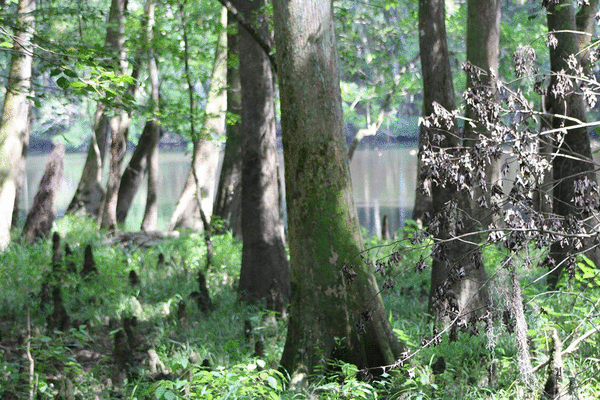
COLUMBIA, S.C. — Fifty years after the federal government saved the Congaree swamp from industrial scale logging, the 27,000 acre nature preserve faces a rash of other threats that have the attention of scientists and conservationists.
The swamp, protected in 1976 and elevated to national park status in 2003, is downstream from factories that release plastic pollution and sewer plants that discharge chemicals. It is virtually next door to a nuclear fuel factory with polluted groundwater, and it is near a sprawling corridor of growth.
Development is inching south of Columbia along the Sumter Highway and that could one day put pressure on Congaree National Park, property long considered isolated and under little threat. Nonnative animals — mainly feral pigs — also have become a concern because of past hunting practices.
And as much as anything, the federal government that once acted to protect the preserve has taken steps under President Donald Trump that are anything but good for South Carolina’s only national park, environmentalists say.
At a symposium Friday on the University of South Carolina campus, scientists, historians and environmentalists discussed many of the parks’ challenges, its importance to the natural world and the need to protect Congaree National Park from pollution, sprawl and politics that are present today. About 160 people attended the event at the USC alumni center.
Trump’s policies toward national parks were a particular concern, participants at the conference said.
“There are these administrative issues,’’ said Congaree Riverkeeper Bill Stangler, who spoke on a panel about future challenges to the national park.
“It’s executive orders that try and ignore science or whitewash history. Things like that, that are not acceptable and in keeping with what you expect from national parks.’’
Some concerns that surfaced during a question and answer session were about a national effort to remove history signs that don’t fit with the administration’s agenda. Those speaking at the session said people need to mobilize to support national parks and conservation.
In addition to those issues, Congaree National Park did not send staff to the annual symposium it has in the past helped to organize, a conference official said.
Staffers have been told by their bosses to focus on visitor services at the park, instead of participating in events like the research symposium Friday at USC, said John Grego, who heads the support group Friends of Congaree Swamp.
Pollution that could affect Congaree National Park also is a worry. Companies like Shaw Industries in Irmo have discharged forever chemicals into the Saluda River that flows into the Congaree River, which runs past the park, a lawsuit says. Plastic pellet pollution from industries also is a concern. Stangler noted both of those types of discharges as threats.
Much of Friday’s conference focused on research highlighting issues inside the park, including work by Texas State University researcher Kimberly Meitzen.
Meitzen has found that historic logging for cypress trees in the area that later became the national park was much more extensive than previously known. Today, Congaree suffers “a substantial loss of cypress from the bottom land hardwood forest,’’ according to a poster displaying her work at the symposium.
“There are a lot of different flood plain conservation challenges occurring for the park right now,’’ Meitzen said.
Another study examined the age of Congaree’s massive trees.
University of Arkansas professor David Stahle has found that many of the park’s mature bald cypress trees are 300 to 600 years old. But research Stahle and co-workers have done in the past three years at the park found some trees were even older.
The oldest known tree at Congaree National Park, labeled “Con85,’’ is at least 788 years old, Stahle told the crowd. He suspects, however, that the big tree is more than 800 years old.
A few bald cypress trees in the park may reach 1,000 years old, based on the work he has done, Stahle said. The oldest known bald cypress in the country is on the Black River in North Carolina. That tree is more than 2,600 years old, he said.
The oldest species of trees at Congaree National Park “are surely bald cypress,’’ according to a slide he presented.
Stahle and fellow researchers based their findings on an examination of 86 large trees in the park. He took core samples and counted rings as part of the study. Some trees were so wide a person could not put their arms around them. The eastern end of the park holds some of the largest trees, researchers said.
John Cely, a former Department of Natural Resources biologist and one of the foremost authorities on the national park, recounted how the forest has changed in other ways through the years.
Though Congaree still contains a deep forest and old growth trees, Cely said the tree canopy has been battered from an array of challenges, including bad weather and beetle infestations.
Hurricane Hugo left gaping holes in the park’s tree canopy when it roared through South Carolina in 1989. Many trees have grown up in place of those lost, including some species that had not been common there before, he said.
But in addition to his discussion of the trees, Cely recounted how Congaree National Park became a home for nonnative pigs. Hunters introduced many of the pigs some 40 years ago, he said.
That’s considered a problem because wild hogs root up the forest floor, damaging native plants. Cely remembers seeing released animals that looked like black and white ‘’ barnyard’’ pigs. Today, the federal government spends thousands of dollars shooting feral hogs in an effort to keep the population in check.
“Surrounding hunt clubs … started introducing pigs — what a great idea that was,’ he said wryly, noting that “we know that pigs, once they get into the wild, are very, very adaptable. And they love flood plains. So within a few years of introduction, they were everywhere.’’
©2026 The State. Visit thestate.com. Distributed by Tribune Content Agency, LLC.






Comments