State finds nearly $500 million in budget reserves amid federal funding uncertainty
Published in News & Features
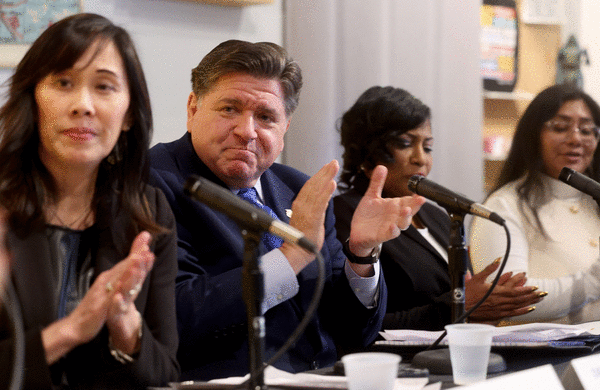
Gov. JB Pritzker’s administration on Thursday announced it has identified nearly $500 million it will keep in budget reserves following the governor’s request last year that state agencies identify 4% of their budgets to hold back amid federal budget uncertainty.
While the trims affect the current budget year, they come as Illinois lawmakers returned to the Capitol this month with a charge to plug a projected shortfall of more than $2 billion in the budget for next fiscal year, which starts this summer.
The announcement also came as the administration of President Donald Trump ordered a broad review of federal funding to Illinois and 13 other Democratic-controlled states, the Washington Post and CNN reported.
The governor’s fall executive order essentially codified his lack of confidence in Illinois’ ability to come out unscathed from Trump’s funding cuts and economic policies. The order applied to agencies that operate only under the governor and not the attorney general, secretary of state or other branches of government.
The Governor’s Office of Management and Budget outlook for next fiscal year “has not changed significantly since last fall,” Alexis Sturm, director of the office, wrote Thursday in a letter to Cabinet directors provided by the governor’s office. Most agencies will likely not see their full funding requests satisfied for next year, Sturm wrote, adding that prioritizing and limiting hiring and other costs associated with government operations “will be key.”
The reserves identified in this year’s budget primarily affect health and human services, with $361.5 million of the $481.6 million identified falling into that category, according to the document provided by the governor’s office.
The largest single chunk comes from a determination that the state could fulfill its obligations without depositing $200 million from its general fund into a Medicaid fund, as it had previously planned. While the state has said that recent federal moves could negatively affect Medicaid funding, those cuts generally are a concern for upcoming years, not this year, said Andres Correa, a Pritzker spokesperson.
Reserves in the Department of Human Services will come from hiring lags, reducing overtime and “reduced grants due to lower than expected caseloads,” according to the budget document.
“Savings were achieved through administrative efficiencies, staffing adjustments, lower-than-expected caseloads and cost controls, reflecting responsible fiscal management without reducing essential services,” a press release from the governor’s office said. “No funding for pensions or K-12 education was impacted.”
The governor’s office didn’t immediately provide a full list of grants or programs that will be reduced. Generally, spending withheld on the health and human services side involved delaying implementation or expansion of programs planned for 2026 into 2027, Correa said.
At the Department of Commerce and Economic Opportunity, some job training and business development grants will be reduced due to factors such as a lack of applications, Correa said. Current grantees will not see reductions in services, he said.
There will also be operational spending withheld in public safety departments, including the Department of Corrections and Illinois State Police, though Correa said the departments’ ability to provide services will not be affected.
And state universities and the Illinois Community College Board are holding 2% in reserves, the document said.
Other reserves come from cost savings on insurance and other operational reductions across some departments, such as limiting travel and hiring.
Heading into the spring, Illinois is staring down a new budget negotiations process, with the governor’s budget address to the General Assembly scheduled for next month. The state has forecast a preliminary $2.2 billion shortfall heading into budget negotiations, amid shrinking federal support from the Trump administration.
It’s also an election year, and the state’s Democratic supermajority has generally resisted a more comprehensive approach to overhauling the tax system after Pritzker’s failed effort to amend the state constitution in 2020 to allow for higher rates on larger incomes.
Although the state budget process for the current fiscal year concluded in the spring, Pritzker and other state-elected officials have considered several measures to mitigate the influence of the Trump administration in Illinois, while also stressing that no state can make up for broad federal government cuts.
Following Trump budget cuts and his administration’s withholding of federal funds, for example, Illinois created a flexible $100 million fund that the governor can use to fill in fiscal gaps. Illinois also expanded the state treasurer’s emergency lending powers.
Pritzker, at times last year, blamed Illinois’ fiscal challenges on economic headwinds he says Trump created. In issuing the executive order in September, he specifically called out Trump’s tariff policies, and cuts to Medicaid and food assistance programs, and taxes, especially for the wealthy. He’s also previously accused the Trump administration of improperly withholding nearly $2 billion in funding from the state.
In response to Pritzker’s order in the fall, House Republican Leader Tony McCombie of Savanna said her caucus had warned that the state budget was “irresponsible and overspent.” And Senate GOP Leader John Curran of Downers Grove said he’d like to see the governor work to cut spending “regardless of who is president.”
____
©2026 Chicago Tribune. Visit at chicagotribune.com. Distributed by Tribune Content Agency, LLC.





Comments