HHS cuts $2 billion in mental health, addiction grants
Published in News & Features
WASHINGTON — The Trump administration quietly rolled back approximately $2 billion in mental health and substance use funding late Tuesday, according to four sources familiar with discussions, blindsiding about 2,000 grantees who rely on these funds to operate.
The scope of cuts to the Substance Abuse and Mental Health Services Administration are worrying stakeholders, who say that cuts may continue to grow.
Grantees were notified of the funding changes in letters that cite “non-alignment with SAMHSA priorities.” The cutbacks primarily affect discretionary grant programs.
Many of the affected grant programs have bipartisan support and President Donald Trump has supported them in the past. Notably, Trump signed a wide-ranging 2018 opioid prevention and treatment law during his first term and signed its reauthorization just last month.
“All of the termination notices said that these programs did not comply with the administration’s priorities,” said Andrew Kessler, founder of Slingshot Solutions, which specializes in behavioral health policy consulting. “If those programs don’t jive with administration priorities, can you please tell us why you signed the legislation?”
SAMHSA, the agency tasked with mental health and addiction issues, has faced sweeping changes under the second Trump administration. The Department of Health and Human Services has gutted staff as part of efforts to reorganize the agency under Secretary Robert F. Kennedy Jr.’s flagship Administration for a Healthy America, which has moved away from efforts to use harm reduction to mitigate drug-related deaths.
The rationale for the cuts mirrors statements when HHS announced the reorganization, which is on hold because of ongoing litigation, and justification in the president’s fiscal 2026 budget request.
HHS did not respond to a request for comment.
“The cancellations were to bipartisan grants already approved by Congress and the President himself that cover programs from youth overdose prevention to prenatal and postpartum care for women. The result of these SAMHSA cuts will be a death sentence for individuals who most need support and care,” Rep. Paul Tonko, D-N.Y., who has focused his efforts in Congress on substance use issues, said in a statement.
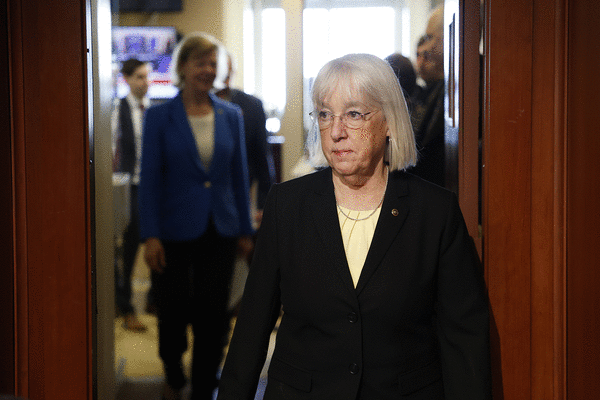
“This administration’s claims about taking on the opioid crisis couldn’t be more hollow,” said Senate Appropriations ranking member Patty Murray, D-Wash., in a statement about the cuts.
The cuts appear not to affect some programs, including the 988 Suicide & Crisis Lifeline, Certified Community Behavioral Health Clinics and funding for State Opioid Response Grants. But the technical assistance to grantees in the latter program was terminated.
Also affected is the National Child Traumatic Stress Network, created to increase access to services for children and families who experience or witness traumatic events, another program that has had bipartisan support.
Jenifer Wood Maze, co-director of the UCLA-Duke National Center for Child Traumatic Stress, said that she had been hearing that most current grantees in the network have received the same notice of immediate termination.
“Many have had other child mental health grants from SAMHSA terminated as well, so the impact is really huge. This network has been operating and growing steadily for 25 years, so this is coming as a shock to us,” she said.
©2026 CQ-Roll Call, Inc., All Rights Reserved. Visit cqrollcall.com. Distributed by Tribune Content Agency, LLC.




Comments