Minneapolis police chief shakes up leadership, creates Major Crimes division
Published in News & Features
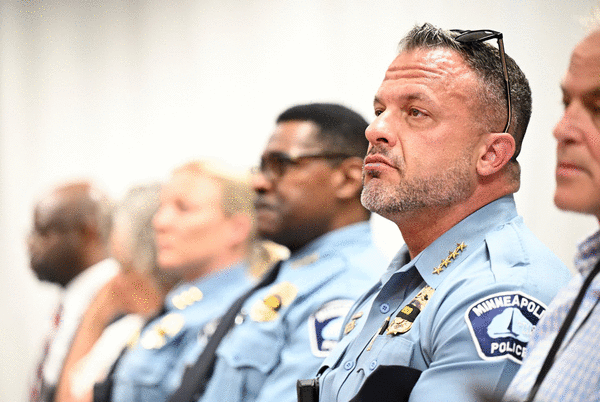
MINNEAPOLIS — In a surprise shake-up of his senior staff, Minneapolis police Chief Brian O’Hara has replaced two sitting deputy chiefs and ordered a department restructuring that consolidates several specialized investigative outfits under one umbrella.
A newly created Major Crimes Division will now house the Homicide Unit, the nonfatal shooting response team and the Violent Criminal Apprehension Team, according to an email obtained by the Minnesota Star Tribune.
Cmdr. Richard Zimmerman, the agency’s longest-tenured employee and former head of the Homicide Unit, has been tapped to oversee Major Crimes. That reprises his longtime role in the high-profile unit, where he served nearly 30 years, either as a detective or supervisor.
The weekend announcement marked a series of sweeping personnel changes, including the promotion of Mark Klukow, a downtown lieutenant, to deputy chief of Patrol. Klukow provided security for former Mayor R.T. Rybak and co-founded “Bike Cops for Kids,” a popular community-engagement program in north Minneapolis, that involves officers delivering donated bicycles to children and taking kids to Twins games.
Zimmerman and Klukow both signed an open letter condemning Derek Chauvin immediately after George Floyd’s killing. Zimmerman has been especially outspoken about the case and served as a key witness in Chauvin’s murder trial.
Cmdr. Erick Fors, a former deputy chief under O’Hara and Medaria Arradondo, was named acting deputy chief of Investigations. Fors spearheaded efforts in 2020 to clear a massive backlog of 1,700 unexamined rape kits spanning 30 years.
Their predecessors, Deputy Chiefs Jonathon Kingsbury and Emily Olson, were demoted and are expected to return to their civil service ranks. The departmentwide email did not disclose what their new roles would be.
Olson’s removal comes after the domestic violence killing of Mariah Samuels, a 34-year-old mother of two gunned down outside her north Minneapolis home in September. The case exposed longstanding gaps in how MPD investigates intimate-partner violence and revealed a sizable backlog of similar domestic calls that sit, often for weeks on end, without proper follow-up by the depleted agency.
In an interview with the Star Tribune last fall, Olson defended the department’s handling of the Samuels’ case and their decision not to assign an investigator after an earlier initial assault by the man later accused of killing her.
Olson also sparred with several City Council members in November during a presentation about 2024 clearance rates. She pointed to low staffing levels, high caseloads and a lack of cooperation by some victims as challenges in solving certain crimes.
Last month, the City Council earmarked $1.7 million within MPD’s budget to set up a nonfatal shooting task force with up to nine investigators, patterned after St. Paul’s unit, which has been credited with pushing its clearance rates above national averages.
Minneapolis police officials did not respond to a request for comment.
The department website has yet to be updated.
Among the other changes:
—Lt. Aimee Linson, head of Homicide since late 2023, will now lead the Domestic Violence unit.
—Sgt. Andrew Schroeder, a homicide investigator, is now detailed as a lieutenant in the revamped Major Crimes division.
—Second Precinct Inspector Nicholas Torborg retired on New Year’s Eve. It’s not immediately clear who will replace him.
_____
©2026 The Minnesota Star Tribune. Visit at startribune.com. Distributed by Tribune Content Agency, LLC.





Comments