Rubio details 3-phase US plan for Venezuela leading to a political transition
Published in News & Features
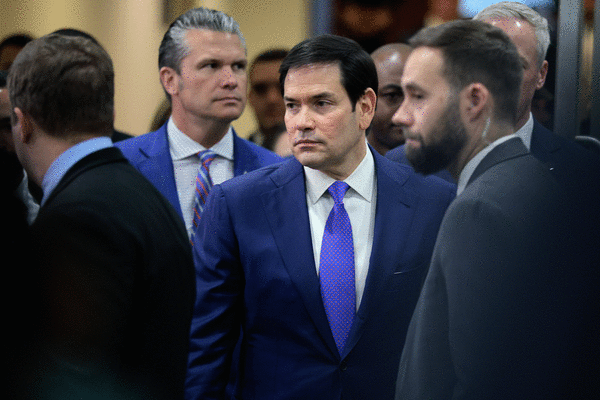
The United States is preparing to take control of tens of millions of barrels of Venezuelan oil as part of a sweeping three-phase strategy aimed at stabilizing the country, jump-starting its economy and steering toward a political transition, Secretary of State Marco Rubio said Wednesday.
Under the plan described by Rubio, the first phase focuses on stabilizing Venezuela and preventing a collapse into chaos, using strict enforcement of oil sanctions and a maritime quarantine as Washington’s primary leverage. The second phase, dubbed recovery, aims to reopen the country’s economy under transparent rules that allow fair access for American, Western and allied companies while advancing national reconciliation through amnesty, prisoner releases and the return of political exiles.
A final transition phase would overlap with both efforts, gradually blending economic reopening with political change and “reconciliation nationally” that would lead to freeing imprisoned members of the opposition as Venezuela moves toward a new governing framework.
Rubio’s comments to reporters after briefing senators on Capitol Hill on the recent U.S. military actions in Venezuela comes after pushback from Democrats worried about what they said was the lack of clarity on the administration's plans following the military operation to capture Venezuelan strongman Nicolás Maduro. Rubio’s timeline also explicitly highlighted that the ultimate goal in Venezuela is to achieve a political transition, which has not been at the center of President Donald Trump’s remarks on the subject.
At the heart of the plan is an aggressive enforcement of an oil quarantine that has effectively trapped large volumes of Venezuelan crude inside the country. That leverage, Rubio said, anchors the first phase of Washington’s plan: stabilization. The goal is to prevent Venezuela from slipping into chaos while using control over oil revenues to shape political outcomes.
“We don’t want it descending into chaos,” Rubio said. “Part of that stabilization … is our quarantine.”
Rubio said U.S. officials are now moving to seize and sell between 30 million and 50 million barrels of that oil at full market prices — a sharp break from years in which Venezuelan crude was sold at deep discounts through opaque channels.
“We are going to sell it in the marketplace at market rates, not at the discounts Venezuela was getting,” Rubio told reporters. The proceeds, he added, will be tightly controlled to ensure they “benefit the Venezuelan people, not corruption, not the regime.”
At current market prices, 30 million barrels of crude would be worth roughly $1.4 billion, while 50 million barrels would have a market value of approximately $2.4 billion.
Venezuela’s state-owned oil company has, for the first time, acknowledged that it is in talks to sell crude to the United States.
The state run Petróleos de Venezuela, PDVSA, said in a statement, “This process is being developed under frameworks similar to those currently in effect with international companies, such as Chevron, and is based on a strictly commercial transaction.”
The second phase, described by Rubio as recovery, would focus on reopening Venezuela’s economy under new rules. U.S. officials envision a system that allows American, Western and allied companies fair access to Venezuela’s energy sector and broader economy, after years of sanctions, mismanagement and political risk drove most foreign investors away.
At the same time, Rubio said, Washington wants to push for a national reconciliation process that would include amnesty for opposition figures, the release of political prisoners and the return of exiles — steps U.S. officials see as essential to rebuilding civil society.
“Begin to create the process of reconciliation nationally within Venezuela,” Rubio said, “so that the opposition forces can be amnestied and released from prisons or brought back to the country and begin to rebuild civil society.”
A third phase, transition, would overlap with the first two, blending economic reopening with political change. Rubio did not provide a timeline but said U.S. officials have already laid out the strategy in detail to relevant parties and expect to release more information in the coming days.
“There’s a lot of operational details that can’t be discussed publicly,” Rubio said. “But we feel like we’re moving forward here in a very positive way.”
Taken together, Rubio’s remarks offer the clearest public picture yet of how Washington intends to use oil, sanctions and political incentives not just to pressure Venezuela’s rulers, but to actively manage the country’s path out of crisis.
According to Rubio, the interim Venezuelan government led by former vice president Delcy Rodríguez, installed after the capture of Nicolás Maduro by U.S. forces, has reached an unavoidable conclusion: without cooperation with Washington, Venezuela cannot move its oil, generate revenue or prevent a full-scale economic collapse.
That realization, Rubio said, has reshaped the balance of power in Caracas and narrowed the regime’s options.
In a press briefing on Wednesday, White House spokeswoman Karoline Leavitt said the administration was “in close correspondence” with Rodriguez and was “dictating” decisions in Venezuela.
“We obviously have maximum leverage over the interim authorities in Venezuela right now and ... their decisions are going to continue to be dictated by the United States,” she said.
_____
©2026 Miami Herald. Visit miamiherald.com. Distributed by Tribune Content Agency, LLC.





Comments