After Maduro's capture, here are the key players in Venezuela's socialist regime
Published in News & Features
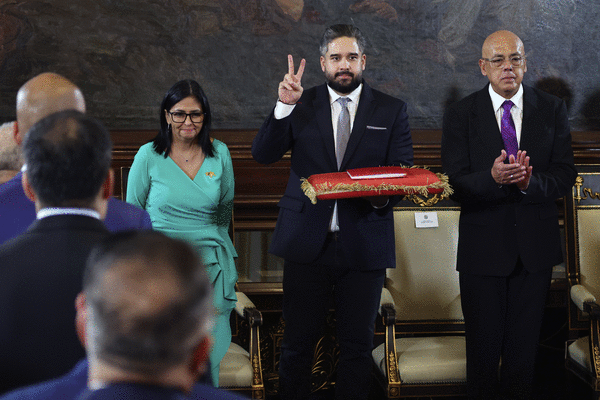
The sudden apprehension of Nicolás Maduro and his wife, Cilia Flores, in a pre-dawn U.S. operation inside Venezuela has upended the country’s political hierarchy, leaving behind a regime without its central figure, but not without power.
What remains in Caracas is a tightly knit group of civilian, military and intelligence officials who for years formed the backbone of Maduro’s rule and now represents the core of what is left of the socialist system he led.
This power ranking focuses on the figures who matter most in the aftermath: the men and women who control the guns, the courts, the intelligence files and the streets. While Maduro served as the symbolic and diplomatic face of Chavismo, day-to-day authority was long dispersed among loyal enforcers, negotiators and security chiefs whose influence often rivaled — and at times surpassed — that of the president himself.
These are the men and women who now run the regime.
Delcy Rodríguez
Delcy Eloína Rodríguez Gómez is the interim president of Venezuela, sworn in on Jan. 5 after the U.S. capture and removal of Maduro. Her appointment followed an order by Venezuela’s Supreme Court to ensure continuity of government amid the unprecedented political crisis.
A seasoned Venezuelan politician and lawyer born in Caracas in 1969, Rodríguez has been a key figure in the socialist government for more than two decades. She served as vice president since 2018 and has held a series of top posts, including minister of foreign affairs, minister of economy and finance and minister of petroleum. Before that, she led the pro-government Constituent National Assembly and worked in communications and diplomacy under both Hugo Chávez and Maduro.
Rodríguez is known for her close ties to Venezuela’s military and political elite and her role in managing the economy amid sanctions and chronic instability. Western governments have imposed sanctions on her in the past for her part in sustaining Maduro’s administration.
Since assuming the interim presidency, she has navigated intense pressure from the U.S. and key players in domestic politics, at times rejecting U.S. interference while later expressing willingness for dialogue, reflecting deep tensions over Venezuela’s future direction.
Jorge Rodríguez
A central figure in Venezuela’s Chavista power structure, Jorge Rodríguez, president of the National Assembly, is one of the most influential political operators of the past two decades. A psychiatrist by training, he entered politics in the government of Hugo Chávez, first gaining prominence as head of the National Electoral Council, where he oversaw elections repeatedly questioned by the opposition. He later served as mayor of Caracas and communications minister, becoming a key strategist and public defender of Chavez’s Bolivarian project.
Under Maduro, Rodríguez consolidated his role as a top negotiator and power broker. He has led government delegations in talks with the opposition and foreign leaders, positioning himself as both a hardline loyalist and a pragmatic tactician. In 2021, he was installed as president of the National Assembly after elections boycotted by much of the opposition. Rodríguez is widely seen as one of the regime’s most disciplined, calculating and durable figures, combining ideological commitment with a keen sense for political survival.
Vladimir Padrino López
Vladimir Padrino López, Venezuela’s defense minister, is the country’s most powerful military figure and a cornerstone of the country’s Chavista system of power. A career officer trained in the army, he rose steadily through the ranks and was appointed defense minister in 2014 by Maduro, a post he has retained longer than any predecessor. His longevity reflects his central role in ensuring the loyalty of the armed forces during years of political crisis, mass protests, international sanctions and economic collapse.
Padrino López has positioned himself as the public face of the military’s alliance with the Maduro government, repeatedly denouncing opposition movements and U.S. pressure as threats to national sovereignty. He has overseen the military’s expanding role in civilian governance, including control over food distribution, ports, mining and key state industries. Critics accuse him of enabling repression and politicizing the armed forces, while supporters portray him as a stabilizing figure. His influence makes him a decisive actor in any future political transition.
Diosdado Cabello
Diosdado Cabello, Venezuela’s Interior Minister, is one of the most powerful and feared figures in the country’s ruling elite, known for his hardline ideology and deep influence over the country’s security apparatus. A former military officer and close ally of Hugo Chávez, Cabello rose to prominence after a failed 1992 coup by Chavez and went on to hold key posts, including vice president, governor of Miranda state, and president of the National Assembly.
Under Maduro, Cabello has remained a central pillar of the regime, wielding power less through formal titles than through loyalty networks within the armed forces, intelligence services and ruling party. As longtime leader of the United Socialist Party of Venezuela and host of the television program Con el Mazo Dando (Striking with the Club) he has publicly threatened opponents, journalists and dissidents. Under international sanctions and accused by U.S. authorities of corruption and drug trafficking—allegations he denies—Cabello is widely viewed as an enforcer of the system and a key guarantor of its survival.
Javier Marcano Tábata
Javier Marcano Tábata is senior intelligence official associated with the inner security apparatus of the regime. A career officer with close ties to counterintelligence and internal security operations, he has been linked to Venezuela’s civilian and military intelligence structures that play a central role in monitoring, detaining and interrogating political opponents.
Marcano Tábata is widely identified by human rights groups as part of the command structure overseeing detention centers where political prisoners have been held, including facilities accused of systematic abuse and torture. He has been sanctioned by the United States and other governments for alleged involvement in human rights violations, including arbitrary detentions and mistreatment of detainees—accusations he and the Venezuelan government reject.
Though far less publicly visible than figures like Diosdado Cabello or Vladimir Padrino López, Marcano Tábata is considered an important operational actor within the regime’s security ecosystem, representing the technocratic, opaque layer of power that sustains political control through intelligence and repression rather than public politics.
Pedro Luis Martín
Pedro Luis Martín is a former senior Venezuelan intelligence and military official who has long been linked to the shadowy financial and security networks of the regime. A retired army major general, he served in military intelligence and later held influential posts within Venezuela’s defense and internal security structures during the governments of Chávez and Maduro.
Martín has been identified by U.S. authorities as a key intermediary in corruption and money-laundering schemes tied to the Venezuelan regime. In 2018, the U.S. Treasury Department imposed sanctions on him for allegedly assisting high-ranking officials in moving and concealing illicit funds abroad, particularly through complex financial operations involving foreign jurisdictions. He has denied wrongdoing, and Venezuelan authorities have dismissed the accusations as politically motivated.
Unlike more public figures of the regime, Martín operated largely behind the scenes, embodying the financial-intelligence nexus that helped sustain the regime amid sanctions and economic collapse. His case illustrates how power in Venezuela has often flowed through opaque military and intelligence channels rather than formal political office.
Carmen Meléndez
Carmen Meléndez is a senior Venezuelan military officer and politician who has been one of the most prominent women in the regime leadership. A career admiral, she rose through the armed forces and became the first woman to serve as Venezuela’s defense minister in 2013 under Chávez. She later held several powerful civilian posts, including interior and justice minister, governor of Lara state and mayor of Caracas.
Throughout her career, Meléndez has been a loyal enforcer of the Bolivarian project, overseeing internal security, police forces and emergency operations during periods of political unrest. She has frequently appeared at the forefront of government responses to protests, natural disasters and security crackdowns. Critics accuse her of complicity in repression and human-rights abuses carried out by security forces under her authority, allegations she rejects.
Meléndez’s trajectory reflects the deep militarization of Venezuela’s civilian institutions and the central role the armed forces play in sustaining Chavista rule.
Domingo Hernández Lárez
A senior Venezuelan army general, Domingo Hernández Lárez is one of the most powerful figures within the country’s military command. A career officer with decades of service, he was appointed in 2021 as commander of the Strategic Operational Command of the Armed Forces, the entity that oversees all military operations, which places him directly under the president’s authority.
In this role, Hernández Lárez has been responsible for coordinating internal security, border control and military deployments, and became a key public voice defending the Maduro government against opposition challenges and foreign pressure. He has frequently used social media to announce operations against illegal mining, smuggling and armed groups, while framing dissent and international sanctions as threats to national sovereignty.
The United States has imposed sanctions Hernández Lárez for alleged involvement in human-rights abuses, including actions against civilians and indigenous communities—allegations denied by the Venezuelan government. His position makes him a central actor in maintaining the military’s loyalty to the regime.
Freddy Bernal
A veteran Chavista politician and security hardliner, Freddy Bernal is seen as the regime’s main point of contact with leftist guerrilla groups operating in the country, such as the ELN and dissident members of the FARC. His career has been closely tied to Venezuela’s policing and internal control structures. A former police officer, he gained national prominence in the early years of Chávez’s government as a fierce defender of the Bolivarian Revolution and a key figure in public security policy.
Bernal served for years as a lawmaker and later as national coordinator of the government’s food distribution system, giving him influence over a critical tool of social control during the country’s economic collapse. Under sanctions by the United States for alleged corruption and human rights abuses—charges he denies—Bernal was elected governor of Táchira state in 2021. He is widely viewed as a loyal enforcer of the regime, combining ideological militancy with control over security and logistics.
Alexander Granko Arteaga
Alexander Granko Arteaga is a senior Venezuelan intelligence official closely associated with the country’s most repressive security operations. A key figure within the Bolivarian National Intelligence Service, he has been identified by human rights organizations as an operative involved in the detention, interrogation and alleged torture of political prisoners.
Granko Arteaga is frequently linked to El Helicoide, the intelligence service’s main detention center in Caracas, which has been widely documented as a site of systematic abuse. Former detainees and international rights groups accuse him of personally participating in or directing harsh interrogation practices, including physical and psychological mistreatment. The United States and other governments have imposed sanctions on Granko Arteaga for alleged human rights violations. Though largely unknown to the public, he represents the operational core of Venezuela’s intelligence apparatus, exemplifying how repression has been enforced through mid-level but powerful security officials rather than only top political leaders.
Rubén Santiago
Rubén Santiago is a senior officer of Venezuela’s Bolivarian National Police, linked to the internal security structures used by the Venezuelan state to maintain public order. His name has been associated with police operations carried out in the context of protests, detentions, and crowd-control actions executed by the PNB, a force that since its creation has played a central role in repressing political dissent.
The National Police has been repeatedly cited by national and international human rights organizations for excessive use of force, arbitrary detentions, and the mistreatment of protesters and civilians. Officers such as Santiago operate within an enforcement chain that carries out directives issued by the regime’s political and security leadership.
Iván Hernández Dala
Gen. Iván Rafael Hernández Dala is a Venezuelan military officer and intelligence chief who has played a key role in the country’s security and repression apparatus under Maduro. The army general has served as head of the General Directorate of Military Counterintelligence, the agency responsible for monitoring the armed forces and investigating alleged internal threats. Under Hernández Dala’s leadership, the agency has been repeatedly accused by the United Nations and human rights organizations of arbitrary detentions, enforced disappearances, torture and deaths in custody, particularly targeting military officers and civilians accused of conspiring against the government. The Venezuelan government has denied these allegations, portraying the agency as essential to defending national sovereignty against coups and foreign intervention.
The United States has imposed sanctions on Hernández Dala for alleged involvement in serious human rights violations. Though he maintains a low public profile, his control over military counterintelligence places him at the core of the regime’s efforts to discipline the armed forces and prevent internal dissent.
Miguel Rodríguez Torres
While currently living in exile, Miguel Rodríguez Torres still holds considerable influence within the regime and serves as an important link between Caracas and its allies in Spain. Once considered a loyal insider, Rodríguez Torres broke with Maduro in the mid-2010s, publicly criticizing the government’s authoritarian turn and economic mismanagement. His dissent made him a rare example of a high-ranking Chavista defector. In 2018, he was arrested by Venezuelan intelligence services and held for years without trial, becoming himself a political prisoner.
Alexis Rodríguez Cabello
A Venezuelan politician and longtime Chavista operative best known for his family and political ties to Diosdado Cabello, Alexis Rodríguez Cabello is currently head of the Bolivarian National Intelligence Service. He has served in multiple public offices, most prominently as governor of Guárico state, a post he held for several years after first being elected in 2008.
As governor, Rodríguez Cabello oversaw a largely rural and strategic region at a time of deepening economic crisis, food shortages and institutional decay. His administration was marked by strong political loyalty to the central government and the ruling United Socialist Party of Venezuela, rather than by national prominence or independent leadership. Critics accused his government of mismanagement and corruption, allegations he has denied.
José David Cabello Rondón
José David Cabello Rondón is a Venezuelan military officer and senior government official closely tied to the inner circle of Chavismo. A brother of Diosdado Cabello, one of the regime’s most powerful figures, he has held influential posts despite maintaining a relatively low public profile. Cabello has served as head of Venezuela’s National Integrated Service of Customs and Tax Administration, giving him control over customs, ports and tax collection—key leverage points in an economy marked by sanctions, smuggling and corruption. He has also been linked to military logistics and commercial operations connected to the state.
Elio Ramón Estrada Paredes
Elio Ramón Estrada Paredes is a Venezuelan military officer and senior security official who has played a prominent role in the country’s internal policing apparatus. A career general of the National Guard, he was appointed in 2023 as commander of the Bolivarian National Police, placing him in charge of one of the main forces responsible for public order, crowd control and internal security.
Under Estrada Paredes’ leadership, the police have continued to be deployed in protests, political crackdowns and security operations alongside military and intelligence agencies. The force has been repeatedly accused by human rights organizations of excessive use of force, arbitrary detentions and abuses against demonstrators and civilians—allegations the Venezuelan government rejects.
Nicolás Maduro Guerra
Known as “Nicolasito”, Nicolás Maduro Guerra is the son of Nicolás Maduro and first lady Cilia Flores. He has become a symbol of dynastic power within the regime, rising to prominent political and institutional roles despite his youth and limited public record outside the ruling elite. Maduro Guerra has served as a member of the pro-government National Constituent Assembly and later as a deputy in the National Assembly, where he has promoted legislation aligned with the regime’s hardline agenda. He has also been appointed to positions linked to economic policy and youth mobilization, frequently presenting himself as a defender of the Bolivarian Revolution and of his father’s legacy.
Tarek William Saab
Tarek William Saab is Venezuela’s attorney general and one of the most prominent civilian figures within the power structure. A former poet and leftist activist, he entered politics through the Bolivarian movement and rose to national prominence as a lawmaker and later as ombudsman. In 2017, he was appointed attorney general by the pro-government Constituent Assembly after the dismissal of his predecessor, a move widely criticized as unconstitutional.
As prosecutor general, Saab has been a key legal pillar of Nicolás Maduro’s government, overseeing cases against opposition leaders, protesters, journalists and civil society activists. Human rights organizations accuse his office of facilitating political persecution and providing legal cover for abuses committed by security forces, including torture and arbitrary detention—allegations he rejects, portraying his work as a defense of order and sovereignty.
©2026 Miami Herald. Visit at miamiherald.com. Distributed by Tribune Content Agency, LLC.

Comments