Defying Trump's NASA proposal, Congress looks to maintain budget, including science, near current levels
Published in News & Features
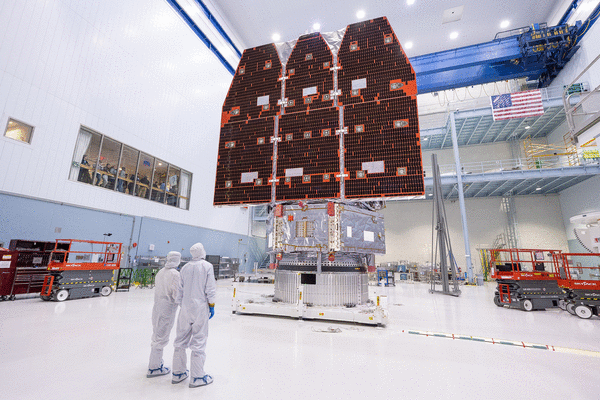
Last year President Donald Trump pitched a severe chop to NASA’s proposed annual budget for 2026, but the House and Senate on Monday released an appropriations bill that would mostly ignore those cuts.
The minibus bill put forth by both congressional bodies’ appropriation committees includes NASA as well as the National Oceanic and Atmospheric Administration and National Science Foundation, It aims to put $24.44 billion into NASA’s hands for the fiscal year that began Oct. 1, 2025 and runs through Sept. 30, 2026.
That’s slightly less than the $24.8 billion that the agency worked with in 2025, but a far larger number than what Trump had proposed, which was only $18.8 billion.
The bill still has to be passed by both House and Senate, and then signed by Trump.
Part of Trump’s proposed cuts were to nearly halve the science and technology budgets, but also kill off future launches of NASA’s Space Launch System and Orion spacecraft after Artemis III. This congressional bill keeps those mostly intact.
Nonprofit group The Planetary Society especially raised the alarm about the science cuts calling it an “extinction-level event” for NASA’s science efforts as Trump’s budget would have killed 41 science projects, which is about 1/3 of NASA’s science portfolio.
“This budget is a retreat, a narrowing of ambition,” the society said in a statement when Trump’s budget was released. “This request represents the smallest NASA budget since FY 1961 — a level enacted before the first American had launched into space.”
The Trump proposal also called for the total elimination of STEM education efforts, something the congressional bill restores.
Casey Dreier, the Planetary Society’s chief of space policy applauded the pushback.
“This legislation further cements congressional resolve to maintain U.S. leadership in space and science,” he said. “It fully rejects the draconian and self-destructive cuts proposed by the Administration to NASA’s scientific, education, and technological development activities. This was not a controversial move.”
He said the bill should serve as a clear message to the White House budgeting office, which had pushed for the cuts.
“Instead of repeating this wasteful inefficient exercise in the coming years, embrace this opportunity to work with Congress and enable NASA to compete on every front: science, human exploration, and education. The universe is much bigger than the moon, and Congress knows it,” Dreier said.
Here’s a rundown.
Exploration, which includes Artemis and other moon and Mars efforts: FY 2025 enacted: more than $7.67 billion; Trump proposal: $8.31 billion; Minibus total: $7.78 billion
Space Operations, including supporting the International Space Station: FY enacted: $4.22 billion; Trump proposal: $3.13 billion; Minibus total: $4.18 billion
Space Technology: FY enacted: $1.1 billion; Trump proposal: $568.9 million; Minibus total: $920.5 million
Science: FY enacted: $7.33 billion; Trump proposal: $3.91 billion; Minibus total: $7.25 billion
Aeronautics: FY enacted: $935 million; Trump proposal: $588.7 million; Minibus total: $935 million
STEM engagement: FY enacted: $143 million; Trump proposal: $0 ; Minibus total: $143 million
Safety, Security and Mission Services: FY enacted: $3.1 billion; Trump proposal: $2.12 billion; Minibus total: $3 billion
Construction and Environmental Compliance & Restoration: FY enacted: $300 million; Trump proposal: $140.1 million; Minibus total: $185.4 million
Inspector General: FY enacted: $47.6 million; Trump proposal: $40.7 million; Minibus total: $46.5 million
New NASA Administrator Jared Isaacman in his initial Senate confirmation hearings last spring had indicated support of NASA’s science portfolio, including the planned 2027 launch of the Nancy Grace Roman Space Telescope.
“To my knowledge, the Nancy Grace Roman Space Telescope is nearing completion and remains on schedule and within budget — something that is unfortunately rare for flagship programs at the agency,” he said. “I’m not aware of any reason why it should be canceled and I would support its completion and successful deployment.”
He had assured senators he was keen to keep funding for existing programs such as the Hubble, James Webb and Chandra space telescopes.
“If confirmed, I will advocate for strong investment in space science — across astrophysics, planetary science, Earth science, lunar science and heliophysics — and for securing as much funding as the government can reasonably allocate,” he said. “I also believe we should look to amplify these efforts through partnerships with international partners, commercial industry and academia whenever possible.”
Isaacman wasn’t confirmed after those initial hearings, though, after Trump removed his nomination. But Trump re-nominated Isaacman later in 2025, and he was approved by the Senate in December as the agency’s 15th administrator.
During his second confirmation hearings, said he was happy to work with whatever funds Congress could allocate, including using funds as designated for specific missions.
“We will maximize the scientific value of every dollar that Congress affords the agency,” he said.
©2026 Orlando Sentinel. Visit at orlandosentinel.com. Distributed by Tribune Content Agency, LLC.






Comments