There's a new push to raise San Diego's sales tax. Here's why backers think this one can pass
Published in News & Features
SAN DIEGO — A local construction union is proposing a San Diego sales tax increase that could have a better shot at passing than a failed 2024 measure, because it would restrict uses of the additional revenue mostly to infrastructure projects.
The union, Local 89 of the Laborers’ International Union of North America, or LIUNA, believes a key reason voters narrowly rejected Measure E last year was that the ballot measure would have allowed city officials to spend the money on almost anything.
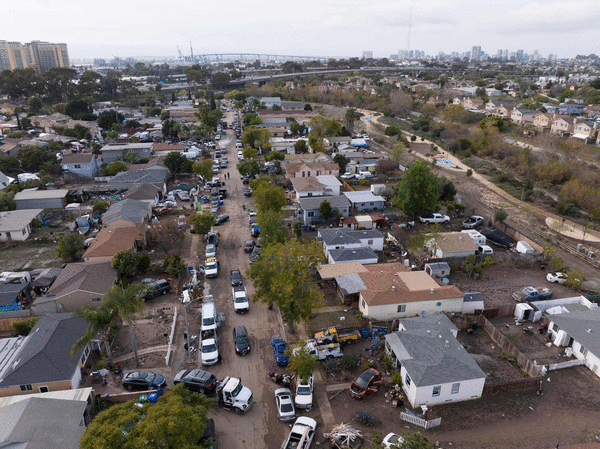
The new proposal would limit spending mostly to infrastructure projects like road construction, dams, fire stations and libraries — an approach the union says will be more popular with voters than giving City Hall a blank check.
Typically, restricting how revenue from a ballot measure can be spent would boost the approval threshold from a simple majority to a daunting two-thirds of voters — but that’s only if the measure is placed on the ballot by city officials.
Local 89 plans to keep the approval threshold a simple majority by making its effort a citizen’s measure. That will require the union to gather valid signatures from about 82,000 registered voters within the city limits.
Similar to Measure E, the new measure would raise the city’s sales tax rate by a full cent, from the lowest in the county at 7.75% to the highest at 8.75%.
Supporters point out that a number of other local cities have already raised their rate to that level — Chula Vista, Escondido, San Marcos, National City, Lemon Grove, Del Mar, Solana Beach and Imperial Beach.
The proposal would appear on the November ballot. Based on the city’s sales tax revenue in recent years, it would be expected to generate an additional $400 million per year.
According to the union, polls it commissioned in September and October found a new proposal with spending restrictions would have a better chance than Measure E, which was narrowly defeated, 50.31% to 49.69%.
The union has also hired Olson Remcho, one of the state’s top election law firms, to handle the ballot language. And work is nearly complete on a detailed expenditure plan that would restrict how the money could be used.
The union is planning a $4 million campaign — about $1.8 million for signature-gathering and $2.2 million to promote the measure to voters, said Kelvin Barrios, Local 89’s policy and community engagement director.
Barrios said supporters will need to spend more than the roughly $1.3 million spent on the Measure E campaign.
That’s partly because the union expects lower voter turnout in 2026 than in 2024, and lower turnout tends to hurt tax measures. And voters already face a wider range of rising expenses than last year, he added.
Another complicating factor could be the presence of additional revenue measures on the November 2026 ballot, including a possible measure to raise the sales tax countywide.
Barrios said the move to restrict how the new city revenue could be spent could make a big difference with voters. “Our polling shows that people don’t trust the city,” he said.
But he added that the same polling found voters understand San Diego has a daunting infrastructure backlog that can’t be solved with existing funding sources.
Barrios expects Mayor Todd Gloria and the City Council ultimately to endorse the measure.
A spokesperson for Gloria said the mayor hasn’t made a decision and plans to evaluate the effort when he has seen a “definitive proposal.”
Also uncertain is whether labor unions representing city police officers, firefighters and other employees will endorse the measure. Because of the spending restrictions, the new measure would not fund any pay raises.
Barrios said support from those unions is crucial, because he expects them to help fund the $4 million campaign.
The measure could face opposition from the San Diego County Taxpayers Association, which led the effort against Measure E. Like that measure, this one also would have no “sunset” clause. The association lobbied hard for Measure E to include such a clause, which would require the tax to expire unless re-approved by city voters in the future.
To the new measure’s union backers, a sunset clause makes no sense because the city’s $6 billion-and-growing infrastructure backlog will take around 30 years to eliminate.
The proposal would let the city raise billions immediately for infrastructure repairs by explicitly allowing city officials to sell bonds that they would pay back over several years with the additional sales tax revenue, Barrios said.
The measure would also require a citizens oversight committee and annual audits.
While the proposal would mostly restrict spending to infrastructure, it would give the city some flexibility and also create a $15 million relief fund to help low-income people pay sewer, water and trash bills.
The proposal also aims to prevent the city from potentially shifting money it now spends on infrastructure to other priorities once it has the new dedicated funding stream.
To do so, the proposal would require the city to keep general fund spending on infrastructure at certain levels, possibly the level from fiscal year 2023 or 2024, Barrios said.
“We’re going to add language saying they can’t go below certain spending minimums,” Barrios said.
The measure would tie spending of the new revenue directly to master plans the city has adopted in recent years for libraries, parks, dams and other infrastructure priorities, Barrios said.
And the effort would include stormwater and flood prevention projects the city was planning to tackle with a stormwater tax hike that was considered for the November 2024 ballot but then abandoned.
In addition, the measure would allow the new revenue to be spent on Phase Two of the city’s Pure Water sewage-recycling project. That could mean lower water and sewer rate increases than previously expected.
Barrios said the proposal, which could change before it’s finalized, now calls for new revenue to be divided up with a heavy emphasis on stormwater and water infrastructure.
Overall, stormwater projects would get 33.75% of the revenue, water 25%, streets 10%, parks 10%, libraries 7.5%, police stations 6.25%, fire stations 3.75% and the relief fund 3.75%.
Organizers expect to have the proposal finalized and submitted to the city in mid-January, with signature gathering likely to begin around Feb. 1.
Barrios said signature gatherers say they expect to need 90 days — February, March and April — to gather about 105,000 signatures. He said that should be enough to ensure they have the 82,000 valid ones required.
©2025 The San Diego Union-Tribune. Visit sandiegouniontribune.com. Distributed by Tribune Content Agency, LLC.






Comments