After joining lawsuit, NC Attorney General recovers $17 million in federal grants
Published in News & Features
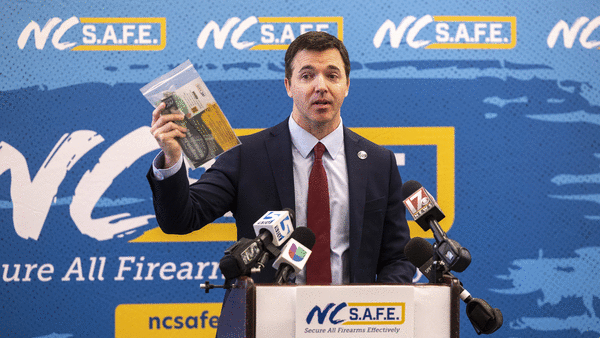
Jeff Jackson and several other state attorneys general won a lawsuit against two federal agencies that refused to release $17 million earmarked to this state for its response to Helene and other projects.
The Federal Emergency Management Agency and the Department of Homeland Security changed the terms of two grants — the Emergency Management Performance Grant and the Homeland Security Grant Program — after Congress enacted into law how much each state should receive, the federal lawsuit states.
The two agencies did this by requiring a hold on one grant until state officials provided a population assessment that excluded people who had been deported by immigration officials — information not readily available to the state — and by changing the dates projects could be enacted.
In North Carolina, FEMA’s changes meant risking reimbursements for expenses the state had already paid out after Helene struck North Carolina, causing historic damage in Western North Carolina and killing at least 108 people.
In November, Jackson joined other state attorneys general suing Homeland Security Secretary Kristi Noem, FEMA Acting Deputy Administrator Karen Evans and FEMA for “imposing unlawful terms” on the Emergency Management Performance Grant and the Homeland Security Grant Program without congressional approval.
“This abrupt change in policy is particularly harmful to local emergency management,” reads an order from U.S. Magistrate Amy E. Potter, issued in Oregon last week. “The decision not to backdate the EMPG awards means that many states and localities would not be reimbursed for emergency response expenses already incurred. None of this appears consistent with Congressional intent or FEMA’s mission.”
Jackson, one of several state leaders fighting the Trump administration for earmarked funding, celebrated this win in a press release on Monday.
“The court saw through FEMA’s attempt to break the law and deny money that North Carolina relies on to respond to hurricanes, natural disasters and other emergencies,” Jackson is quoted saying in the release. “Our state is going to get back the $17 million that Congress promised so that our emergency responders and law enforcement officers are ready to respond to the next crisis.”
Emergency Management Performance Grant
FEMA awarded North Carolina $8.6 million in EMPG funding in September. Typically, this funding can be used to reimburse costs incurred over the prior year.
The money was used to enhance and sustain preparedness and response operations related to the highly destructive remnants of Hurricane Helene, which hit North Carolina hard in September 2024. That included activating and deploying trained emergency management staff across the state to coordinate response efforts, shelter operations and logistic management. It was also used to purchase equipment after widespread power outages and communication failures.
After receiving the award from FEMA, North Carolina leaders learned that the agency changed the dates to Oct. 1, 2025, to Sept. 30, 2026, meaning money spent following Helene could no longer be reimbursed.
The money would also be recalculated based on the required adjustment to the state’s population number.
Homeland Security Grant Program
North Carolina received two other grants, worth a combined $21.1 million, under the Homeland Security Grant Program, focused on preventing, preparing for and responding to acts of terrorism.
Of the $21.1 million, $14.2 million was awarded through an Urban-Area Security Grant focuses on “high-risk urban areas.” Another $6.9 million was allocated through the State Homeland Security Program.
The grant program’s eligibility dates suddenly changed too, from Sept. 1, 2025, through Aug. 30, 2028 to Oct. 1, 2025, through Sept. 30, 2026, after the money had been awarded. That also altered what North Carolina was to receive.
The state uses these grants for including, training, conducting drills, improving school safety, conducting active shooter exercises, detecting drones and purchasing equipment for bomb squads and search and rescue teams, Jackson’s press release says.
The money also pays the salaries of nearly 100 state emergency management workers and personnel in all 100 counties and the Eastern Band of Cherokee Indians.
©2025 The News & Observer. Visit at newsobserver.com. Distributed at Tribune Content Agency, LLC.






Comments