Colombia's last major guerrilla group now a binational criminal force, report says
Published in News & Features
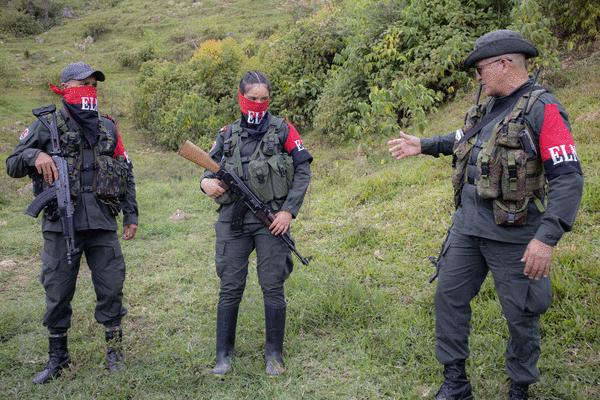
Colombia’s last major guerrilla force has evolved into a binational armed criminal organization deeply embedded in Venezuelan territory — with support from the Nicolás Maduro regime — according to a newly-released investigation that argues that the suspended peace talks with the insurgency were unlikely to succeed.
The report, Peace Never Had a Chance: Colombia’s ELN in Venezuela, released by InSight Crime, a non-profit think tank that provides in-depth analysis on organized crime and security issues, says the National Liberation Army (ELN) has expanded its finances, territorial control and political influence across the Colombia-Venezuela border, building what researchers describe as “a parallel state” inside Venezuela.
Its findings suggest the ELN is no longer simply a Colombian rebel movement interested in negotiating an end to their ongoing armed struggle, but a transnational actor with powerful incentives to preserve the status quo.
Six decades after its founding, the ELN has entered what researchers describe as its strongest and most expansive phase. With income from cocaine, gold, extortion and cross-border trade — and with Venezuelan recruitment rising — the group could soon dominate large stretches of the 2,219-kilometer frontier.
The peace process launched by Colombian President Gustavo Petro was doomed, the authors argue, not because talks broke down but because the guerrilla force entered negotiations from a position of historic strength.
“What rebel group has ever signed a political deal while it is growing in strength and the military option allowed for further expansion?” the report asks. “Petro sat down with an ELN stronger than ever before in its history — and with a huge strategic advantage: Venezuela and the support of the Maduro regime.”
A turning point in Catatumbo
The investigation highlights a decisive escalation in January 2025 in Catatumbo, a region along the northeastern Colombian border long considered one of the world’s most productive cocaine zones. According to the report, up to 200 ELN fighters crossed from Venezuela to launch a coordinated assault on FARC dissidents, killing more than 100 people and displacing an estimated 50,000. The attack effectively ended Petro’s peace talks.
Catatumbo’s importance is as economic as it is strategic. The region holds an estimated 55,000 hectares of coca, which could generate roughly $600 million annually at the farm level and up to $10 billion once exported, the report says. Controlling the area gives the ELN access to a financial engine capable of sustaining its operations indefinitely.
The group has expanded from taxing coca production to directly running laboratories, managing trafficking corridors and coordinating exports through illicit financial networks. That vertical integration now places the insurgency on par with mid-size drug cartels in terms of revenue and operational reach, investigators conclude.
A mutually beneficial alliance with Caracas
InSight Crime argues that the ELN’s consolidation in Venezuela would not have been possible without the support or acquiescence of senior Venezuelan officials. The report describes a symbiotic relationship built on ideological alignment, profit-sharing and shared security interests.
What began as sanctuary from Colombian military pressure, researchers say, has evolved into a political and economic entanglement. Venezuelan officers and officials allegedly benefit from revenue tied to smuggling, illegal mining and narcotrafficking, creating powerful incentives to maintain — and deepen — cooperation with the ELN.
The report characterizes Venezuela as a “hybrid criminal state,” where illicit income serves as a tool of governance and loyalty. In that environment, the ELN acts as a subcontracted security force, controlling smuggling routes, enforcing order in remote communities and serving as a buffer against an eventual foreign intervention from the United States, a country deemed by Caracas as its natural enemy.
The group has also become a component of Venezuela’s defensive strategy, the authors argue. In the event of external military action — including by Colombia or the United States — the ELN could mobilize thousands of fighters across terrain that has historically favored insurgent warfare.
A parallel authority along the border
In Venezuelan states such as Apure and Táchira, the ELN operates as a de facto government, according to the investigation. The group imposes curfews, regulates commerce and transport, operates informal judicial systems and levies taxes — including a 5 percent cut of public contracts in some municipalities. It mediates disputes, distributes food and pays salaries in regions where state institutions have collapsed.
Decades of economic crisis have made the ELN a source of stability for some communities. With an estimated 86 percent of Venezuelans living in poverty, joining the guerrilla can offer income and protection. Nearly 40 percent of ELN fighters operating in Catatumbo are now believed to be Venezuelan nationals, a demographic shift that could deepen the group’s entrenchment and complicate any future negotiations.
The report concludes that Colombia’s “Total Peace” initiative underestimated how far the ELN has transformed. Any agreement would require the organization to surrender territorial authority, criminal revenue and political leverage — concessions it has little incentive to make.
Petro negotiated with a movement that no longer sees itself as Colombian or primarily revolutionary, the investigation states. It functions as a territorial authority with access to lucrative illicit markets and state-provided sanctuary. Demobilization would mean relinquishing power, not trading it for political participation.
“Colombia needs to understand that the ELN is no longer just a Colombian guerrilla group; it is now a binational organization. This means that to dismantle it, there must be decisive action from both sides of the border, something that will not happen until Maduro leaves power,” Julio Borges, a longtime opposition politician and former president of the Venezuelan National Assembly, told InSight Crime
U.S. involvement and the risk of escalation
The report also warns that recent U.S. actions — including naval deployments and strikes on alleged narcotrafficking vessels — could feed escalation. Washington has increasingly portrayed the ELN as a threat comparable to groups such as al-Qaeda or ISIS, language that could justify more direct military engagement.
A transition away from the Maduro government would not necessarily weaken the ELN, the investigation cautions. On the contrary, internal fragmentation within Venezuela’s armed forces and continued dependence on illicit rents could fuel competition for territory and revenue. A post-Maduro administration may inherit a militarized border, corrupt security institutions and communities reliant on rebel governance.
Diplomats interviewed warn that even a democratic opening could trigger fresh conflict if the ELN seeks to defend its territorial footholds. The ELN is positioned to endure regardless of political transitions, the report concludes.
©2025 Miami Herald. Visit at miamiherald.com. Distributed by Tribune Content Agency, LLC.






Comments