How college campus organizing has been upended in Florida's political climate
Published in News & Features
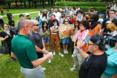
TAMPA, Fla. — In September, the Turning Point USA chapter at the University of South Florida’s Tampa campus held a vigil to honor its founder, conservative activist Charlie Kirk, who was murdered days earlier.
Thousands stretched down the street and attendees waited in the heat with signs and flowers. The chapter, part of the national Turning Point USA organization that advocates for conservative politics at college campuses, worked with USF to plan the event. The university provided free security and helped secure space at the student center last minute.
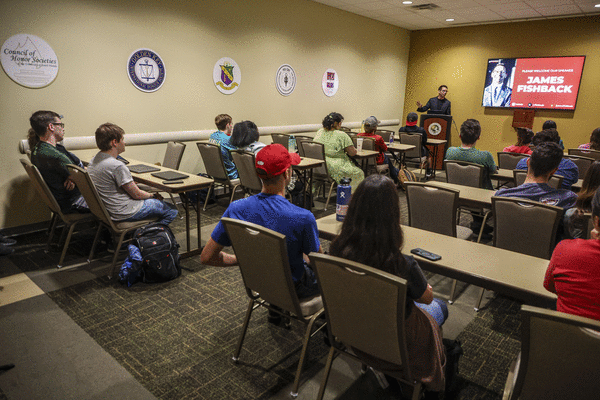
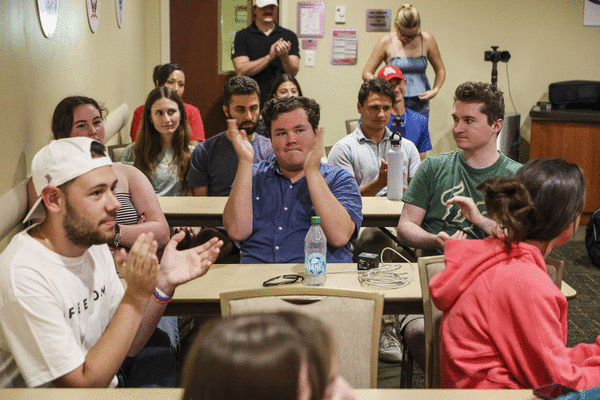
Club attendance surged after Kirk’s death, said Matt Montes, chapter president. Since then, the USF group has hosted right-wing investor and Republican gubernatorial candidate James Fishback and held a Kirk-style “Prove Me Wrong” debate with conservative pastor Josh Griffin.
At the same time, a progressive student group is navigating how to organize after being pushed off campus altogether.
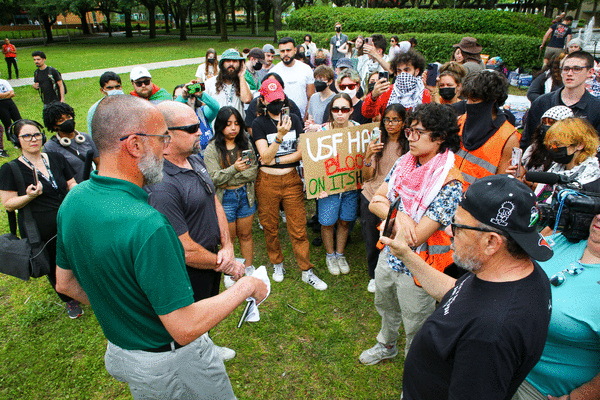
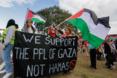
Tampa Bay Students for a Democratic Society, which is in the midst of a lawsuit against the university, was expelled from campus for two years following its pro-Palestine demonstrations.
Campus organizing, for both the left and the right, didn’t look like this a decade ago, said Amy Binder, a professor at Johns Hopkins University who studies collegiate activism. The reaction to Kirk’s death is another example of how both sides are responding to new political realities like the crackdown on diversity programs, heavy opposition to left-wing protests and a growing emphasis from state and university leaders on civil discourse.
While some right-leaning groups find support from their universities, some left-wing activists are alleging their schools have infringed upon their rights to free speech.
The viewpoints that are censored by universities change over time, said Graham Piro, a fellow at the Foundation for Individual Rights and Expression, a national group that advocates for free speech on campuses.
Some years, conservative students feel uncomfortable speaking out while liberal students feel more supported, he said, and vice versa.
Universities are allowed to establish restrictions on the reasonable time, place and manner of speech. That said, Piro emphasized, those policies must be enforced equally across viewpoints.
“A vigil on behalf of Charlie Kirk is probably going to be a bit more amenable to what administrators may look for on campus,” Piro said. “But that doesn’t mean that they’re able to treat protests more harshly.”
Conservative organizing
Reserving space at the student union as one of hundreds of clubs tends to be an uphill battle, Montes said.
It normally costs a USF student organization $110, plus security fees, to reserve all three ballroom sections.
But for the Kirk vigil, USF paid for a third ballroom section, metal detectors and bag searches and officials assured Montes they assigned every officer who was not on a call, he said.
Nick Coyte, the Florida Atlantic University Turning Point chapter president, had the same experience at his school.
“Given the suddenness of the assassination, (the university was) willing to speed up the process,” Coyte said. “We didn’t have to go through the typical bureaucratic channels to get an event planned.”
USF spokesperson Althea Johnson said the university has spaces and processes to accommodate events like memorials, which are challenging to plan in advance. They’ve approved the Nepalese Student Association and the Bangladesh Students Association, for example, to hold vigils without cost, Johnson said.
But right-wing groups haven’t historically used university resources like guidance from professors or spaces like cultural resource centers in their activism, Binder said. They’ve instead been supported by off-campus organizations, including groups like Turning Point USA.
Before Trump’s first term, conservative student groups often organized by hosting provocative speakers and holding purposefully controversial events, Binder said. (Think the ”Catch an Illegal Immigrant" game on the University of Texas campus or the Turning Point chapter at Clemson University holding an affirmative action bake sale). She said they thrived on the backlash.
“A way that conservatives can provoke, in the same way that protests do on the left,” she said, “is to bring in really confrontational, flamethrower-type speakers.”
Binder said conservative student groups have slightly toned down their on-campus events. Although Turning Point chapters have continued to invite provocateurs, Kirk’s campus visits, for example, were notably less charged than what he said on social media, she said.
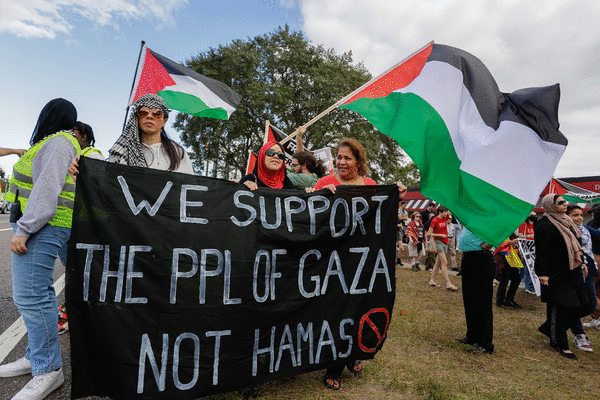
This change in strategy is likely because President Donald Trump is in the White House, Binder said. It also comes as Gov. Ron DeSantis and state higher education leaders have encouraged civil discourse while pushing back against diversity initiatives and classroom studies on topics like race and gender. DeSantis has also cracked down on what he’s called disorderly student protests in support of Palestine, calling in the Florida Highway Patrol to the University of Florida, USF and other campuses.
FAU President Adam Hasner praised the Turning Point vigil on FAU’s campus in a speech at the event.
“I’m hopeful that these events can provide an example and set an example of a level of civility and discourse that seems to be evading us,” he said. “Not only on college campuses across the country, but throughout our country.”
USF President Rhea Law sent out a campus-wide email shortly after Kirk’s death, reaffirming free speech as a pillar of the university. She referenced the vigil, writing that attendees and those nearby were able to listen and treat everyone with respect.
Montes said seeing the president’s praise was a “really good feeling.”
Response to left-leaning speech
Before they were expelled, Tampa Bay Students for a Democratic Society held vigils, too.
Two years ago, the group met at the Dr. Martin Luther King Jr. Plaza on USF’s Tampa campus, the school’s designated free speech zone, to honor Nex Benedict, a transgender teenager in Oklahoma. Benedict died by suicide after they were attacked by classmates. People left flowers and other offerings at the base of the MLK statue. Some gave speeches, and everyone quieted for a moment of silence.
Until recently, left-wing groups found a welcome home in some spaces dedicated to marginalized groups, like campus LGBTQ+ resource centers, Binder said. All Florida public universities shuttered their DEI programs last year, cutting faculty members who supported students in diversity, equity and inclusion issues.
“What (left-wing students) don’t have is an ecosystem of groups on the left that are going to shore them up in the same way that the right-wing ecosystem has historically shored up students,” Binder said.
Left-wing student groups have a long history of protesting on campuses, Binder said, while maintaining relationships with administrators.
This changed two years ago when left-wing groups set up pro-Palestinian demonstrations at campuses nationwide , Binder said.
The demonstrations and their aftermath created a divide between students and administrators.
Nick Ostheimer, the president of FAU’s College Democrats, organized a demonstration in early September to protest a policy that gives campus officers some powers of immigration enforcement. The protest went off without incident, but the school’s large security presence was jarring, Ostheimer said.
“We did everything possible by the book, and still, the whole time you were there, every other person at that protest was a police officer armed with a long gun,” he said.
Joshua Glanzer, a spokesperson for FAU, said the safety of the university community and anyone visiting, including protestors, is the utmost priority.
President Law wrote a university-wide email after the pro-Palestine encampment disbanded, expressing the university’s commitment to free speech. But she reiterated that expression must be peaceful and not break university policy. The students erected tents without written notice, university officials said. USF expelled and suspended a handful of students for their connection to the encampment.
Students for a Democratic Society sued the university this fall, alleging that USF published defamatory materials about the group, created arbitrary policies targeting them and encouraged police to use excessive force.
In a statement, USF spokesperson Ryan Hughes reiterated the points in Law’s email and said “there are consequences for students who fail to comply” with protest rules.
“We will defend ourselves against these meritless claims through the legal process,” Hughes said.
USF introduced a new policy prohibiting protests after 5 p.m., masks used to conceal identities and sharing literature without approval. Other universities across the country adopted similar policies.
Students for a Democratic Society is still organizing, though they can’t hold on-campus gatherings. It’s been a lot of trial and error, USF student Allie Enriquez said, in trying to stay connected to the university community through off-campus meetings.
Although their attendance dropped by half following the expulsion, Enriquez said, momentum has picked back up.
“As much as I disagree with the Trump agenda and everything that he and the right currently stand for,” Enriquez said, “I will say they’ve revitalized people’s interest, especially student interest, in organizing.”
©2025 Tampa Bay Times. Visit at tampabay.com. Distributed by Tribune Content Agency, LLC.




Comments