Seattle traffic worsens amid roadwork and return to office mandates
Published in News & Features
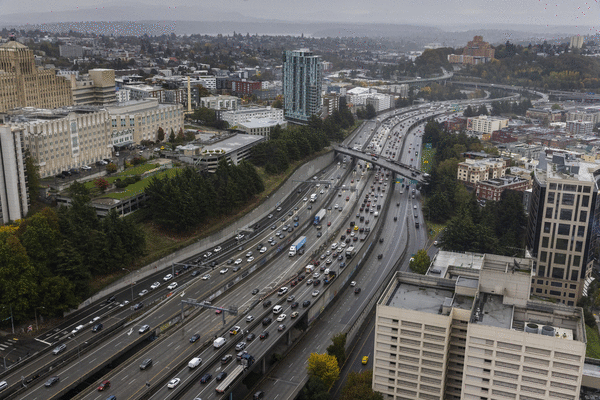
SEATTLE — Seattle drivers spent more time in traffic this year than they did in 2024, as construction on major corridors continued and remote work ebbed.
Motorists spent nearly three extra days behind the wheel, as the typical driver in the metro region lost 68 hours to traffic congestion in 2025, up 8% from 63 hours last year, and 19 hours more than the national average.
The Seattle region ranks 22nd for worst traffic delays in an analysis of 942 urban areas worldwide, sandwiched between Izmir, Turkey, and Melbourne, Australia, according to the INRIX Global Traffic Scorecard released this week, which uses congestion data through September, and estimates end-of-year traffic delays based on historical and seasonal trends for each urban area.
Nationwide, Seattle sits in 10th place, behind only a few of the nation's largest and most traffic-clogged cities.
Still, area commuters haven't yet plumbed the depths seen before the pandemic, when drivers lost 74 hours to congestion in 2019.
The primary culprits: work on the interstates, and return to office mandates by some of the area's largest employers.
There’s been a decent amount of construction and refurbishing," said Bob Pishue, a transportation analyst at INRIX, pointing to ongoing work to add lanes on I-405 between Renton and Bellevue.
Last week, the Washington State Department of Transportation said the project would not be finished by the end of this year as originally planned. Now, the work won't wrap up until summer 2027, WSDOT said, because "construction has moved slower than planned, and the contractor has not met key milestones in the contract."
Not coincidentally, the stretch of northbound I-405 between Renton and Interstate 90 was the most congested roadway in the region, and the 24th most congested in the country. "If you took that every working day, you’d have 61 hours of delay," Pishue said.
The next two corridors with the most congestion are I-5 from Northgate to the Mill Creek area, and northbound I-5 between South Albro Place and James Street, delays related to work on the Ship Canal Bridge, Pishue said.
There's no solution to congestion, but Pishue said reducing the amount of construction could help. Emergency shutdowns can be especially disruptive, like the complete closure of the Highway 99 tunnel below downtown Seattle last month that stretched what are normally 20-minute commutes well past the hour mark.
"When it's planned, the impacts are far less," he said. "It's the unplanned (work) that has a much larger shock to the system."
It wasn't just roadwork. Some notable employers told their employees to return to the office this year, including Amazon, which required its employees to work in-person five days a week, and Microsoft and its three-day-a-week mandate.
The shift to telecommuting, and the more recent reversion to in-office work, was more noticeable in West Coast cities like Seattle, Pishue said, which have less diverse economies compared to places like New York and Chicago.
"West Coast cities took a huge hit during COVID" as tech workers stayed home, he said. "The more you're dialed into one industry or two, the more your region is affected by those things."
As remote workers turn back into commuters, congestion has increased. In 2025, the time sitting in traffic cost the average driver $1,252 in wasted time and productivity, according to INRIX. The total economic toll to the region was $2 billion.
Seattle isn't alone in its worsening traffic.
Chicago, which ranked first — and worst — in the national rankings, had a 10% increase in delays from last year, and the typical driver there lost 112 hours to traffic this year.
New York City, in second, had no change year to year, a result of congestion pricing, which began in January and charges drivers to enter lower Manhattan.
On the West Coast, Los Angeles fared the worst with 87 hours of congestion, putting it fourth in the nation. San Francisco placed 15th, with 49 hours, and Portland was 25th, with 41 hours of delay.
Istanbul and Mexico City topped the list for the world's most traffic-clogged cities, with 118 and 108 hours lost, respectively.
With such a plague cast over the world's cities, a solution remains elusive.
The scorecard notes that some of the world's largest, most dense urban areas saw no increase in congestion, including New York, Los Angeles and Toronto in North America, as well as London and Paris.
All of these cities have taken congestion head on, with programs charging drivers to enter certain parts of the city, a massive expansion of transit or a robust push for alternative transportation like, in Paris' case, a quick build-out of its bicycle network.
Could any of those work here?
"Seattle's finding that out," said Pishue, pointing to the expansion of the regional light rail system. But, he said, transit isn't really designed to stop traffic delays, just help people avoid them. "It's mostly an alternative to congestion.
©2025 The Seattle Times. Visit seattletimes.com. Distributed by Tribune Content Agency, LLC.






Comments