David Murphy: The Sixers' shooting was a big problem in Game 1. The bigger problem is it might not have mattered.
Published in Basketball
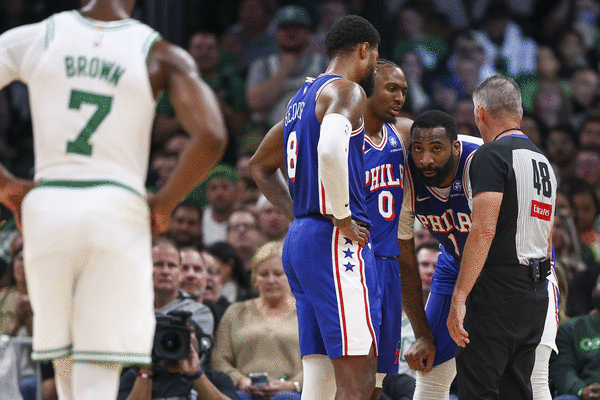
BOSTON — The bottom line is actually worse than any of the top-line numbers. And the top-line numbers were quite bad.
In a 123-91 loss to the Boston Celtics in Game 1 Sunday, the Philadelphia 76ers shot 39% from the field and missed 19 of their 23 3-point attempts. They turned the ball over 14 times and were credited with just four steals and blocks combined.
As Sixers coach Nick Nurse said afterward, “A lot went wrong, that’s for sure.”
The bigger problem?
It might not have mattered if everything had gone right.
The disparity between the Sixers and Celtics was so stark on Sunday that it almost feels meaningless to articulate. You could see it without looking at the scoreboard. The guys in green were full-grown men in their physical prime. The other guys looked a lot closer to your typical No. 7 or No. 8 seed than you would hope given the presence of two max contract stars with more than 150 games of playoff experience combined. Tyrese Maxey looked like he was playing 1-on-5 at times. Paul George attempted eight shots. Each of their combined 12 field goals looked like the result of an epic struggle compared to the easy 51 that Jayson Tatum and Jaylen Brown hung on them.
The usual sportswriterly parlance would paint Game 1 as a statement. Here was Boston, eliminating any doubt. Except, such a framework supposes that there was some modicum of doubt in the first place. There wasn’t.
Everybody knows it now. But they also knew it before. Boston entered this first-round series as the odds-on favorite to a laughable degree. To win $100 on a Celtics series win, you had to wager $950. They were a 12.5-point favorite heading into Game 1. Both of those numbers are gigantic. They were also conservative, it turns out.
“They didn’t feel like it was a playoff game,” said Tyrese Maxey, who led the Sixers with 21 points on 8-of-20 shooting. “We did, but they didn’t. They felt like it was an easy game.”
The problem wasn’t the Sixers’ failure to stop Tatum or Brown as much as it was their failure to stop guys like Neemias Queta. The Celtics’ rim-running center scored 13 points in 15 minutes with very little resistance. He entered the game with career playoff totals of 14 points and 26 minutes over five NBA seasons.
It’s not that Queta was great to any concerning degree. It’s that his was the kind of performance you tend to see when an opponent has no answers for anything.
In normal circumstances, the Sixers could find some silver lining in the potential for regression to the mean. They won’t give away any more points than they did in Game 1. That would be almost mathematically impossible. More than half their possessions ended with a missed shot or a turnover. Many of those misses were ones that even overmatched teams tend to make at a 40-50% clip. In the first half, they failed to convert on 10 of their 15 shots at the rim. Same goes for the 3-pointers. Kelly Oubre Jr., had good looks at the rim on each of his five threes, including a brick midway through the third quarter that could have cut the Sixers’ deficit to 12. From there, the Celtics’ lead quickly swelled toward 30.
“I thought we had a lot of good looks,” George said. “I thought we turned down some shots, but we also had a lot of good looks, a lot of chippy ones we usually make at the rim. I thought it was just one of those days where we missed some easy ones. Would it have made a difference? I don’t know. You give a team 123, and they shoot 50%, you aren’t going to win like that on the road.”
George pretty much nailed it right there. Sure, the Sixers will have better shooting nights. But Boston could, too. The Celtics’ 16 for 44 performance from long range was their median outcome during the regular season. They shot better than 40% from deep in 27 of 82 games. Their five offensive rebounds in Game 1 were fewer than they had in all but two regular season games.
“From the second quarter to midway through the third, we got ourselves underneath it a little bit and started playing some good basketball,” Nurse said, “but the minutes around that were unacceptable.”
With Joel Embiid sidelined with his appendectomy recovery and without much scoring juice behind him on the depth chart, the Sixers are going to struggle to win any game in which Maxey attempts just four 3-pointers and George attempts just eight shots total. VJ Edgecombe looked very much like a rookie in Game 1, same as he did in the Sixers’ play-in win over the Magic. Edgecombe missed all five of his 3-point attempts and finished 6 for 16 from the field overall.
Unless George can summon a playoff performance from years past and Maxey can regain the pull-up jumper that has eluded him since his March finger injury, the Sixers are going to struggle to compete. One hopes they struggle a little less in Game 2.
©2026 The Philadelphia Inquirer. Visit inquirer.com. Distributed by Tribune Content Agency, LLC.




Comments