John Romano: Public subsidies for stadiums are exploding. Can Tampa Bay keep up?
Published in Baseball
TAMPA, Fla. — Still fuming about the rising cost of a cup of coffee? Just wait until you try to buy a baseball stadium.
The baseline for state-of-the-art sports facilities used to be outrageous but now probably qualifies for the Supreme Court definition of obscene.
You might be inclined to blame that on inflation or tariffs or regulations, and those all likely play a role in the escalating cost. But for the typical taxpayer on Main Street USA, the real culprit is your crazy neighbor in Kansas. Or Washington D.C. Or any number of other desperate municipalities.
We’re not talking about the actual cost of construction — which is significant and rising daily by itself — but the public funds/enticements that are being tossed around so towns can either lure or retain baseball, football, hockey and basketball teams.
In the past four months, politicians in D.C. and Kansas have not just upped the ante for what local/state governments are willing to pay to get NFL stadiums built, they’ve darn near broken the bank.
The Washington Commanders have agreed to pay the entire $2.7 billion cost (plus overruns) to build a domed stadium in the nation’s Capitol, which sounds like the civic-minded thing to do, except D.C. is paying around $1.1 billion in infrastructure costs, it is offering another $1 billion in tax breaks and other incentives, and it is giving the team a bunch of valuable land rent-free to use for development, which is likely worth billions more.
To which Kansas said, hold my overpriced stadium beer.
In luring the Chiefs across the Missouri/Kansas border about 30 miles down the road from Kansas City, the governor has offered about $2.4 billion in bonds for a new stadium, practice facility and mixed-use development. The team is coughing up about $1.6 billion but will keep 100% of stadium revenues.
“If you had asked me three months ago whether the D.C. deal was the new normal, I would have said, ‘No, no, no.’ That deal was an outlier. No one is stupid enough to do that again or try to beat that deal, right?” said Geoffrey Propheter, an associate professor at the University of Colorado-Denver who has written extensively on stadium costs. “No one would give D.C. a run for their money for the most egregious subsidy deal ever.
“Then, of course, Kansas comes along.”
———
You know where this is going, right?
The Rays have been talking about building a new stadium for nearly 20 years with a variety of stops and starts, designs and concepts, sites and wish lists. The first plan was introduced in 2007 and would have cost $450 million on the St. Petersburg waterfront with the redevelopment of the Tropicana Field site providing the biggest revenue source.
Since the demise of that idea, the Rays have proposed ballparks in Ybor City and the Historic Gas Plant District, and seriously considered a handful of other locations on both sides of the bay, as well as Montreal. After coming to an agreement with St. Petersburg and Pinellas County on a deal to rebuild at the Trop site using more than $600 million in public funds, former owner Stuart Sternberg exercised an out clause and walked away from the deal in 2025.
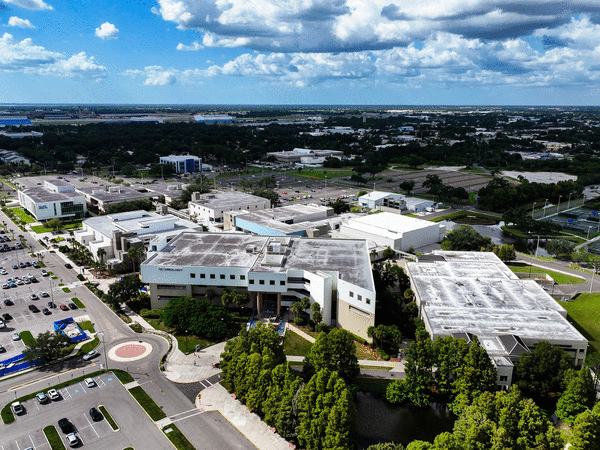
The latest plan — although not officially acknowledged by the team’s new owners — appears to be the campus of Hillsborough College across the street from Raymond James Stadium and a long fly ball from Steinbrenner Field. The stadium price tag has grown to well over $1 billion.
But if the idea ever reaches elected officials in Hillsborough County, the final price will not be the sticking point. Instead, it will be the size of the public investment. The Tampa Bay Times reported in October that the Rays could be seeking as much as $1.1 billion in subsidies.
Based on the public contributions in Washington D.C. and Kansas, that $1.1 billion might be a little light.
If you’ve been paying attention to previous proposals and counter proposals, that sounds like the Hillsborough College idea won’t even make it out of the registrar’s office. When the Rays were negotiating for an Ybor stadium in 2018, the best offer they got from Hillsborough/Tampa was roughly $450 million for a $900 million stadium. Jumping from $450 million to $1.1 billion or more sounds a bit fanciful considering Tampa’s reticence in the past.
Except for … D.C. and Kansas. And, to a lesser extent, The Battery in Atlanta.
The pitch the Rays are expected to make is the same one that the Braves used to successfully build an entertainment district/ballpark in Cobb County in 2017. And the Commanders and Chiefs used that same philosophy in recent months.
The basic premise?
By using a stadium as an anchor for a 100-acre multiuse development, municipalities could recoup their initial investment with funds from property taxes on new construction, liquor taxes in new bars and restaurants, and a variety of other fees and taxes that would not otherwise exist without the project.
It’s an intriguing idea that obviously wooed politicians in D.C., Cobb County and Kansas.
It’s also a load of hooey, according to economists and critics around the globe.
Multiple studies suggest that communities rarely — if ever — see an economic impact that matches the public investment made in the building of stadiums or arenas.
“There’s been a rise in the idea of a stadium district, but what they’ve tended to be is much more of a real estate play,” said John C. Mozena, president of the Center for Economic Accountability. “If a generic real estate developer came in and said, ‘Hey, we want the college to give us their land so we can construct office buildings that we can make a profit on,’ nobody is going to listen to them. That would get laughed out of City Council, or whatever other decisionmakers are involved.
“But if they say, ‘Oh, we’re going to build a stadium,’ that grabs people’s hearts and minds and the best judgment gets thrown out the window because sports are an emotional and tribal thing.”
• • •
These stadium plans tend to work like fashion trends. In the late 1960s/early 1970s, round, multiuse stadiums were all the rage, and cities like Pittsburgh, Cincinnati, Philadelphia, St. Louis, Atlanta, San Diego and Oakland all built similar-style ballparks. Thirty years later, around the time those stadiums were paid off, a new retro, brick-style ballpark came into vogue after Baltimore built Camden Yards.
Between 1989 and 2012, 24 of MLB’s 30 franchises moved into new stadiums, a rate of 1.7 new ballparks per season.
Now, we are entering the next generation of construction and the stadium-as-an-entertainment-anchor appears to be the favored concept.
Economists tend to look at these deals from a spreadsheet perspective, and the vast majority agree they’re not financially sound in a dollar-for-dollar breakdown of what communities put in and what they get back.
Lost in that perspective are the intangibles that a franchise brings to a community, although critics suggest that concept is also vastly overrated. Still, the Rays could make a strong argument that downtown St. Pete was a virtual ghost town when the team began playing in 1998 and, a generation later, is now a thriving, funky, artistic centerpiece of Florida’s Gulf Coast.
The question is whether the ancillary benefits of being a “big-league” city is ultimately worth the cost.
Based on the way politicians continue to throw money at stadium projects, you would think the answer is a resounding yes. But even that evidence is somewhat skewed. When left up to residents, referendums for stadiums and arenas tend to be slightly favorable toward teams. According to data compiled by Propheter, the Colorado professor, referendums were approved by voters roughly 61% of the time in dozens of votes around the country from 1990 to 2023.
The odds are far more favorable when going through legislative bodies, likely because the economic impact — good or bad — is usually not felt until years down the road when politicians have moved on to different offices.
“It all creeps up on you over time,” Prairie Village (Kan.) council member Ian Graves told NPR in Kansas City. “In one or two election cycles, it’s going to be like, ‘Gosh, we really have this budget shortfall, and it’s because we’ve nuked off all this natural growth from (counties) feeding into the state coffers.’ And so how are they going to plug that hole? Are they going to cut services? They going to raise taxes? They going to do both? And that will be a question for future Kansas.”
From Tampa Bay’s perspective, the real threat comes from communities willing to go overboard to get in the game.
Maybe Kansas spent stupidly in order to lure the Chiefs across the state line, but the governor considers that stadium project to be an economic driver unlike anything else in the state. Similarly, the state of Maryland once invested heavily in luring Washington’s football team away from D.C., and now the district is turning its coffers upside down to get the team back in the city.
The Braves did not just build a new ballpark in downtown Atlanta. Instead, they went 20 miles away to an affluent suburb in another county willing to spend to be in business with MLB. The Athletics are set to become the first MLB team to relocate to another state in more than 20 years when they go to Las Vegas.
Could something like that happen with the Rays?
Baseball commissioner Rob Manfred has clearly expressed a preference for the Rays to remain in Tampa Bay, but he also said the same thing about the Athletics when they were negotiating for a new ballpark in Oakland.
And while Manfred has drawn a distinction between Tampa Bay and Orlando, that distance may not seem so impenetrable if the Rays do not find a stadium deal to their liking in Hillsborough County.
As history has shown, it only takes one desperate community armed with municipal bonds to completely change the landscape — and the zip code — of a baseball or football team.
____
©2026 Tampa Bay Times. Visit tampabay.com. Distributed by Tribune Content Agency, LLC.






Comments