House Democrats eye stock trading ban as early priority next Congress
Published in Political News
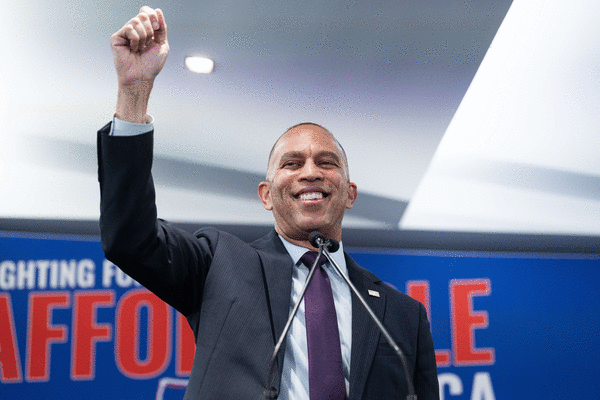
WASHINGTON — After stock trading became a major talking point on the campaign trail this fall, Democrats are feeling pressure to push through a bill in the new year.
But banning trading by members of Congress may not be easy, and some worry the issue could get bogged down in larger debates over the party’s anti-corruption agenda.
“I’d rather have it be a clean bill focused on stock trading, and not muddy it by adding other topics, even if they’re good policies,” said Rep. Seth Magaziner, D-R.I.
The incoming majority could plant a flag on government accountability with a broad package ranging from insider trading to campaign finance and more. Or they could zoom in on the stocks issue with a standalone bill.
Magaziner said he hasn’t received any assurances from House Democratic leaders, instead describing a “collaborative conversation” about what form the legislation could take.
“I worry that it would get weighed down under its own weight if you try to load it up with too many things,” Magaziner said, while stressing he would support whatever expected incoming Speaker Hakeem Jeffries decides.
Meanwhile, more than half of the Democrats in the incoming freshman class are calling for action on Day One of the new Congress, sending a letter to Jeffries last week suggesting they make a “down payment on much-needed reform” by changing House rules to curb stock trading.
“Democrats may have won the election, but we have a long way to go to earn back the trust of voters across the country,” reads the letter, signed by Reps.-elect Sarah Trone Garriott of Iowa and Jamie Ager of North Carolina. “A stock trading ban alone will not fix Washington, but it is the fastest way to show voters we heard them.”
Folding new language into the House’s internal rules would be a relatively easy path, requiring just a majority vote on the House floor, instead of passage in both chambers and the president’s signature. But such internal limits wouldn’t have the force of law, and some believe it would cool the urgency around the issue while doing little to crack down on insider trading.
Colorado Rep. Jason Crow said moving forward quickly with a rule change wouldn’t preclude passing a bill, suggesting his fellow Democrats do both.
“I want to pursue a parallel track,” said Crow, who co-chairs the End Corruption Caucus. “We want to move via rule and just prohibit it right out of the gate, or as much as we can.”
What’s in a ‘ban’?
Jeffries has repeatedly said the topic is high on his to-do list as he looks to deliver on the accountability the “American people are demanding.”
“We’re committed to making sure we pass legislation that bans members of Congress from trading stocks. That will be a high priority,” he said at a news conference this week.
But with more than two dozen different bills on the topic introduced over the past few years alone, lawmakers will have to decide exactly what a “ban” means to them.
Some want to force members of Congress to fully offload their stocks with the exception of widely held mutual funds. Other proposals would block lawmakers from buying new stocks but allow them to keep the ones they already own, like a Republican-led bill that passed the House earlier this year but stalled in the Senate.
Democrats resisted that push, which was led by outgoing House Administration Chair Bryan Steil, R-Wis., partly because it included an unrelated voter ID provision they called a “poison pill.” Many also complained the measure didn’t go far enough, extending to members’ spouses and dependent children but leaving out key figures in other branches of government, such as the president.
Rep. Pramila Jayapal, D-Wash., said she wants to stay close to the text of a consensus bill she hammered out last year with a small bipartisan group that included Magaziner and Reps. Chip Roy, R-Texas, Alexandria Ocasio-Cortez, D-N.Y., Tim Burchett, R-Tenn., and Brian Fitzpatrick, R-Pa.
“That is the most comprehensive, thorough, thoughtful proposal and bipartisan proposal that we have,” she said of the bill, dubbed the Restore Trust in Congress Act.
That measure would not apply to President Donald Trump, as many Democrats have urged as they seek to draw attention to his ballooning wealth while in office. Still, Jayapal suggested a presidential stock trading ban could be moved separately.
“There is discussion about the president, vice president, Cabinet, Supreme Court. I know we’re working on some language around enforcement, around those pieces, but I actually think that can be a separate bill,” Jayapal said. “We want to hold everyone accountable — but at minimum, we have to do ourselves.”
Something vs. nothing
It’s not clear how much appetite will exist next year for a bipartisan compromise that could realistically clear a 60-vote cloture threshold in the Senate. Notably, key Republicans who worked on the consensus bill will be leaving Congress, with Roy losing a primary bid for Texas attorney general and Fitzpatrick unseated by a Democratic challenger.
While lawmakers could in theory advance a new stock-trading bill even sooner, before Democrats take control of both chambers, time and patience is short in the lame-duck session.
At a news conference at the Capitol earlier this week with Crow and Jayapal, a group of freshman and returning Democrats took matters into their own hands, promising not to hold or trade individual stocks as part of a broader pledge backed by the Political Integrity Project.
“My district, New York 10, happens to include Wall Street, but I don’t represent Wall Street. I represent the people of Brooklyn and Manhattan who deserve someone who goes to work every single day and shows right up front, ‘I work for you.’ And what better way to prove that than by day one showing we will ban members of Congress from enriching themselves, from trading stocks?” Rep.-elect Brad Lander said.
While momentum has grown in recent years as key senior lawmakers softened their resistance to a stock trading bill, not everyone is on board. Some members still argue, whether publicly or privately, that they should be able to trade on the stock market just like other citizens or that existing disclosure requirements established by a 2012 law are already enough to discourage dubious trades.
As they iron out the legislative text of any new bill, members will have to decide how to handle emerging topics such as prediction markets and crypto, along with sticky questions such as whether to allow blind trusts. And extending restrictions to the president could be a nonstarter for many Republicans.
Sen. Josh Hawley, R-Mo., said Democrats in the next Congress should look to a bipartisan bill that advanced out of the Senate Homeland and Governmental Affairs Committee in July 2025 as a model.
“The legislation we passed out of the committee applied to the executive branch,” he said. “But it didn’t take effect for anybody until their next terms, which was a compromise.”
That proposal would apply to future presidents but not the current one, potentially freeing up more Republicans to vote for it without angering Trump. Still, it hasn’t seen action on the Senate floor.
Hawley said that while he’d like to see a “full ban on trading and holding” in Congress, he would be open to a weaker proposal in the interest of getting something done.
“I’ll take anything that’s an incremental improvement over what we have now, which is nothing,” he said.
_____
Aris Folley contributed to this report.
_____
©2026 CQ-Roll Call, Inc. Visit at rollcall.com. Distributed by Tribune Content Agency, LLC.














































Comments