Marco Rubio testifies he was 'unaware' of former Rep. David Rivera's $50 million deal with Venezuelan subsidiary
Published in Political News
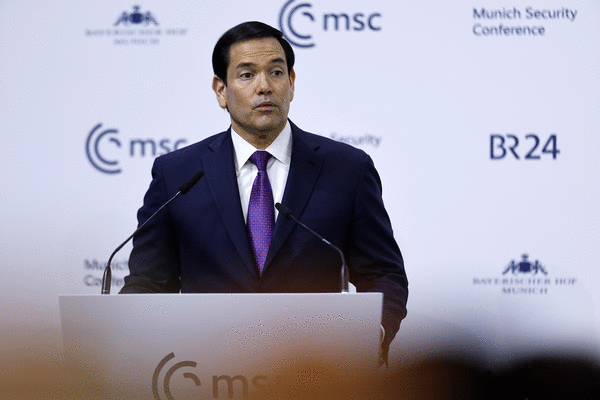
MIAMI — Secretary of State Marco Rubio testified Tuesday at the Miami federal trial of former Congressman David Rivera that he never would have talked with his friend about his plan for democratic elections in Venezuela if had known that Rivera had signed a $50 million contract with the U.S. subsidiary of the country’s national oil company.
Rubio, the former Republican senator from Miami, said he had no idea Rivera had secured the highly profitable agreement with PDV USA when he met with him twice in 2017 to discuss the plan to oust Venezuelan President Nicolás Maduro and make way for an opposition leader.
“All I can say is, I was unaware of any agreement,” Rubio testified.
Rubio also said that while he always considered Rivera a staunch critic of communism and socialism, his view of the former GOP conservative would have been different if he had known about his contract with the Houston-based oil company that Rubio considered to be under the control of the Venezuelan government and Maduro.
During his three-hour testimony at Rivera’s trial on charges of failing to register as a foreign agent for Venezuela, federal prosecutor Harold Schimkat asked Rubio what he would think of his friend’s politics if he knew he had been working as a secret lobbyist for the Venezuelan regime almost a decade ago.
“It would have been shocking,” Rubio said at the end of his testimony, before leaving through a side door in the Miami federal courtroom amid heavy security.
His testimony in the federal criminal trial was highly unusual, given that Rubio is among the highest-ranking officials in the Trump administration advising the president on consequential global matters, including the U.S. war against Iran.
Rivera, 60, and Miami-Dade political consultant Esther Nuhfer, 51, are standing trial on charges of conspiring against the U.S. government, acting as unregistered agents for the Venezuelan government and money laundering, stemming from his company’s contract with PDV USA, which operates as Houston-based CITGO in the United States.
Their defense attorneys, however, counter that it is a holding company based in New York and incorporated in Delaware, therefore not affiliated with the state-owned oil business, PDSA, in Caracas. Consequently, Rivera and Nuhfer did not have to register as agents for Venezuela with the U.S. Attorney General and did not break the law.
Throughout Rubio’s testimony, attorneys for both Rivera and Nuhfer peppered the former senator with questions about his longtime friendship with both defendants, dating back to 2004, and their conservative political beliefs to demonstrate to the jury that they were not trying to “normalize” relations with Maduro, as an indictment alleges.
Rivera’s attorney, Ed Shohat, asked Rubio if Rivera had ever said anything nice about Maduro in any of their conversations. His answer: “No.”
Shohat asked him several times if Rivera was an ardent opponent of communism in Cuba and socialism in Venezuela.
“He was known for that,” Rubio said. “It was consistent throughout his career.”
Then, Shohat asked Rubio about his autobiography, “American Son,” chronicling his life as the son of Cuban immigrants, and how he credited Rivera with providing political assistance and in the book’s acknowledgments.
Request for Rubio to sign his book
Rubio recalled Rivera’s loyal support over the years — both had shared a home in Tallahassee about 20 years ago when they were both serving in the state Legislature — and read the book’s acknowledgments in court.
At the end of his cross-examination, Shohat asked Rubio to sign his copy of the former senator’s book, which elicited laughter in the packed courtroom.
Rubio testified about two meetings he had with Rivera and others in Washington to discuss efforts to oust Maduro and replace him with an opposition candidate in a democratic election.
In the first, he and Rubio met at the senator’s residence in Washington on July 9, 2017. They discussed how Rivera’s contact, wealthy Venezuelan businessman Raúl Gorrín, could broker Maduro’s exit because he was believed to be close to both the president and his political opponents.
Rubio testified that he knew of Gorrin and thought he was “a corrupt Maduro insider,” but was willing to consider Rivera’s proposal if it meant a chance at resolving the crisis in Venezuela, an oil-rich country that collapsed economically under the rule of Maduro and his predecessor, Hugo Chavez.
“I questioned whether it was real and was worth my time,” Rubio testified.
In making his pitch, Rubio said, Rivera opened his computer and showed the GOP senator an online bank account with JP Morgan Chase containing a substantial amount of money that Rivera said Gorrín would use to support the opposition in Venezuela.
Rubio testified that he did not ask Rivera about the bank account, which held millions of dollars. Rivera likely showed Rubio the account of his company, Interamerican Consulting, which had received $15 million from PDV USA at that point.
On July 11, 2017, Rubio said he spoke with President Donald Trump and his staff about a potential solution to the Venezuelan crisis and delivered a speech on the Senate floor about U.S. interests in a peaceful transition of power in the country.
Meeting at Washington Marriott
The following day, the senator met with Rivera, Gorrín, Nuhfer and others at the Marriott Hotel off Connecticut Avenue in Washington rather than Rubio’s office because he didn’t trust Gorrin.
Rubio testified that he thought the meeting was going to be about Gorrín’s role to obtain a letter from Maduro indicating his willingness to hold democratic elections in Venezuela and to arrange to have that letter delivered to President Trump. At the time, Trump was considering sanctions against Maduro, other senior officials and Venezuela’s state-owned oil company, PDVSA.
But Gorrin spent the entire time talking about why life was so bad in Venezuela, and didn’t bring the letter from Maduro as promised under Rivera’s plan.
One of the Venezuelan opposition leaders, Henry Ramos Allup, participated in the hotel meeting by phone from New York and also spoke about the country’s dire economic conditions under Maduro.
“I didn’t understand, frankly, that we had the meeting,” Rubio testified. “It was a total waste of time. I was angry and frustrated.”
Rubio said the meeting was “the only time” that he and Gorrín spoke, leaving him wondering why the Venezuelan tycoon flew from Miami, where he owned a waterfront home, to Washington.
Rubio said he and Rivera discussed potential sanctions against certain high-ranking Venezuelan officials, including Maduro, whom they referred to as “the bus driver,” his former job before he entered politics during the socialist revolution of his predecessor, the late President Hugo Chavez.
After receiving mixed messages from Gorrín, Rivera arranged for Rubio to deliver a speech promoting the plan for a peaceful transition of power on Gorrín’s TV station, Globovision, in Caracas. Rubio gave the speech on July 31, 2017 — the very day the Trump administration issued the “first wave” of sanctions against Maduro and his government after he refused to hold democratic elections.
$50 million contract
Rivera and co-defendant Nuhfer, the political consultant, are accused of failing to register as foreign agents with the U.S. Attorney General in March 2017 when Rivera’s consulting company signed the $50 million contract with the Houston-based subsidiary of Venezuela’s national oil company, PDVSA, which operates as CITGO.
The contract was ostensibly for promoting CITGO’s expansion in the United States, including resolving oil-drilling disputes with U.S. behemoth Exxon, whose holdings had been nationalized by Venezuela.
Both Rivera and Nuhfer counter that they were working directly for the U.S. subsidiary of Venezuela’s state-owned oil company, PDV USA —not for PDVSA itself — and therefore they didn’t have to register as foreign agents for the Venezuelan government and didn’t break the law.
Rivera’s consulting firm received $20 million from PDV USA before the U.S. subsidiary ended the contract after a falling out in 2017.
However, federal prosecutors say a high-ranking Venezuelan official close to Maduro arranged the highly profitable contract between Rivera’s consulting firm, Interamerican, and PDV USA as a cover so that Rivera, Nuhfer and others could be compensated for lobbying to gain political support for Venezuela to “normalize” relations with the United States.
They accuse Rivera and Nuhfer of deliberately not registering as foreign agents for Venezuela so they could lobby U.S. government officials such as Rubio without their knowledge.
As part of that scheme, prosecutors say, Rivera and Nuhfer sought to prevent sanctions against Maduro and other high-ranking officials in Venezuela.
But on Tuesday, Nuhfer’s defense attorney, David O. Markus, hit Rubio with a series of questions that raised doubts about why she was named as a co-defendant in the criminal case with Rivera.
Markus, noting that Nuhfer and Rubio’s wife had been in a Bible studies class together, asked the former senator if his client was always trustworthy, acted in good faith and generous as a person.
Each time, Rubio answered, “Yes.”
Markus asked him if she was strongly opposed to socialism in Venezuela. Again, he said, “Yes.”
Then the attorney asked Rubio if Nuhfer asked any questions at the second meeting in Washington with Rivera and others, or whether she ever lobbied him for anything, or was ever under the control of the Venezuelan government.
Each time, Rubio answered, “No.”
Prosecutors charged her along with Rivera because, ultimately, Rivera divided about $13 million of the $20 million he received from PDV USA among three Miami associates: Nuhfer, Gorrin and a developer Hugo Perera.
Records show Nuhfer received about $4 million for introducing Rivera to Perera, who was a neighbor of Gorrin’s on exclusive Fisher Island. Perera, in turn, introduced Rivera to Gorrin, who had access to Venezuela’s political inner circle, including Maduro.
_____
©2026 Miami Herald. Visit miamiherald.com. Distributed by Tribune Content Agency, LLC.


Comments