Trump signals possible end to war, floats removing oil sanctions
Published in Political News
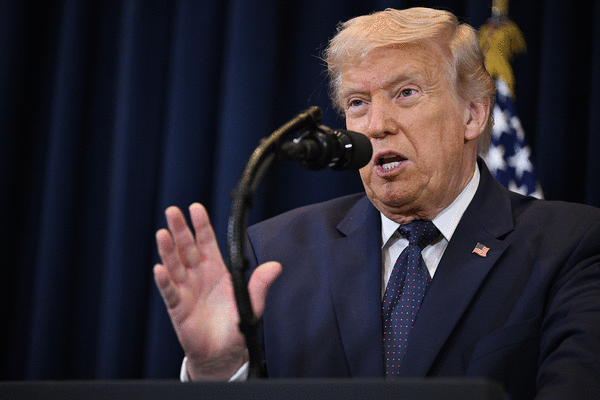
WASHINGTON — President Donald Trump said he plans to waive oil-related sanctions, have the U.S. Navy escort tankers through the Strait of Hormuz and predicted the war with Iran would resolve “very soon” as he confronted mounting economic and political pressures after days of dramatic fluctuations in oil markets.
The president said he didn’t believe the conflict would be over this week, but insisted the operation was ahead of schedule and looked to shore up investors increasingly concerned about energy prices. He vowed bombing “at a much, much harder level” if Iran disrupted oil supplies alongside his sanctions pledge.
“We’re looking to keep the oil prices down,” Trump said at a news conference at his resort in Doral, Florida. “They went artificially up because of this excursion.”
The president didn’t offer additional specifics, beyond acknowledging he had discussed the topic with Russian President Vladimir Putin in a phone call earlier Monday. Russia has faced sanctions on its oil revenue in an international bid to deprive the country of revenue over its war in Ukraine.
Trump is mulling a menu of possible options to combat surging oil and gasoline prices in the wake of the Iran war, according to people familiar with the matter. Those could include releasing emergency stockpiles, pausing federal gas tax collections — something Congress would have to approve — and the U.S. Treasury Department’s involvement in the oil futures market. Treasury Secretary Scott Bessent had previously suggested the U.S. could waive more Russian oil sanctions, after moving last week to temporarily allow Indian refiners to purchase more Russian oil.
While U.S. officials have repeatedly insisted they can prosecute the conflict indefinitely, Trump’s remarks underscored a new willingness by the White House to publicly indicate that it could be moving soon to attempt to wrap up hostilities.
“Together with our Israeli partners, we’re crushing the enemy in an overwhelming display of technical skill and military force,” Trump told Republican lawmakers earlier Monday. At the press conference, the president claimed the U.S. had hit 5,000 targets in the country, said Iran’s missile capability was down to 10%, and that drone launches from the country had decreased 83%. The U.S. military objectives could be described as “pretty well complete,” Trump said.
At the same time, Trump acknowledged unanswered questions that remained about the leadership in Tehran and vowed he would “not relent until the enemy is totally and decisively defeated.” The president said that while the US had sunk more than 50 Iranian ships, a prolonged conflict could see the U.S. bomb additional “important targets” including electricity production facilities.
“We’ve already won in many ways, but we haven’t won enough,” he said. “We go forward more determined than ever to achieve ultimate victory that will end this long-running danger once and for all.”
The comments underscored the challenges ahead for Trump, who will need to reconcile his promises of total victory with the economic and political consequences of continuing the war.
U.S. stocks recovered from losses earlier Monday, after the president made initial comments signaling an openness to ending the conflict to CBS News. Those comments sent the S&P 500 up as much as 1%, after a CBS reporter posted the comments on X. Oil and U.S. Treasury yields fell.
U.S. oil futures fell below $90 a barrel post settlement after surging above $119 early in the session in a volatile trading day. Markets eased as the world’s largest economies considered a coordinated effort on emergency energy supplies and Trump’s comments signaled he could seek a conclusion to the conflict.
Still, the Strait of Hormuz remained all but closed, with no finalized plans on how nations will safeguard ships passing through the key waterway.
Trump told CBS the Strait of Hormuz was seeing more ship traffic and that he is “thinking about taking it over.” It was not immediately clear what specific actions the president was contemplating.
The U.S. president, already facing domestic concerns over persistent inflation ahead of November midterm elections, must now grapple with rising gasoline pump prices as the war shows no letup. On Sunday, he called $100 oil a “small price to pay” and said the cost “will drop rapidly when the destruction of the Iran nuclear threat is over.”
The effective closure of the Strait of Hormuz has forced Saudi Arabia, the world’s biggest oil exporter, to reduce production, according to a person familiar with the matter. That follows similar moves by the United Arab Emirates, Kuwait and Iraq.
Trump on Monday warned Iran against blocking oil transporting through the strait, saying that if it did so “they will be hit by the United States of America TWENTY TIMES HARDER than they have been hit thus far.”
“Additionally, we will take out easily destroyable targets that will make it virtually impossible for Iran to ever be built back, as a Nation, again — Death, Fire, and Fury will reign upon them — But I hope, and pray, that it does not happen!”
Futures pulled back after Group of Seven finance ministers said they were ready to take any steps needed to support global energy supply, including releasing strategic oil reserves.
Still, the G-7 is “not there yet” in terms of agreeing to tap emergency energy supplies, according to France, which holds the current presidency. But the group said in a statement that it would “continue to closely monitor the situation and developments in the energy markets” and “stand ready to take necessary measures, including to support global supply of energy such as stockpile release.”
The U.S. reported its seventh casualty on Sunday. Two Israeli soldiers and about a dozen Israeli civilians also have lost their lives. Data from the UAE suggests Iran’s barrage of missiles and drones is easing, even as Tehran is still attacking Israel and Arab Gulf states regularly with drones and missiles.
More than 1,300 Iranians have died in the war so far, according to an official toll that’s not been updated for several days. Some 486 people have died in Lebanon, according to the nation’s health ministry. Four civilians died in the UAE, while two members of its armed forces were killed when a malfunctioning helicopter crashed. There also have been several deaths in other Gulf countries.
Israeli forces maintained attacks on southern Lebanon, aiming to degrade Iran-aligned Hezbollah. The North Atlantic Treaty Organization intercepted a ballistic missile fired from Iran toward Turkey on Monday, the second such incident, raising the risk the military alliance could be drawn more directly into the conflict.
On Sunday, Iran’s media announced that Mojtaba Khamenei — whose father Ayatollah Ali Khamenei ruled the country for almost 37 years and was killed when US-Israeli strikes began on Feb. 28 — won a “decisive vote” in Iran’s Assembly of Experts to become supreme leader.
The 56-year-old has deep ties to the Islamic Revolutionary Guard Corps, about the most powerful military and economic organization in Iran. The group pledged full obedience to the new leader.
On Monday, Trump indicated his displeasure, saying Iran should put in a leader “that’s going to be able to do something peacefully, for a change.”
The new leader “shares many of the same ideological leanings as his father and will aim to maintain continuity — including in the war,” said Dina Esfandiary, a Bloomberg Geoeconomics analyst. His election “suggests Iran won’t be shifting tack in the Middle East war,” she said.
Saudi Arabia and Bahrain again dealt with incoming projectiles again overnight, while blasts were reported across Iran, including in the capital Tehran.
Saudi Arabia, which has intensified its diplomatic outreach to Iran, has also hardened its tone in recent days. The Saudi foreign ministry warning Monday that Tehran’s actions risk further escalation, in which Iran “will be its biggest loser.”
On Monday, the U.S. ordered American non-essential diplomats in Saudi Arabia to leave the country, citing safety risks.
_____
(With assistance from John Harney, John Bowker, Mike Cohen, Devika Krishna Kumar, Jordan Fabian, Michael P. Regan, Nick Wadhams and Meghashyam Mali.)
_____
©2026 Bloomberg L.P. Visit bloomberg.com. Distributed by Tribune Content Agency, LLC.



































Comments