As primary looms, Illinois Republican governor candidates say they oppose abortion-is-murder bill
Published in Political News
Opposing abortion has been an Illinois Republican litmus test for decades, but even the party’s four candidates seeking the GOP nomination for governor are walking away from recently filed legislation that would criminalize the procedure as murder and make women who undergo an abortion and those who assist her eligible for the death penalty.
Darren Bailey, Ted Dabrowski, Rick Heidner and James Mendrick have all positioned themselves as pro-life and criticized Democratic Gov. JB Pritzker’s efforts to make Illinois a haven for women seeking abortions after the U.S. Supreme Court overturned Roe v. Wade, leaving the legality of the procedure up to individual states.
But the four say the package of bills introduced by downstate Republican state Sen. Neil Anderson goes too far, as it would classify a fertilized egg as a “person” and criminalize the disposal of eggs used in in vitro fertilization with no exceptions for rape, incest or the health of the woman.
Anderson’s legislation, which has no co-sponsors, also would allow family members to sue over the death of an unborn child, leaving open the ability of a sexual assault perpetrator to sue his victim if she has an abortion. Overall, Anderson’s proposals have virtually no chance of passage in the Democratic-controlled General Assembly.
But as the March 17 primary election approaches, it has nonetheless forced GOP candidates to address a subject in which they have fared poorly in the politically critical Chicago suburbs, where moderate suburban women voters are a powerful voting bloc. Already, Anderson’s sponsorship of the bill led to his removal from the leadership team of Senate GOP leader John Curran of Downers Grove.
Bailey, a former state senator and the party’s unsuccessful 2022 challenger to Pritzker, sought to downplay the issue of abortion in his previous run despite his focus on his downstate evangelical Christian credentials, saying no change in abortion law was likely because of the Democratic legislative supermajorities.
Shortly after Anderson filed his legislation, Bailey, who has said he is trying to become more attuned to suburban voters this time around, released a statement asking the lawmaker from Andalusia to withdraw the legislation from consideration.
“When women and families are facing a crisis, they need understanding, support and real help, not the threat of jail time. Criminalizing women in these situations doesn’t solve problems, it deepens hurt and pushes people away from the alternatives and support that could help them,” Bailey said.
“We should be leading with compassion and practical solutions that strengthen families and build trust. I am pro-life, but I believe we also have to face reality: Approaches like this pull people away and make it harder to move Illinois forward,” he said.
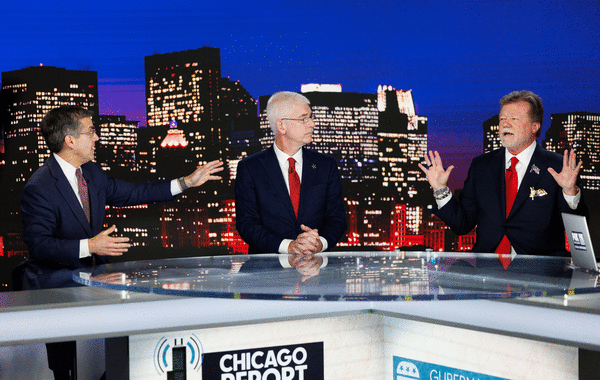
The three other candidates during a forum Tuesday night hosted by WFLD-Ch. 32 also said they could not support Anderson’s legislative package. Bailey did not attend the discussion.
Dabrowski, a conservative policy analyst, has frequently touted himself as “pro-life” and has labeled Illinois as “too extreme” on abortion. That includes leaders encouraging women from out of state to have the procedure performed in Illinois and allowing the use of taxpayer dollars to fund abortions for women who are poor — a policy approved by the late GOP Gov. George Ryan a quarter century ago.
But of Anderson’s legislation, Dabrowski said simply, “That’s extreme too.”
A first-time candidate for office, Dabrowski has sometimes had difficulty speaking to GOP voters on the issue.
At an event in Marengo last month, Dabrowski said he believed his candidacy would appeal to the “disenchanted,” including “a lot of suburban moms who have seen their rights taken away over their kids, whether it’s in the schools or whether it’s in the hospitals, rights over abortion and things like that.”
After the forum, Dabrowski said he was speaking about parental notification laws, not about curbs on a woman’s right to obtain an abortion.
Earlier this month, he told voters in Champaign that “even safe, legal, rare sounds good now, you know, which is crazy,” using a phrase that President Bill Clinton used in 1992. After the forum, he said Clinton’s terminology “would be a big, big step” in Illinois.
Heidner, a real estate developer and video gambling operator with a controversial history, appeared to adopt Bailey’s 2022 stance in the forum, saying, “We can’t really change anything here in Illinois.”
“I’m pro-life but when it comes to incest and it comes to rape and it comes to obviously the woman’s health, that’s a whole different story for me,” he said. He called for more incentives and programs to encourage adoption as an alternative.
Mendrick, the DuPage County sheriff, said that “absolutionism is never right on either side,” apparently confusing the pronunciation of the word “absolutism.”
“There always has to be wiggle room and leeway for special exceptions,” he said. “What if (giving birth is) going to kill the mother? What if it’s rape or incest?”
Abortion was one of several issues brought up at the wide-ranging, hourlong forum at the station’s Loop studios. The three also had divergent views on taxpayer assistance on efforts to retain the Chicago Bears in Illinois amid overtures from Indiana.
Republicans have largely used the Bears’ consideration of an incentive package to move the founding NFL franchise to Hammond as a way to try to mock Pritzker’s policies for losing business to other states.
But Dabrowski was alone in saying he opposed a state legislative proposal aimed at giving the Bears long-term certainty over the property taxes they would face in developing the 326-acre former Arlington Park International Racecourse into a team-financed stadium, along with an entertainment and residential district.
“We should do all the public infrastructure that’s fair and necessary that the public benefits from to support a stadium, but we shouldn’t give the Bears anything and certainly we should not give them (property tax) breaks,” Dabrowski said. “I love the Bears. I want them here. But taxpayers have done their share in Illinois for decades.”
Pritzker has said the state is open to paying for hundreds of millions of dollars in infrastructure work, such as improvements for highways, water and sewer, as it would for any major project. Pritzker also supports negotiated property tax legislation.
Heidner said he favored using tax breaks and taxpayer-financed incentives to move the team to Arlington Heights.
“For me, it’s very simple. They’re going to produce hundreds of millions of dollars worth of tax dollars. We have to give some of it back to them so that they can afford to build everything,” Heidner said. “To lose all that income and lose our beautiful Bears because we don’t want to help them with money that they’re going to produce?”
When Dabrowski complained to Heidner that “taxpayers have to pay for that. We can’t keep doing that to our people,” Heidner responded: “This is not giving tax dollars away. These are giving tax dollars that they’re going to create a partnership.”
Heidner also wrongly maintained that “right now we’re getting zero property taxes at the old racetrack.” In actuality, the Bears are paying about $3.6 million in real estate taxes on the Arlington Heights property under a 2024 agreement.
Bailey has been more circumspect on what he would support to keep the Bears, chiding Pritzker for the potential of losing the team but maintaining the team’s Soldier Field lease allows plenty of time for negotiations.
Mendrick, who has made fighting illegal immigration a major campaign theme, combined that with the Bears.
“I believe we should be keeping the Bears,” he said. “If we simply clean up our sanctuary state policies … we could support the victims and have the football stadium.”
_____
©2026 Chicago Tribune. Visit chicagotribune.com. Distributed by Tribune Content Agency, LLC.





































Comments