Supreme Court invalidates Trump's tariff regime
Published in Political News
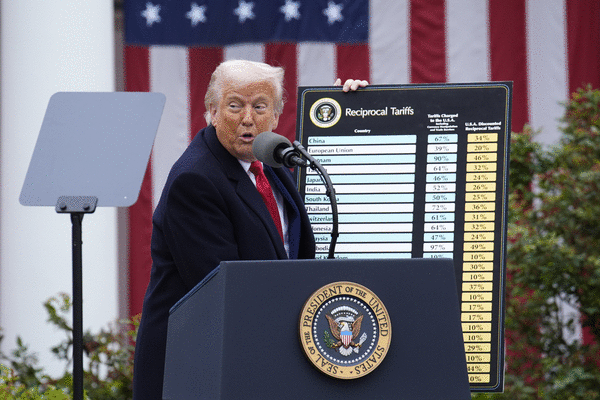
WASHINGTON — The Supreme Court invalidated much of the Trump administration’s worldwide tariff regime in a ruling released Friday, dealing a major setback to one of President Donald Trump’s signature domestic and foreign policy efforts.
The 6-3 ruling found that Trump overstepped the emergency authority Congress gave to presidents in the International Emergency Economic Powers Act of 1977, or IEEPA.
The decision wipes out the tariffs and sets the stage for court fights over potential refunds of more than $130 billion in tariffs paid to the federal government. It also represents a major blow to the administration’s effort to wield executive power outside of Congress.
Chief Justice John G. Roberts Jr., writing for the majority, said IEEPA did not explicitly give the president the power to impose tariffs. And he wrote that the Trump administration’s interpretation of it would be “a sweeping delegation of Congress’s power to set tariff policy.”
“What common sense suggests, congressional practice confirms. When Congress has delegated its tariff powers, it has done so in explicit terms, and subject to strict limits,” Roberts wrote.
The ruling sides with a lower court ruling that had invalidated tariffs on hundreds of nations. The ruling had been on hold and allowed the tariffs to continue as the Supreme Court decided.
The administration had argued that the law gives the president the authority to “regulate” importation after declaring a national emergency. The Trump administration has leaned on those tariffs in international negotiations to seek trade agreements.
Roberts’ majority opinion downplayed the administration’s arguments that tariffs were necessary for national security and foreign affairs reasons.
“And whatever may be said of other powers that implicate foreign affairs, we would not expect Congress to relinquish its tariff power through vague language, or without careful limits,” Roberts wrote.
The justices who joined the majority opinion in parts were Amy Coney Barrett, Neil M. Gorsuch, Elena Kagan, Sonia Sotomayor and Ketanji Brown Jackson.
Gorsuch, in his concurring opinion, emphasized that tariffs are a power that is meant to be decided by Congress, not the president.
“Yes, legislating can be hard and take time. And, yes, it can be tempting to bypass Congress when some pressing problem arises. But the deliberative nature of the legislative process was the whole point of its design,” Gorsuch wrote.
Kagan emphasized that hundreds of statutes give federal agencies the power to “regulate” aspects of American society, a phrase that has never been used to impose taxing power. Kagan leaned on the court’s prior decisions that Congress should be explicit when answering “major questions” of political and economic significance.
“Most important, IEEPA’s key phrase — the one the Government relies on — says nothing about imposing tariffs or taxes,” Kagan wrote.
The ruling covers tariffs against Canada, Mexico and China, the worldwide “Liberation Day” tariffs and other specific ones against countries such as Brazil. Both the U.S. Court of International Trade and U.S. Court of Appeals for the Federal Circuit disagreed with the Trump administration, finding that Congress did not give the president the authority to set tariff rates with the law.
Before the Supreme Court decision, Trump warned of economic devastation if the tariffs were thrown out and the administration had to provide refunds. Trump has argued that the tariffs are needed to counter issues ranging from fentanyl trafficking to long-standing trade imbalances with other countries and Brazil’s prosecution of its former president.
“In other words, if the Supreme Court rules against the United States of America on this National Security bonanza, WE’RE SCREWED!” Trump posted on his Truth Social platform in January.
The administration has said it may still pursue some tariffs through other legal avenues if the tariffs are invalidated.
Refunds on the table
According to Customs and Border Protection, the administration has taken in more than $130 billion in tariff revenue across the IEEPA tariffs. As the court case was pending, more than 100 companies have filed lawsuits seeking refunds from tariffs they paid, and Friday’s ruling likely kickstarts the process for seeking refunds.
Justice Brett M. Kavanaugh, in a dissent joined by Justices Samuel A. Alito Jr. and Clarence Thomas, pointed out that the decision would have “serious practical consequences,” including refunding the billions of dollars that importers had already paid in tariffs.
“The Court says nothing today about whether, and if so how, the Government should go about returning the billions of dollars that it has collected from importers. But that process is likely to be a ‘mess,’ as was acknowledged at oral argument,” Kavanaugh wrote.
Congress still has the power to reverse the national emergency declarations that Trump used to implement the tariffs, and both the Senate and the House have taken votes to end the national emergencies. That came after nearly a year of procedural votes in the House to prevent votes on the declarations.
Kavanaugh, in the dissent, wrote that the majority infringed on the president’s ability to use tariffs as a foreign policy tool.
Kavanaugh wrote that presidents have long imposed tariffs as a means of exercising foreign policy goals, and President Richard Nixon imposed 10% worldwide tariffs, which were upheld by a lower court, under a prior version of the statute.
“Statutory text, history, and precedent demonstrate that the answer is clearly yes: Like quotas and embargoes, tariffs are a traditional and common tool to regulate importation,” Kavanaugh wrote.
Friday’s ruling follows a yearlong campaign from the Trump administration in its second term to expand the power of the presidency, including asserting the ability to freeze federal funds, shut down agencies and other changes to reshape the government without Congress.
The cases were brought by a group of companies and states who challenged the tariffs, arguing they exceeded the president’s power under the law.
The cases are Learning Resources Inc. v. Trump and Trump v. V.O.S. Selections.
------------
©2026 CQ-Roll Call, Inc. Visit at rollcall.com. Distributed by Tribune Content Agency, LLC.















































Comments