When is the shutdown 'snapping point'? Don't ask the House
Published in Political News
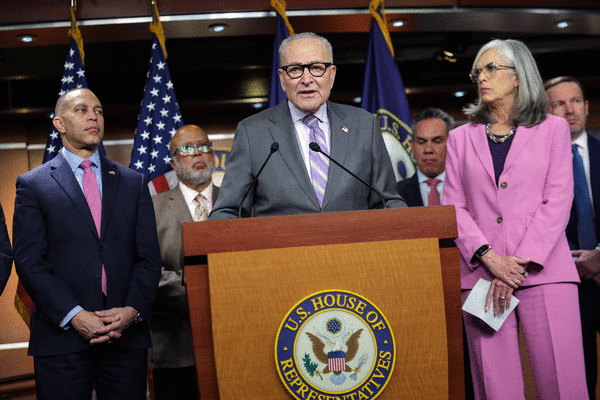
WASHINGTON — Last fall, a breakaway group of Senate Democrats undercut their party to make a deal with Republicans and reopen the government, angering many of their colleagues in the other chamber.
Now, with the Department of Homeland Security shuttered in the midst of a fierce fight over President Donald Trump’s immigration policies, some in the House are hoping that history won’t repeat itself.
“The question always is about the strength of Senate Democrats to hold, and that has been an ongoing problem,” said Rep. Pramila Jayapal, D-Wash.
Publicly, Democrats have been in harmony since lawmakers left town last week without funding the agency before last Friday’s deadline. House Minority Leader Hakeem Jeffries, D-N.Y., has said House and Senate Democrats are “standing together firmly,” with Senate Minority Leader Charles E. Schumer, D-N.Y., repeating that they are “on the same page.”
But the underlying reality of Senate procedure, which requires at least a handful of Democrats to join Republicans in order to avoid a filibuster, has made Schumer effectively a central character in this drama while sidelining Jeffries, although Jayapal said she believes “Jeffries is at the table.”
Matt Glassman, a Hill veteran and senior fellow at the Government Affairs Institute, said it comes down to “basic math.”
“At some point, there’s a snapping point, and the compromise is whatever seven or eight Democrats feel in the Senate. And those moderate Democrats, they have the balance of power, and Schumer knows it, and he has to keep his caucus happy,” Glassman said.
Those moderate Democratic senators, he said, are further to the right politically than the median Democrat in the House.
“Jeffries can be involved, but it’s never going to be his position that’s the winning position,” Glassman added. “This is the classic situation of a House minority.”
Holdout anxiety
A similar dynamic played out in the fall during the 43-day government shutdown. Most Democrats in both chambers stood together in opposing a funding deal unless the White House and Republicans agreed to their health care demands. But the stalemate ended when several moderate Senate Democrats joined with Republicans, overcoming the 60-vote filibuster threshold and sending a spending package to the House, where it needed just a simple majority to pass.
The mathematical reality isn’t lost upon rank-and-file House Democrats, who already saw these politics play out a few weeks back, when Schumer negotiated to end another brief partial government shutdown at the beginning of February.
“House Democrats were not involved. We were not at the table,” said Rep. Jared Moskowitz, D-Fla. “And, as you can see, look where we’re at right now. No deal. We’re in the same situation we thought we would be in two weeks ago.”
At the time, Jeffries described being “on the same page” as Schumer but not directly involved in negotiations with Trump, saying House Democrats would “evaluate whatever comes out of the Senate.”
Now, a staff member familiar with negotiations said Jeffries remains in “constant contact” with Schumer. Although his staff is in “regular contact” with Trump’s, Jeffries has not directly joined in White House discussions.
Democrats kicked things off with a list of 10 demands, which included requirements for federal immigration enforcement officers to acquire judicial warrants and un-mask during arrests. Schumer and Jeffries said they sent their latest counterproposal to the Trump administration this week but haven’t provided details about its contents.
White House press secretary Karoline Leavitt on Wednesday called the counterproposal “unserious” and said Trump has not been in direct contact with Democratic lawmakers recently.
Glassman said the small scope of the current shutdown could cause negotiations to lag. Immigration and Customs Enforcement already received a $75 billion boost in the reconciliation law passed last summer, and it could be a while before the public feels the shutdown strain from other agencies under DHS. If discussions drag on, that leaves Democrats’ demands hanging on the resolve of a few in the Senate, he added.
“The fact of the matter is that the Republicans have the votes in the House to do whatever they want to do in the House, and so it’s the Senate that is the line right now,” said Rep. Brad Schneider, D-Ill. “I would love to have a bigger House Democratic presence at the table. … We don’t. That’s why the election in November is so important.”
If the past is any indication, Senate Democrats have yet to prove they can hold, their House counterparts say.
“I’m always concerned about that,” Jayapal said. “You have to be strong in the face of a bully, and you have to be willing to show that you’re going to stand up, and we have not been able to do that in the Senate the last couple of times.”
Jayapal said she’s “hopeful this time is different,” citing some Republican concern with how DHS is operating. At least two GOP senators, for example, said Homeland Security Secretary Kristi Noem should step down after federal immigration officers fatally shot a citizen last month.
“Right now, it feels like they are being strong,” she said of Democratic senators. “But we’ll see.”
--------
—Nina Heller and John T. Bennett contributed to this report.
©2026 CQ-Roll Call, Inc., All Rights Reserved. Visit cqrollcall.com. Distributed by Tribune Content Agency, LLC.




















































Comments