Kennedy's push to find cause of autism divides Hill Republicans
Published in Political News
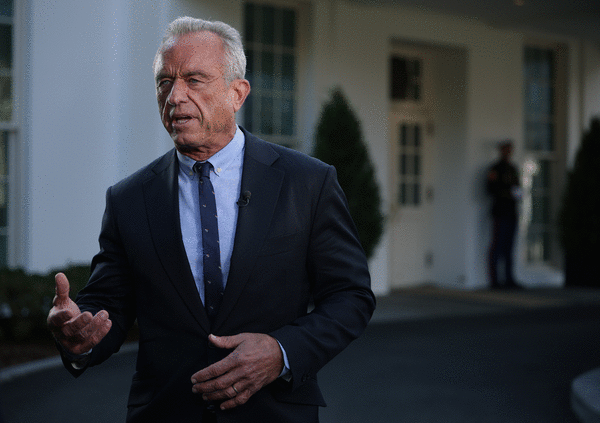
WASHINGTON — One year into his first term, Health and Human Services Secretary Robert F. Kennedy Jr.’s focus on autism is showing how polarizing Trump administration health policy can be for Capitol Hill Republicans.
Some GOP lawmakers say Kennedy’s interest in autism is counterproductive and could cause long-term mistrust in public health as the administration reopens investigations into vaccines as the cause, which numerous studies have debunked.
Others say that any attention on autism is good attention and point to recent increases in federal spending on research into the condition as evidence.
At the outset of his term as secretary, Kennedy vowed to quickly find the root cause of autism. He hasn’t, but Kennedy has warned the American public not to take Tylenol during pregnancy or give the medication to babies while ending the use of the preservative thimerosal in large-batch vaccines, all because of unproven ties to autism.
In January, Kennedy overhauled the federal autism advisory committee, replacing all public members with his own picks — including several who have ties to the anti-vaccine community or support dubious autism treatments.
“If you stir the pot on theories that have been disproven … it creates anxiety and a lot of self-recrimination,” Senate Health, Education, Labor and Pensions Committee Chair Bill Cassidy, R-La., said when asked about Kennedy’s interest in the link between vaccines and autism. “But it’s not true, and it delays finding out what is the reason [for autism].”
Cassidy, who cast a deciding vote on the Senate Finance Committee to confirm Kennedy, was asked if Kennedy has been receptive to his point of view on vaccines and autism in their conversations. To that, Cassidy shrugged and responded, “look at his actions.”
The issue is personal for Appropriations Chair Susan Collins, R-Maine, who co-led the reauthorization of a major autism research and programs funding bill in 2024. Her husband has a severely autistic son.
“I think it’s helpful to look further into research on the causes of autism. I did not think that it was helpful in any way to link it to vaccines, because the scientific evidence does not support such a link,” Collins said when asked about the administration’s focus.
National Institutes of Health Director Jay Bhattacharya struggled to defend Kennedy’s interest in the links between vaccines and autism at the Senate Health hearing this month. Bhattacharya told lawmakers that he did not believe the measles, mumps and rubella vaccine was linked to autism, but when pressed he did not rule out a link between autism and other shots and said the press paints an unfair “caricature” of the secretary.
Increasing diagnosis
Other Republicans are much more welcoming of the administration’s actions.
Sen. Jim Banks, R-Ind., praised Kennedy’s approach to autism research, arguing Republicans and Democrats alike should be thanking the Trump administration because because it is focused on stemming the growing autism diagnosis rate.
One in 31 children aged 8 years old received an autism diagnosis in 2022, according to a CDC study. The rate of diagnosis in adults ages 26 to 34 increased by 450% from 2011 to 2022, according to a study published in JAMA.
Autism advocates and physicians say the increase in diagnoses is two-fold; on one hand, screening for autism has improved and doctors widened the definition of autism spectrum disorder, or ASD, to include more subtle forms. But on the other, experts say these changes do not account for the huge rise and it’s likely there are unknown environmental or social factors at play.
Rep. Christopher H. Smith, R-N.J., has been involved in autism policy almost his entire career. Smith became interested in autism, especially profound autism, after hearing about the experiences of a family in his district. He recalled a time when the CDC spent less than $250,000 a year on autism research. With the passage of the 2024 autism legislation, spending has risen to $2 billion over a five-year span within multiple health agencies.
Smith, who says he supports vaccinations, praised removing thimerosal from vaccines and spreading out the childhood vaccination schedule, calling the administration’s focus “a breath of fresh air.”
“I mean, anyone who thinks there has not been a manifold spike in autism and say we’re just diagnosing it better, you know, I’ll sell you the Brooklyn Bridge,” he said. “If it turns out it’s not linked to getting vaccinations, OK. But the question should be asked.”
Advocacy split
Autism advocates are also generally split between outright rejecting Kennedy’s vaccine policy push and welcoming the newfound spotlight with some cautious optimism.
Finding the root cause isn’t helpful to those living with autism today, said Zoe Gross, a former Senate HELP Committee staffer and the director of advocacy at the Autism Self Advocacy Network.
“It’s not that they are trying to improve our lives,” Gross said of the administration. “It’s about using us as kind of this talking point to try and undermine public confidence in vaccines.”
She would like to see Congress provide more federal programs and support for people living with autism and use its platform to draw attention to misinformation about vaccines and autism. She called on Cassidy to hold Kennedy accountable.
The administration’s focus has helped individuals with profound autism get more federal attention, said Judith Ursitti, co-founder and president of Profound Autism Alliance.
For the first time ever, the 2026 Senate Labor-HHS appropriations report directed the NIH to ensure autism research includes profound autism. While that exact language was not included in the final bill, the bill report says funding should ensure “research reflects the entire population of individuals with ASD.” Ursetti said this helps her organization’s lobbying efforts.
While profoundly autistic people make up about 26% of the autistic population, they are included in just 6% of clinical autism research, according to the CDC.
She’s hopeful Kennedy’s shakeup on the Interagency Autism Coordinating Committee could help drive some change for the profoundly autistic, and the committee could focus on things like adult services and early mortality among autistic individuals.
“I can see how people are concerned about these big changes in the IACC. On the other hand, more of the same, honestly to me, would have been just as devastating,” Ursetti said. “Change does need to happen.”
©2026 CQ-Roll Call, Inc., All Rights Reserved. Visit cqrollcall.com. Distributed by Tribune Content Agency, LLC.












Comments