Iran foreign minister to meet UN nuclear chief before US talks
Published in Political News
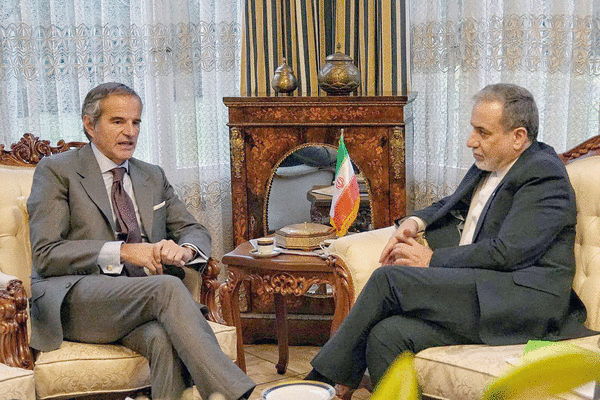
Iran’s Foreign Minister Abbas Araghchi is set to meet the head of the United Nations’ nuclear watchdog, ahead of a second round of talks with the U.S.
Monday’s talks with Rafael Grossi, the director general of the International Atomic Energy Agency, will be “deep technical,” Araghchi said on X.
On Tuesday, he’ll lead Iran’s delegation for a new round of indirect negotiations over a deal with the U.S. President Donald Trump is threatening strikes on Iran unless it agrees to an accord that would likely curb Tehran’s nuclear ambitions in return for sanctions relief.
“I am in Geneva with real ideas to achieve a fair and equitable deal,” Araghchi said about the discussions with the U.S., which Oman is mediating.
Trump’s son-in-law, Jared Kushner, and special envoy Steve Witkoff are expected to head the U.S. delegation.
The first round of talks, also mediated by Oman in its capital, Muscat, got off to a “good start,” Iran said, adding that discussions were limited to nuclear issues — a condition the Islamic Republic has insisted on. Still, the U.S. and Israel say the talks should also cover Iran’s missile program and support for regional militias.
Israel’s Prime Minister Benjamin Netanyahu said he proposed terms that Iran shouldn’t possess enriched material or nuclear enrichment capabilities during a meeting with Trump said last week.
The U.S. is pressuring Iran to reach an agreement to roll back Tehran’s nuclear ambitions or face a “very traumatic” situation if it fails to do so, Trump said, adding that negotiations could stretch for as long as a month.
The U.S. president mobilized warships and fighter jets near Iran in response to a recent deadly crackdown by the regime there following mass protests.
Iran has prevented IAEA inspectors from verifying the status of its uranium stockpile or visiting sites bombed by Israel and the U.S. A law passed shortly after the 12-day war broke out requires agency monitors to negotiate access each time they want to visit Iranian nuclear facilities.
While that’s given them access to undamaged places like the Russian-built Bushehr nuclear plant and Tehran research reactor, Iran has claimed it’s still too dangerous to visit bombed enrichment sites in Fordow and Natanz, as well as its main uranium-processing facility in Isfahan.
Grossi has said the damaged sites are safe-enough to inspect and Iran is long past due to allow a resumption of inspections.
-------
—With assistance from Jonathan Tirone.
©2026 Bloomberg L.P. Visit bloomberg.com. Distributed by Tribune Content Agency, LLC.

















Comments